
Stablecoins as a New Engine for U.S. Treasury Demand: Implications for Investors
The rise of stablecoins has quietly transformed the U.S. Treasury market into a new frontier of financial innovation. What began as a niche tool for crypto traders has evolved into a $260 billion force reshaping liquidity dynamics, yield curves, and even the Federal Reserve's policy calculus. For investors, understanding this shift is no longer optional-it's essential.
The Treasury Demand Surge: A New Reserve Asset
Stablecoins now hold over $125 billion in U.S. Treasury securities, with projections suggesting this could balloon to $2 trillion by 2028. This growth is driven by regulatory clarity, such as the 2025 GENIUS Act, which mandates that stablecoin reserves be fully backed by safe, liquid assets like Treasuries. The result? A new, non-traditional source of demand for short-term U.S. debt.
Circle and TetherUSDT--, the two largest stablecoin issuers, exemplify this trend. Circle's $20 billion in Treasury holdings (43% of its assets) and Tether's $125 billion in Treasuries highlight how stablecoins are becoming a de facto extension of the U.S. monetary system. This demand is not trivial: stablecoins now account for 0.5–2% of total privately held Treasuries, a figure that could rise as the market expands.
Liquidity Metrics and Yield Dynamics: A Double-Edged Sword
The surge in stablecoin-driven Treasury demand has had measurable effects on liquidity and yields. A 2025 Cleveland Fed study found that stablecoin inflows can reduce 3-month Treasury yields by 2–2.5 basis points within 10 days, while outflows amplify yield increases by 2–3 times the same amount. 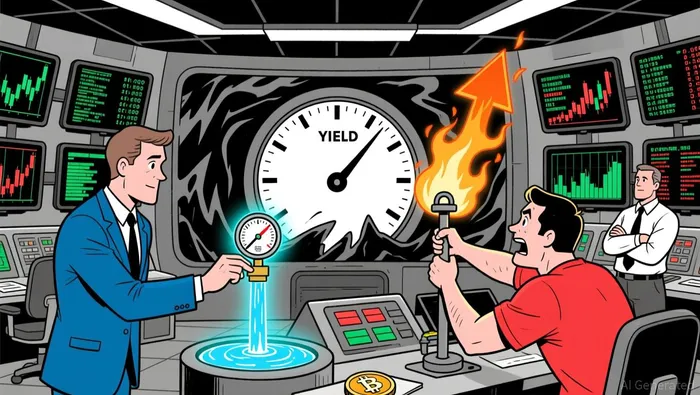 This asymmetry creates a volatile feedback loop: higher yields attract more stablecoin inflows, which further suppress yields, potentially distorting traditional monetary policy transmission.
Liquidity metrics also show signs of strain. In April 2025, Treasury bid-ask spreads widened following tariff announcements, a classic sign of reduced market depth. While stablecoins themselves are not the sole culprit, their growth has intensified competition with traditional intermediaries like money market funds and banks, which now face a shrinking share of the safe-asset market.
Policy Responses and Investor Implications
Central banks are scrambling to adapt. The Federal Reserve, under Governor Miran, has acknowledged that stablecoins could lower U.S. borrowing costs by increasing Treasury demand but warns of systemic risks if stablecoins displace traditional banking systems. The IMF and Financial Stability Board (FSB) are pushing for global regulatory alignment, recognizing that stablecoins' cross-border nature makes unilateral action ineffective.
For investors, the implications are twofold:
1. Opportunities: Lower Treasury yields could reduce government borrowing costs, indirectly benefiting sectors reliant on cheap debt (e.g., infrastructure, housing).
2. Risks: If stablecoins siphon deposits from banks, credit availability for small businesses and households could shrink, offsetting the benefits of lower Treasury yields.
The Road Ahead: Navigating the Stablecoin Era
The coming years will test whether regulators can balance innovation with stability. For now, investors should monitor three key metrics:
- Treasury yield spreads: Asymmetric yield shifts linked to stablecoin flows could signal broader market instability.
- Bank funding costs: Rising costs for traditional lenders may force a reevaluation of credit risk premiums.
- Regulatory developments: The success of frameworks like the GENIUS Act will determine whether stablecoins remain a net positive for financial systems.
In this new era, stablecoins are not just a crypto phenomenon-they're a macroeconomic force. Investors who ignore their influence on Treasuries and liquidity do so at their peril.





Comentarios
Aún no hay comentarios