
The Stablecoin Yield Debate: A Make-or-Break Moment for U.S. Crypto Competitiveness
The U.S. stablecoin landscape is at a pivotal inflection point. With the enactment of the GENIUS Act in 2025 and the ongoing deliberation of the STABLE Act, the regulatory framework for stablecoins has shifted from ambiguity to a structured, albeit complex, ecosystem. For investors, this marks a critical juncture: the rules now redefine how stablecoins can be used, the risks they entail, and the opportunities they unlock. The debate over yield generation-once a cornerstone of DeFi innovation-is now a litmus test for the U.S.'s ability to maintain its edge in the global crypto race.
Regulatory Clarity, Structural Constraints
The GENIUS Act, signed into law under the Trump administration, has established a federal framework requiring stablecoin issuers to maintain 100% reserve backing with liquid assets like U.S. dollars or short-term Treasuries. This mandate has eliminated the risk of fractional-reserve practices that plagued earlier stablecoin models, such as the collapse of TerraUSD. However, it has also imposed a hard cap on yield generation. As stated by the Comptroller of the Currency, stablecoin issuers are now prohibited from paying interest on stablecoin balances, effectively sidelining them as investment vehicles. This shift has forced investors to pivot from direct yield strategies (e.g., staking or lending stablecoins) to indirect ones, such as deploying stablecoin reserves into tokenized assets or structured products.
The STABLE Act, still pending in the House, seeks to further refine this framework by introducing a dual regulatory model. It would allow state-chartered issuers to operate under state supervision if their frameworks meet federal standards, while nonbank entities must apply directly to the Office of the Comptroller of the Currency (OCC) according to Merkles Science analysis. This approach aims to prevent regulatory arbitrage but could also create a two-tier system where larger institutions with traditional banking infrastructure dominate the market. For smaller crypto-native firms, the compliance burden may be prohibitive, stifling innovation in yield-generating protocols.
The Yield Migration: From Stablecoins to Tokenized Assets
With stablecoins no longer a source of yield, capital is flowing into tokenized assets. According to a report by Investax, tokenized U.S. Treasuries alone surged to $7.3 billion in August 2025, while tokenized private credit assets exceeded $14.4 billion. These products offer institutional investors a way to generate returns while adhering to the GENIUS Act's reserve requirements. For example, tokenized money market funds now hold over $8 billion in U.S. Treasuries, leveraging the efficiency of blockchain to replicate traditional fixed-income strategies.
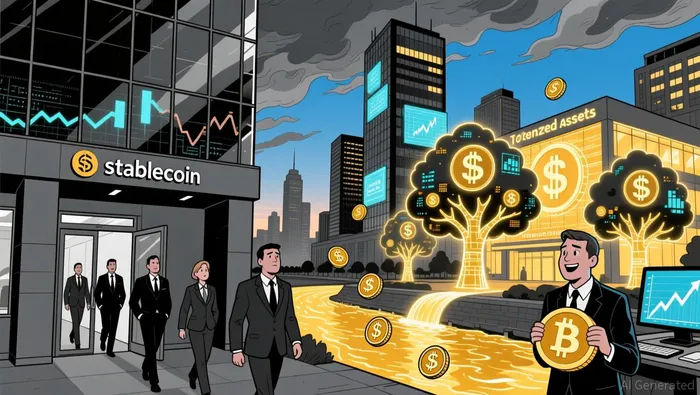
This migration is not without risks. The privatization of seigniorage-where stablecoin-issued liquidity competes with traditional banking- could disrupt deposit structures and increase liquidity risk for community banks. However, for investors, the trade-off is clear: tokenized assets provide transparency, programmability, and access to markets previously constrained by intermediaries. As Barclays and SoFi have demonstrated, stablecoin infrastructure is now being integrated into back-office operations, enabling 24/7 settlements and AI-driven financial transactions.
Global Competitiveness: U.S. vs. the World
The U.S. regulatory approach has positioned it as a counterweight to the EU's Markets in Crypto-Assets (MiCA) regulation, which critics argue stifles DeFi innovation. By mandating reserve-backed stablecoins and prohibiting interest, the U.S. has created a framework that aligns with global financial stability goals while preserving the dollar's dominance. In 2025, USD-backed stablecoins accounted for over 80% of global stablecoin transfers, reinforcing the U.S. dollar's role as the de facto digital reserve currency.
However, this dominance is not guaranteed. China's digital yuan (e-CNY) continues to advance, offering a state-backed alternative to private stablecoins. Meanwhile, jurisdictions with more permissive regulations, such as Singapore and the UAE, are attracting crypto firms seeking to avoid U.S. compliance costs. The STABLE Act's potential to create a fragmented regulatory environment could exacerbate this trend, as firms may opt for state-level charters over federal oversight.
Investor Positioning: Navigating the New Normal
For institutional investors, the key to success lies in adapting to the new regulatory perimeter. The GENIUS Act's reserve requirements have created a "capital efficiency premium" for firms that can tokenize assets at scale. As noted by State Street, tokenized stablecoin products now offer a bridge between traditional finance and crypto, enabling investors to hedge against macroeconomic volatility while maintaining liquidity.
Retail investors, meanwhile, face a more fragmented landscape. The prohibition on stablecoin yields has shifted demand toward tokenized commodities and real-world assets (RWAs). For instance, tokenized gold AUM climbed above $3.5 billion in Q4 2025, reflecting a growing appetite for tangible collateral. However, the lack of retail-friendly products under the current framework remains a challenge, with many platforms still in the pilot phase.
The Make-or-Break Moment
The U.S. stands at a crossroads. The GENIUS and STABLE Acts have brought much-needed clarity to stablecoin regulation, but they also risk stifling innovation by favoring incumbents over disruptors. For investors, the next 12–18 months will determine whether the U.S. can maintain its crypto leadership or cede ground to more agile jurisdictions.
The data is clear: tokenized assets are the new frontier. Investors who position themselves at the intersection of regulatory compliance and technological innovation-whether through tokenized Treasuries, private credit, or AI-driven settlement platforms-will be best positioned to capitalize on this shift. As the global crypto market evolves, the U.S. has a unique opportunity to redefine the rules of the game. The question is whether it will seize it.







Comentarios
Aún no hay comentarios