
Stablecoin and Tokenization ETFs as Strategic Entry Points to the Next-Generation Digital Finance Infrastructure
The evolution of digital finance has reached a pivotal inflection point, driven by regulatory clarity and institutional adoption. Stablecoins and tokenization ETFs are no longer speculative novelties but foundational components of a reimagined financial infrastructure. For investors seeking to capitalize on this transformation, these instruments offer a unique convergence of liquidity, efficiency, and access to emerging markets.
Regulatory Clarity: A Catalyst for Institutional Confidence
The United States' passage of the GENIUS Act in 2025 marked a watershed moment for stablecoin adoption. According to Bitgo's analysis, the act established a federal regulatory framework and removed a critical barrier to participation. This clarity enabled entities like VisaV-- and PayPalPYPL-- to scale stablecoin operations, leveraging them for cross-border settlements. Similarly, the EU's MiCA implementation created a harmonized environment where traditional institutions could engage with crypto projects under consistent rules. According to SSGA data, 86% of institutional investors now either hold digital assets or plan allocations in 2025.
Tokenization ETFs: Bridging Traditional and Digital Markets
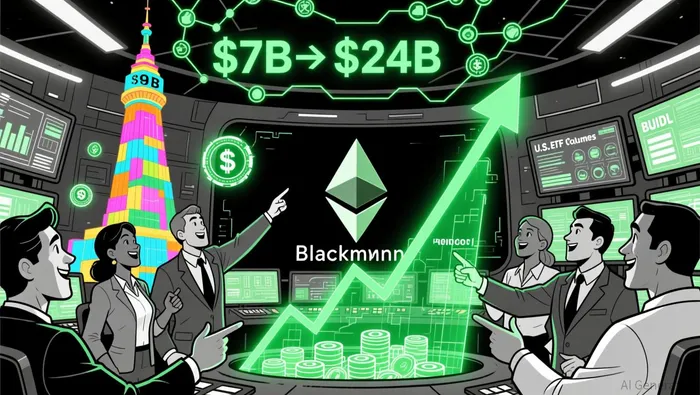
Tokenization ETFs have emerged as a linchpin in the integration of real-world assets (RWAs) into blockchain ecosystems. Over the past quarter, tokenized RWAs surged from $7 billion to $24 billion in value, with EthereumETH-- serving as the primary settlement layer. BlackRock's tokenized fund, BUIDL, exemplifies this trend, growing to $2.3 billion year-to-date as institutions recognize tokenization's potential to enhance liquidity and reduce friction in asset distribution. The approval of U.S. spot ETFs further amplified this momentum, driving daily trading volumes from sub-$1 billion to over $5 billion, with peaks exceeding $9 billion. These figures underscore a structural shift: tokenization is no longer a niche experiment but a scalable infrastructure for capital markets.
Strategic Advantages for Investors
The strategic appeal of stablecoins and tokenization ETFs lies in their ability to address core inefficiencies in traditional finance. Stablecoins provide a programmable, low-cost medium for cross-border transactions and collateral management, while tokenization ETFs democratize access to previously illiquid assets like gold or U.S. Treasuries. According to Chainalysis analysis, for institutions, these tools also align with broader trends in custody innovation and decentralized settlement, reducing counterparty risk and operational overhead. Moreover, the growing utility of tokenized money market funds as alternative stores of value-particularly in volatile macroeconomic environments-has attracted capital seeking yield without sacrificing liquidity.
Risks and Considerations
Despite the optimism, risks persist. Regulatory frameworks, while clearer, remain subject to reinterpretation, particularly in jurisdictions outside the U.S. and EU. Additionally, the nascent nature of tokenization markets means liquidity can be uneven, and technical risks-such as smart contract vulnerabilities-require robust due diligence. However, the rapid institutional adoption and infrastructure development observed in 2025 suggest these challenges are being actively mitigated through collaboration between regulators and market participants.
Conclusion: Positioning for the Future
Stablecoins and tokenization ETFs represent more than a tactical investment-they are strategic entry points to a financial ecosystem defined by programmability, transparency, and global accessibility. As institutional capital continues to flow into these vehicles, early adopters stand to benefit from compounding advantages in market share and infrastructure control. For investors, the imperative is clear: engage now, with a focus on platforms and protocols that align with the long-term trajectory of digital finance.





Comentarios
Aún no hay comentarios