
The Stablecoin Sovereignty Battle: Why Dollar Tokens Pose a Strategic Threat to China's Financial Control
The global financial landscape is undergoing a seismic shift as stablecoins-digital tokens pegged to fiat currencies-emerge as tools of geopolitical competition. At the heart of this contest lies a strategic battle between the United States and China over monetary sovereignty, with dollar-backed stablecoins threatening to undermine Beijing's tightly controlled financial system. For investors, this rivalry presents both opportunities and risks, particularly in China's digital finance sector, where regulatory uncertainty and geopolitical tensions could reshape markets.
The U.S. Dollar Stablecoin Advantage
The U.S. has formalized its approach to stablecoins through the GENIUS Act, a legislative framework that allows regulated banks to issue dollar-backed tokens pegged 1:1 to the U.S. dollar according to CFR analysis. These tokens, designed to function as programmable, borderless cash equivalents, are poised to dominate cross-border trade and remittances. By 2025, analysts project that up to $1.75 trillion in dollar-backed stablecoins could circulate globally, leveraging the dollar's entrenched status as the world's reserve currency.
This development is not merely economic but geopolitical. Dollar stablecoins enable transactions that bypass traditional banking systems, reducing reliance on correspondent banking networks and circumventing capital controls. For China, which has long relied on state-directed capital flows and a centralized financial system, this represents a direct challenge. As Bloomberg opined, the U.S. stablecoin "dream" could become a "nightmare" for Beijing, eroding its ability to monitor and restrict capital movements.
China's Counterstrategy: The Digital Yuan and Yuan-Backed Stablecoins
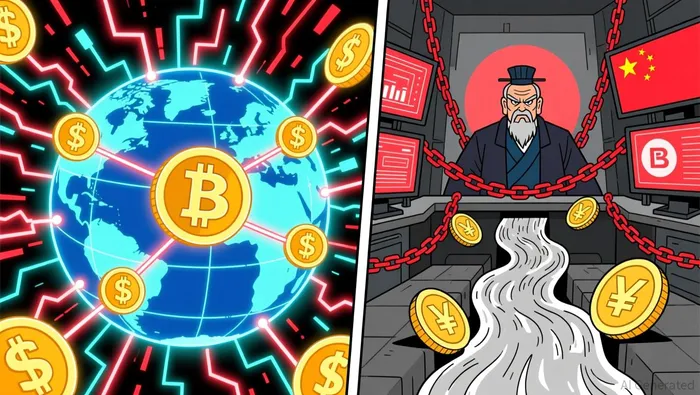 China has responded with a dual approach: upgrading its digital yuan (e-CNY) and cautiously exploring yuan-backed stablecoins. Starting January 1, 2025, the People's Bank of China (PBOC) reclassified the e-CNY as "digital deposit money," allowing it to accrue interest and reduce reserve requirements. This shift aims to make the e-CNY more attractive to banks and individuals, integrating it into global trade and supply chain settlements.
Simultaneously, China is considering authorizing yuan-backed stablecoins to counter dollar dominance. A proposed policy shift by the State Council could approve such tokens, leveraging Hong Kong's Stablecoin Ordinance-a legal framework for fiat-backed digital currencies-as a regulatory sandbox. This strategy mirrors the U.S. approach but prioritizes state control: while the e-CNY and yuan-backed stablecoins may compete globally, they remain under strict PBOC oversight, ensuring monetary policy coherence.
Geopolitical Implications and the Risk of Financial Decoupling
The stablecoin rivalry underscores a broader contest for financial sovereignty. The U.S. seeks to reinforce the dollar's dominance through decentralized, programmable tokens, while China aims to extend the yuan's reach via centralized digital currencies. This competition risks deepening the "decoupling" of global financial systems, with dollar and yuan stablecoins operating in parallel ecosystems.
For China, the stakes are existential. The Chinese Communist Party views dollar stablecoins as a threat to its political system, which relies on capital controls and state-directed lending to maintain power. As former PBOC Governor Zhou Xiaochuan acknowledged, stablecoins could either entrench dollar hegemony or offer a path for the yuan to gain international traction-depending on Beijing's ability to adapt.
Investment Risks in China's Digital Finance Sector
Investors in China's digital finance sector face mounting risks as this battle intensifies. Regulatory shifts, such as the PBOC's reclassification of the e-CNY, could disrupt existing business models and create compliance challenges for fintech firms. Additionally, geopolitical tensions may lead to fragmented markets, with cross-border transactions increasingly restricted or surveilled.
Hong Kong, a critical node in China's digital finance strategy, exemplifies these risks. While its stablecoin legislation offers flexibility for international transactions, it also exposes the city to U.S.-China regulatory clashes. For instance, U.S. sanctions on Chinese entities could limit Hong Kong's role as a stablecoin hub, creating volatility for investors in the region.
Moreover, the PBOC's cautious approach to private cryptocurrencies-banning decentralized alternatives while promoting state-backed solutions-highlights the sector's susceptibility to sudden policy changes. This duality creates a high-stakes environment where innovation is stifled by regulatory overreach, yet state-driven projects like the e-CNY receive preferential treatment.
Conclusion: Navigating the Stablecoin Sovereignty Battle
The stablecoin sovereignty battle is reshaping global finance, with dollar-backed tokens and China's digital yuan vying for dominance. For investors, the key lies in understanding the interplay between technological innovation and geopolitical strategy. While the U.S. leverages decentralized, market-driven solutions to expand dollar influence, China prioritizes centralized control to preserve its financial and political system.
In this context, China's digital finance sector remains a high-risk, high-reward arena. Regulatory shifts, geopolitical tensions, and the evolving role of stablecoins will continue to testTST-- the resilience of investors. As the PBOC and U.S. regulators refine their frameworks, the outcome of this battle will not only determine the future of digital money but also redefine the balance of global financial power.







Comentarios
Aún no hay comentarios