
Stablecoin Regulation and Financial Sector Disruption: Strategic Implications of Regulatory Convergence on Fintech and Traditional Banking Investments
The global financial landscape is undergoing a seismic shift as stablecoin regulation converges across major jurisdictions, reshaping the strategic calculus for fintechs and traditional banks. By 2025, the European Union's Markets in Cryptoassets Regulation (MiCA), the U.S. GENIUS Act, and the UK's Financial Conduct Authority (FCA) proposals have created a mosaic of rules that prioritize transparency, stability, and consumer protection. These frameworks are not merely technical adjustments but foundational reconfigurations of how digital assets integrate into the broader financial ecosystem. For investors, the implications are profound: regulatory clarity is unlocking new opportunities while forcing institutions to adapt or risk obsolescence.
Regulatory Convergence: A New Baseline for Stability
The EU's MiCA framework, fully applicable since December 2024, has set a global benchmark for stablecoin oversight. By requiring direct T+1 redemption at par value and mandating the use of highly liquid, fiat-backed asset pools, MiCA has elevated operational standards for cryptoasset service providers. Meanwhile, the U.S. GENIUS Act, enacted in July 2025, mandates full reserve backing for stablecoin issuers and monthly reserve disclosures, explicitly excluding Big Tech from the space. The UK's FCA has taken a nuanced approach, distinguishing stablecoins from e-money and investment products while emphasizing prudential resilience.
These developments signal a move toward harmonization, albeit with jurisdictional nuances. The U.S. and UK's Transatlantic Taskforce for Markets of the Future underscores the urgency of aligning oversight to address cross-border risks. For investors, this convergence reduces regulatory arbitrage but raises the bar for compliance, particularly for firms operating in multiple markets.
Strategic Implications for Fintechs: Innovation Amid Constraints
Fintechs are leveraging stablecoins to disrupt traditional payment rails, particularly in cross-border transactions and automated cash management. Open banking advancements under Rule 1033, combined with stablecoin integration, have enabled real-time settlements and reduced friction in financial services. However, rising data-access costs from banks threaten the economics of data aggregators, a critical component of the open banking ecosystem.
Venture capital flows reflect this duality. In 2025, crypto and blockchain startups raised $904 million in the first half of the year, a 47% increase from 2024, with early-stage valuations surging by 159%. Investors are shifting focus from speculative L1 blockchains to infrastructure projects that support stablecoin ecosystems, such as custody solutions and compliance tools. According to insights, for fintechs, the challenge lies in balancing innovation with compliance, particularly as the SEC's emphasis on harmonizing oversight tightens scrutiny.
Traditional Banking: Disruption or Integration?
Stablecoins pose a dual threat and opportunity for traditional banks. On one hand, they could erode deposit flows by enabling faster, lower-cost transactions, particularly in emerging markets where dollar-backed stablecoins are gaining traction. According to analysis, on the other, banks can capitalize on stablecoin infrastructure by offering custody services, compliance frameworks, and yield-bearing treasury products.
The 2026 banking outlook highlights a critical inflection point: banks must decide whether to issue, custody, or partner in the stablecoin ecosystem to remain competitive. For example, Stripe's 2025 strategy-integrating stablecoins into its payment systems and acquiring Privy-demonstrates how traditional players can adapt. However, the GENIUS Act's restrictions on Big Tech entry into stablecoin issuance also signal a regulatory preference for institutional players, potentially favoring banks with existing compliance infrastructure.
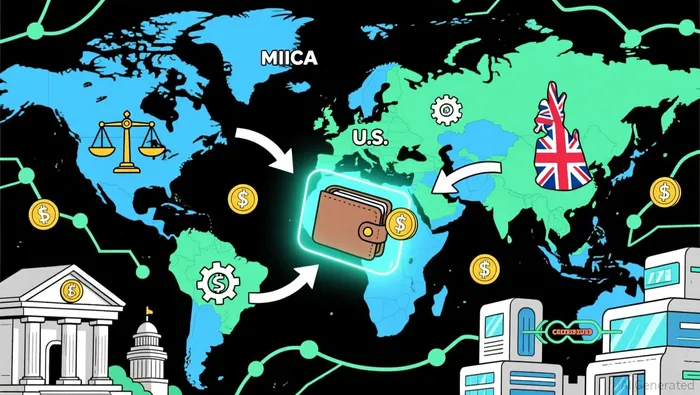
Geopolitical and Economic Considerations
Stablecoins are not just financial tools but geopolitical instruments. In non-dollarized economies, they are becoming de facto mediums for cross-border transactions, with the U.S. and EU frameworks shaping global adoption. The IMF has noted that widespread use of dollar-backed stablecoins could lead to dollarization, weakening local banking systems in high-inflation environments. For investors, this underscores the need to evaluate stablecoin adoption through a geopolitical lens, particularly in regions like Africa, where stablecoins are already facilitating $30 trillion in transaction volume in 2025.
Conclusion: Navigating the New Normal
The convergence of stablecoin regulation is accelerating the transition from a crypto niche to a mainstream financial infrastructure. For fintechs, the path forward lies in leveraging regulatory clarity to innovate while navigating rising compliance costs. Traditional banks, meanwhile, must decide whether to embrace stablecoins as a strategic asset or risk being sidelined by more agile competitors. Investors, in turn, should prioritize firms that align with universal compliance standards and demonstrate adaptability in a rapidly evolving landscape.
As the financial sector grapples with these shifts, one thing is clear: the era of stablecoins is no longer speculative-it is foundational.







Comentarios
Aún no hay comentarios