
Stablecoin Market Volatility and Systemic Risk: Governance and Operational Safeguards in DeFi Infrastructure
The stablecoin market, now a $232 billion asset class, has emerged as both a cornerstone and a vulnerability in decentralized finance (DeFi). While stablecoins promise price stability, their governance and operational frameworks have repeatedly exposed systemic risks, as evidenced by the collapse of TerraUSD (UST) in 2022 and the 2025 exploit of Yala's YU stablecoin. These incidents underscore the urgent need for robust safeguards to prevent cascading failures in an increasingly interconnected financial ecosystem.
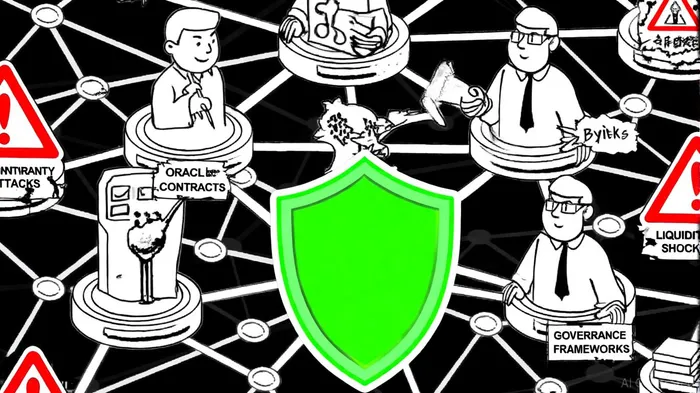
The Anatomy of Failure: Governance and Operational Flaws
Algorithmic stablecoins, which rely on complex economic models rather than full collateralization, have proven particularly susceptible to reflexivity and loss of confidence. The UST collapse, triggered by a self-reinforcing spiral of selling pressure and liquidity withdrawal, wiped out $45 billion in value and exposed the fragility of dual-token systems, according to an Elliptic risk assessment. Similarly, YU's de-pegging in September 2025-caused by an exploit enabling unauthorized minting of 120 million tokens-highlighted cross-chain vulnerabilities and thin liquidity risks, even in Bitcoin-backed models, as reported by Cointelegraph.
Operational failures compound these governance issues. Smart contract vulnerabilities, such as reentrancy attacks and integer overflows, have drained over $500 million from stablecoin protocols since 2022, according to Stablecoin Insider. Oracle manipulation, which distorts price feeds critical for algorithmic stabilization, further exacerbates instability. As noted in the Elliptic assessment, these technical flaws create "points of failure" that can propagate across DeFi networks during market stress.
Building Resilience: Governance Frameworks and Operational Safeguards
The DeFi ecosystem has responded to these challenges with innovative governance and operational strategies. A key development is the adoption of hybrid models that blend algorithmic mechanisms with over-collateralization. For example, Frax Finance's hybrid approach-combining 98.5% asset-backed reserves with dynamic algorithmic adjustments-has achieved remarkable stability, according to a 2025 simulation study. Similarly, AaveAAVE-- and Ethena's collaboration introduced "soft governance" (reputational commitments) and "hard safeguards" (on-chain emergency redemption channels), mitigating reflexivity risks during volatile periods, as discussed in an Aave & Ethena risk report.
Operational safeguards have also evolved. Smart contract audits, formal verification, and multi-signature controls are now standard practice, reducing exploit losses by 90% since 2020, according to a Coindesk report. Protocols like DAIDAI-- have integrated automated liquidation mechanisms and circuit breakers to stabilize during liquidity shocks. Regulatory alignment is another critical pillar: Singapore's Project Guardian, which introduces "Trust Anchors" to verify DeFi participants, and the EU's MiCA framework, which mandates transparency for stablecoin reserves, are reshaping compliance standards, according to GFTN Insight.
Systemic Risk Mitigation: Lessons from the Field
The 2022 Terra collapse catalyzed systemic risk mitigation strategies across DeFi. Protocols now prioritize liquidity diversification, cross-chain redundancy, and real-time monitoring. For instance, the Structural Risk Factor (SRF) framework, developed in 2024, enables granular risk assessments for stablecoins and real-world asset (RWA) integrations, aiding institutional capital allocation, as noted in the Coindesk report. Academic research further highlights the role of stablecoins like DAI in absorbing market stress, contrasting with volatile assets like ETH and UNIUNI--, which amplify contagion during downturns, as shown in an MDPI study.
The Path Forward: Balancing Innovation and Stability
While progress is evident, challenges persist. Regulatory fragmentation and the decentralized nature of governance remain hurdles. For example, the U.S. GENIUS Act (2025) and EU AI Act impose stringent compliance requirements, yet jurisdictional overlaps create uncertainty for developers, as discussed in a research paper. Investors must weigh these risks against the potential of DeFi's institutionalization, as protocols increasingly adopt third-party risk management tools and cross-protocol monitoring.
In conclusion, stablecoin volatility and systemic risk are not insurmountable. By integrating robust governance frameworks, operational safeguards, and regulatory alignment, DeFi can evolve into a resilient financial infrastructure. However, continuous innovation-and a willingness to learn from past failures-will be critical to securing this future.







Comentarios
Aún no hay comentarios