
Stablecoin Market Growth: Can the Bulls' $2T Vision Outrun Regulatory Realities?
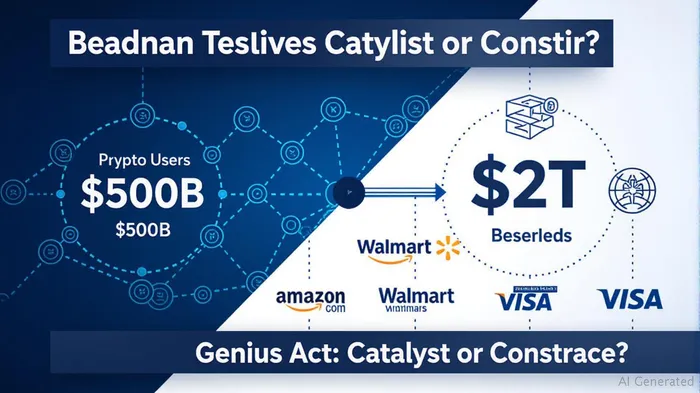
The stablecoin market stands at a crossroads. JPMorganJPM-- forecasts $500 billion in adoption by 2030, anchored to crypto-native demand, while bullish analysts envision $2 trillion as stablecoins disrupt legacy payment systems. The gap between these visions hinges on one critical variable: whether regulators can resolve structural barriers to mass adoption fast enough. Let's dissect the forces pulling this market in opposite directions—and where investors should place their bets.
The JPMorgan Thesis: Crypto's Own, For Crypto's Own
JPMorgan's $500 billion outlook centers on existing crypto demand. Their stablecoin, JPMD, targets users who already transact in DeFi, NFTs, or cross-border remittances. This cohort values stablecoins for their speed, low fees, and interoperability with decentralized systems. Yet, it's a niche crowd—roughly 50 million global crypto holders, per Chainalysis—limiting the addressable market.
The firm's caution is understandable. Even with the Genius Act's regulatory clarity, crypto-native adoption faces operational friction. Consider the “on-ramp” problem: converting fiat to crypto remains cumbersome for most users. . Until banks and exchanges simplify this process, mass adoption will lag.
The Bulls' $2T Bet: Toppling the $224B Payment Empire
The $2 trillion vision, however, imagines stablecoins replacing traditional payment rails. Merchants like WalmartWMT-- and AmazonAMZN-- could save $224 billion annually by bypassing credit card networks. The Genius Act's 1:1 reserve requirements and transparency rules make this plausible—but only if regulators allow retailers to mint their own stablecoins at scale.
Here's the catch: yield limitations. Unlike credit cards, stablecoins don't offer rewards. . To attract consumers, retailers may need to subsidize transactions or launch loyalty programs. But this requires corporate buy-in—and patience.
The Genius Act: A Double-Edged Catalyst
The Genius Act's bipartisan passage is a win for stability, but its rules create both opportunities and constraints:
- For JPMorgan's $500B Path:
- Win: Bank-issued stablecoins gain legitimacy under federal oversight.
Risk: Fractional reserves are banned, capping profitability.
For Bulls' $2T Path:
- Win: Retailers can enter the market, leveraging their customer bases.
- Risk: Foreign stablecoins may face Treasury sanctions, complicating cross-border use.
The Act's bankruptcy priority rule—giving stablecoin holders senior claims—is a mixed blessing. It reduces redemption risk but sets a dangerous precedent: bailing out stablecoin issuers could become politically unavoidable if a major player fails.
Structural Barriers: Yield, Trust, and Geography
Three hurdles could cap growth:
Yield Competition:
Credit cards offer rewards (1-5% of spending), while stablecoins provide none. Without incentives, consumers may stick to plastic.Trust in Reserves:
The monthly disclosures mandated by the Genius Act are a start, but fraud isn't impossible. A major reserve shortfall could trigger panic.Geopolitical Friction:
The Act's sanctions on non-compliant foreign stablecoins could provoke retaliation from countries like China or the EU, fragmenting the market.
Portfolio Playbook: Conservative vs. Aggressive
Conservative Play:
Stick with bank-backed stablecoins (JPMD, PYUSD). Their reserves are audited, and issuers have capital buffers. Pair with traditional financials (e.g., VisaV--, Mastercard) that could adapt to stablecoin ecosystems.Aggressive Play:
Bet on retailers (Walmart, Amazon) and fintechs (Ripple) if they commit to stablecoin initiatives. Monitor .Avoid:
Decentralized stablecoins (DAI, FRAX) remain in regulatory limbo. The Genius Act excludes them, risking shutdowns or reclassification.
Final Verdict: The $500B Floor, $2T Ceiling
The Genius Act ensures the $500 billion baseline becomes reality—but $2 trillion requires payment systems to fully embrace disruption. Investors should:
1. Track merchant partnerships (e.g., Amazon's rumored “AmazonDollar”).
2. Watch for House amendments to the Act (e.g., $10 billion state issuance caps could limit competition).
3. Prioritize liquidity: Stablecoins with instant fiat conversion (e.g., USD Coin) are safer than those tied to illiquid reserves.
The stablecoin market is no longer a crypto sideshow. It's a battleground where banks, retailers, and regulators will redefine money itself. Choose your side wisely.





Comentarios
Aún no hay comentarios