
Stablecoin Market Expansion and Infrastructure Innovation: Capital Allocation Opportunities in 2025
The stablecoin market in 2025 is undergoing a seismic shift, driven by explosive growth in cross-border settlements, institutional adoption, and regulatory clarity. With a global market capitalization exceeding $250–280 billion as of September 2025—a 89–128% year-to-date increase—stablecoins are no longer speculative assets but foundational infrastructure for global finance [1]. This transformation is underpinned by the U.S. GENIUS Act, which mandates 1:1 reserves in safe assets, and the EU's MiCA framework, which standardizes stablecoin issuance across member states [1]. For investors, this creates a unique window to allocate capital to startups and DeFi protocols positioned to capitalize on the $40+ trillion in annual transaction volumes projected for 2025 [1].
Infrastructure Innovation: The New Frontier
Stablecoin infrastructure is evolving rapidly, with startups and DeFi protocols redefining liquidity, custody, and cross-chain interoperability. Utila, a U.S.-based stablecoin operations platform, exemplifies this trend. After securing $22 million in a Series A extension round in September 2025, the company tripled its valuation to $40 million within six months, processing over $15 billion in monthly transactions [2]. Its platform, which automates on-chain accounting and treasury management for enterprises, is expanding into Latin America, Africa, and Asia-Pacific—regions where stablecoins are increasingly central to financial infrastructure [2].
Meanwhile, Kura, a Harvard-MIT-founded startup, is leveraging stablecoins like USDCUSDC-- to disrupt cross-border B2B settlements. By reducing remittance fees by up to 85% and enabling instant transactions, Kura has attracted small and medium-sized merchants in the Caribbean and Central America [4]. While specific ROI metrics for Kura remain undisclosed, its focus on emerging markets aligns with broader trends: 90% of businesses globally are either testing or using stablecoins for real-world applications, driven by lower fees and faster processing [1].
DeFi Protocols: AaveAAVE-- vs. Lido—Who Holds the Edge?
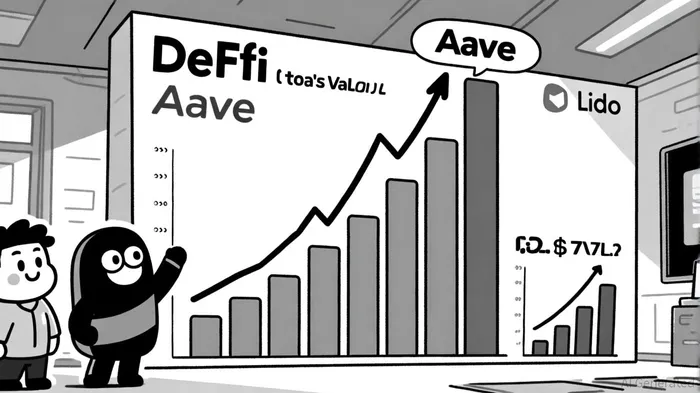
The DeFi sector is another critical arena for capital allocation. Aave and Lido dominate the space, but their trajectories diverge sharply. As of Q3 2025, Aave's Total Value Locked (TVL) reached $73.2 billion, surpassing Lido's $39.58 billion and solidifying its position as the leading lending protocol [3]. Aave's cumulative borrow volume now exceeds $775 billion, with profitability sustained for multiple months. The protocol's recent launch of GHO, a high-margin stablecoin, further enhances its competitive edge by enabling instant liquidity for users [3].
Lido, by contrast, remains a key player in liquid staking, with $42.5 billion in TVL as of September 2025 [1]. However, its native token (LDO) has underperformed Aave's AAVE token, which gained 253% year-to-date while LDOLDO-- declined by 55% [2]. This disparity reflects Aave's strategic shift toward governance-driven incentives and buyback programs to reduce circulating supply, whereas Lido's focus on EthereumETH-- 2.0 staking has limited its diversification [3].
ROI Metrics and Institutional Adoption
For investors, the ROI potential of stablecoin-adjacent assets is tied to their ability to optimize liquidity and yield. Aave's annualized fees hit $586 million in Q3 2025, with $84.8 million in revenue, underscoring its financial resilience [3]. Similarly, Utila's valuation growth—tripling in six months—highlights the demand for infrastructure that bridges traditional finance and blockchain [2].
Institutional adoption further amplifies these opportunities. Hedge funds are allocating 5–20% of their net asset value (NAV) to stablecoin yield strategies, while venture capital firms use USDC for transparent capital disbursement [1]. Protocols like MakerDAO and Bitwave are also gaining traction, with MakerDAO's Dai stablecoin integrating into global supply chains and Bitwave automating on-chain accounting for enterprises [2].
Regulatory Tailwinds and Geopolitical Dynamics
Regulatory clarity is a critical catalyst. The U.S. GENIUS Act and EU's MiCA framework are creating a “geo-fenced” environment where capital flows are rebalanced monthly based on jurisdictional compliance [1]. For example, Singapore and Japan's licensing regimes are attracting DeFi protocols seeking institutional-grade custody solutions, while Latin America's adoption of stablecoins for remittances is driven by financial inclusion [1].
Conclusion: Strategic Allocation in a High-Growth Ecosystem
The stablecoin market's expansion and infrastructure innovation present a compelling case for capital allocation. Startups like Utila and Kura are addressing cross-border inefficiencies, while DeFi protocols like Aave are redefining liquidity and governance. For investors, the key lies in balancing exposure to high-growth startups with institutional-grade DeFi platforms, leveraging regulatory tailwinds and ROI metrics to build resilient portfolios.
As the market matures, the winners will be those who prioritize scalability, compliance, and interoperability—qualities that define the next phase of stablecoin-driven finance.







Comentarios
Aún no hay comentarios