
Stablecoin Market Expansion: A New Frontier for Institutional Yield and Risk Management in 2025
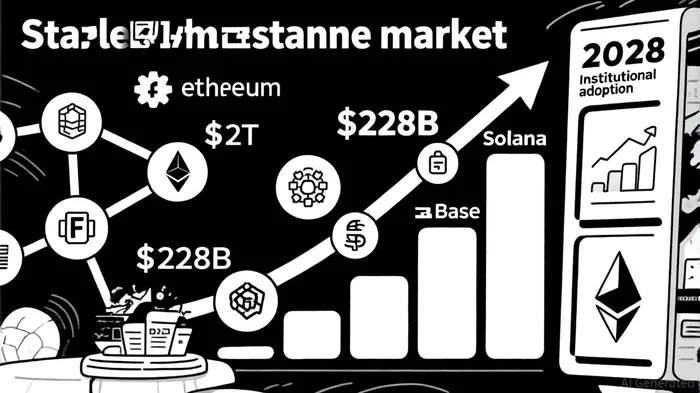
The stablecoin market has emerged as a cornerstone of global financial infrastructure in 2025, with total market capitalization surging to $251.7 billion by mid-year and projections suggesting it could surpass $2 trillion by 2028 [1]. This exponential growth, driven by regulatory clarity and real-world utility, has positioned stablecoins as a critical asset class for institutional investors seeking yield optimization and risk mitigation in volatile crypto markets.
The Rise of Stablecoins: A Macro-Driven Shift
Stablecoins now dominate cross-border transactions, remittances, and liquidity management, with 43% of B2B payments in Southeast Asia utilizing stablecoins [3]. Emerging markets like Argentina and Nigeria have adopted stablecoins as a hedge against inflation, while Fortune 500 companies' interest in stablecoins has tripled from 8% in 2024 to 29% in 2025 [2]. Regulatory frameworks such as the U.S. GENIUS Act and the EU's MiCA have provided institutional-grade clarity, enabling stablecoins to transition from crypto-native tools to mainstream financial rails [4].
Yield Optimization: From DeFi to Real-World Assets
Institutional investors are leveraging stablecoins to generate competitive yields across decentralized and traditional finance. DeFi protocols like Aave and Compound offer variable interest rates (3.2–14% APY) on stablecoins such as USDCUSDC-- and DAIDAI-- [2]. Meanwhile, real-world asset (RWA)-backed stablecoins—collateralized by U.S. Treasuries or high-grade bonds—are gaining traction. For example, Ondo Finance's USDY and Angle Protocol's stUSD provide inflation-adjusted returns of 4–7% APY while maintaining regulatory compliance [5].
Automated yield aggregators like Yearn Finance and Beefy use AI-driven strategies to optimize returns, dynamically shifting capital across lending pools, liquidity provision, and RWA-backed yields [5]. These tools are particularly appealing to institutions, with hedge funds allocating 5–20% of their net asset value to stablecoin strategies [5].
Risk Mitigation: Technical, Economic, and Regulatory Safeguards
Despite their promise, stablecoins introduce complex risks. Technical vulnerabilities—such as smart contract exploits and cross-chain bridge failures—require robust security audits and multi-signature controls [1]. Economic risks, including liquidity shortages and depeg events, demand diversified reserve strategies and real-time monitoring. For instance, fiat-backed stablecoins must balance aggressive reserve investments with conservative liquidity buffers [1].
Regulatory compliance remains a priority. The GENIUS Act mandates full reserve backing and federal licensing for stablecoin issuers, while MiCA enforces transparency and AML protocols [4]. Institutions are adopting institutional-grade custody solutions (e.g., Anchorage, Fireblocks) to ensure compliance, with platforms like Brava offering automated risk assessments and real-time settlement proofs [5].
Strategic Allocation: Balancing Yield, Liquidity, and Compliance
Institutions are diversifying stablecoin allocations across compliant jurisdictions and protocols. For example, USDC is used for immediate liquidity and cross-border transactions, while sUSDe and vlCVX tokens are deployed for yield generation and governance exposure [5]. Tokenized Treasuries and programmable cash (e.g., PYUSD) are replacing traditional corporate checking accounts, enabling real-time capital deployment [5].
Quantitative data underscores the appeal: stablecoin TVL in yield-bearing protocols reached $11 billion in 2025, with Pendle capturing 30% of this TVL [4]. Meanwhile, CeFi platforms like Nexo and Binance offer 6–18% APY on stablecoins, outperforming traditional fixed-income instruments [2].
The Future: Stablecoins as Global Capital Infrastructure
As stablecoins mature, they are redefining financial workflows. Institutions are integrating them into digital treasury systems, automating compliance, and leveraging smart contracts for real-time reporting. The convergence of DeFi and TradFi—exemplified by platforms like Coinbase Institutional and Matrixport—is creating hybrid models that balance innovation with regulatory rigor [5].
Conclusion
Stablecoins have evolved from speculative assets to foundational components of global capital infrastructure. For institutional investors, they offer a unique blend of yield, liquidity, and programmability—provided risks are managed through advanced technical safeguards, diversified strategies, and regulatory alignment. As the market continues to expand, stablecoins will likely become a standard tool for institutional treasuries, hedge funds, and corporate finance teams navigating the complexities of 2025's macroeconomic landscape.






Comentarios
Aún no hay comentarios