
Stablecoin Liquidity Evolution: OKX's USDT Strategy and the Future of Exchange Competitiveness
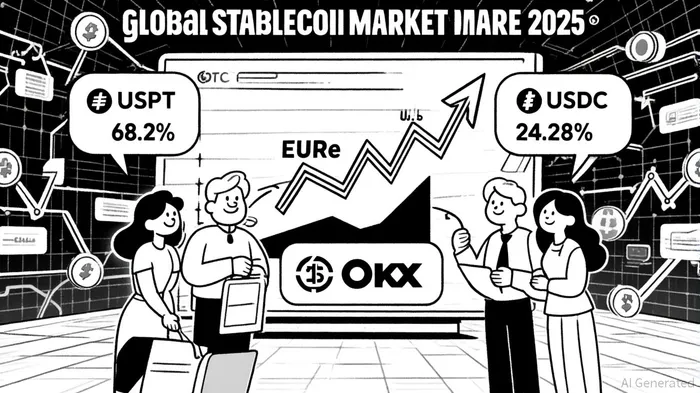
The stablecoin landscape in 2025 is no longer a niche corner of crypto—it's the backbone of global liquidity. Regulatory tailwinds, institutional adoption, and technological innovation have collided to redefine how value moves across traditional and decentralized systems. At the center of this evolution is Tether's USDTUSDC--, which retains a staggering 68.2% market share despite regulatory headwinds in the EU and U.S. [1]. Yet, the story isn't just about USDT's dominance; it's about how exchanges like OKX are leveraging stablecoin liquidity to reshape investor confidence and competitive positioning in a fragmented market.
Regulatory Tailwinds and the USDT Paradox
The EU's Markets in Crypto-Assets (MiCA) regulation, fully enforced in July 2025, has created a bifurcated stablecoin ecosystem. Non-compliant assets like USDT were delisted from European exchanges, pushing liquidity into MiCA-compliant alternatives like USDCUSDC-- and EURe [2]. Meanwhile, the U.S. Senate's passage of the GENIUS Stablecoin Act in June 2025 provided a legal framework for institutional adoption, indirectly boosting confidence in compliant stablecoins [2]. This regulatory duality has created a paradox: USDT remains the most liquid stablecoin globally (with 65% of stablecoin-based trades on centralized exchanges [1]), yet its offshore risks make it a regulatory pariah in key markets.
OKX, a global exchange with a footprint in both regulated and emerging markets, has navigated this paradox by doubling down on USDT's utility while hedging against regulatory volatility. The exchange's Q3 2025 strategy emphasized cross-border payments and DeFi integration, leveraging USDT's entrenched liquidity pools to attract retail and institutional users [1]. By abstracting blockchain complexity through tools like payment cards and treasury management solutions, OKX has positioned itself as a bridge between legacy finance and crypto-native ecosystems [1].
The OKX Playbook: Liquidity, Yield, and Compliance
OKX's approach to stablecoin integration in 2025 is threefold: liquidity optimization, yield generation, and regulatory alignment.
Liquidity Optimization: USDT's dominance in DeFi (40% of stablecoin liquidity pools [1]) makes it a critical asset for OKX's decentralized offerings. The exchange has expanded its support for USDT on high-activity blockchains like EthereumETH-- and SolanaSOL--, while discontinuing low-usage chains to streamline operations [1]. This focus on high-liquidity networks ensures OKX can offer fast, low-cost transactions—a key differentiator in a market where speed and cost efficiency are paramount.
Yield Generation: OKX has tapped into the growing demand for interest-bearing stablecoins by integrating real-world asset (RWA) lending and DeFi protocols. For example, users can now earn yields on USDT through OKX's treasury management tools, which allocate funds to RWA-backed loans or tokenized government securities [3]. This mirrors broader trends in tokenized money markets, where stablecoins are no longer just “cash equivalents” but programmable capital .
Regulatory Alignment: While USDT's regulatory risks persist, OKX has aligned with frameworks like the GENIUS Act and MiCA to future-proof its stablecoin offerings. By prioritizing compliance-driven stablecoins (e.g., USDC) in regulated markets and retaining USDT in unregulated jurisdictions, OKX balances innovation with risk mitigation [2]. This dual strategy allows the exchange to capture liquidity in both on-chain and off-chain ecosystems.
Investor Confidence and Exchange Competitiveness
The implications of OKX's strategy are profound. For investors, the integration of USDT into yield-generating and cross-border tools reduces the “dead money” problem associated with stablecoins. By offering passive income streams and seamless fiat on-ramps, OKX turns stablecoins into active assets—a critical factor in attracting institutional capital [3].
For exchanges, the battle for liquidity is no longer just about trading volume; it's about ecosystem dominance. OKX's focus on stablecoin utility—payments, treasury, and DeFi—positions it to compete with both legacy banks and decentralized protocols. Consider the EU's delisting of USDT: while this initially fragmented liquidity, OKX's ability to pivot to MiCA-compliant stablecoins while retaining USDT's on-chain utility has allowed it to maintain a competitive edge [2].
The Road Ahead
Stablecoins are no longer a side bet—they're the rails of the new financial system. For OKX, the strategic integration of USDT isn't just about liquidity; it's about asserting control over the value transfer layer in a world where speed, compliance, and yield are non-negotiable. As cross-border payments and tokenized assets gain traction, exchanges that master stablecoin dynamics will define the next era of crypto finance.
Investors should watch OKX's ability to balance regulatory agility with USDT's entrenched liquidity. If the exchange can scale its yield-bearing and payment solutions without compromising compliance, it could cement itself as a leader in the hybrid finance era. But the risks are real: regulatory shifts, interoperability challenges, and the rise of central bank digital currencies (CBDCs) could disrupt the current stablecoin paradigm [1].
In the end, the stablecoin story in 2025 is one of adaptation. And OKX, with its USDT-centric playbook, is betting big on the idea that liquidity isn't just a metric—it's a moat.






Comentarios
Aún no hay comentarios