
Stablecoin Innovation and Token Backing: Assessing the STBL Protocol's $1 Billion USST Launch
In the post-2025 DeFi landscape, stablecoins have evolved beyond mere liquidity tools to become foundational pillars of decentralized finance. The collapse of algorithmic stablecoins in 2022 and the regulatory scrutiny of centralized counterparts have underscored the need for innovation in token-backed stablecoin design. Enter the STBL Protocol's USST, a $1 billion stablecoin launch that reimagines stability, scalability, and systemic risk mitigation through institutional-grade real-world assets (RWAs) and yield-splitting mechanics.
A New Architecture for Stability
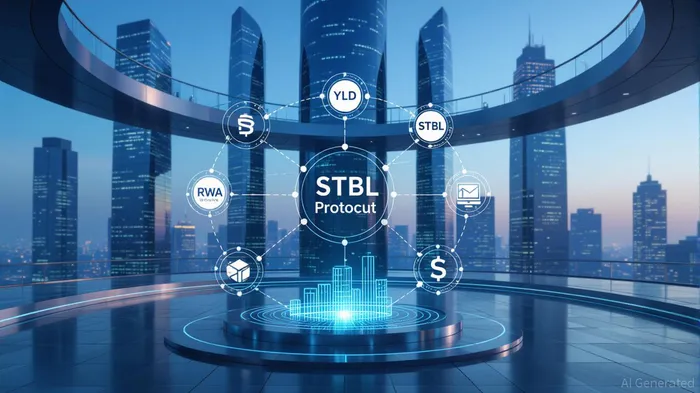
The STBL Protocol's USST is fully over-collateralized by RWAs such as U.S. Treasuries and AAA-rated money market funds, ensuring a robust $1 peg[1]. Unlike traditional stablecoins like USDTUSDT-- and USDCUSDC--, where centralized issuers capture yield from collateral, USST decouples principal and yield into distinct tokens: USST for liquidity and YLD for yield rights[3]. This innovation allows users to retain both liquidity and income, addressing a critical limitation of first-generation stablecoins. For instance, a user holding USST can deploy it in DeFi protocols while simultaneously earning yield via YLD, creating a dual utility that enhances capital efficiency[4].
The protocol's multi-chain deployment on EthereumETH-- and SolanaSOL-- further amplifies scalability. By leveraging Solana's high throughput and Ethereum's institutional adoption, STBL caters to both retail and institutional users while maintaining regulatory compliance[1]. This dual-chain strategy not only broadens accessibility but also mitigates single-chain vulnerabilities, a key concern in DeFi's post-2025 environment[5].
Systemic Risk Mitigation: A Layered Approach
Systemic risk has plagued stablecoins since the 2022 collapses, but STBL's architecture introduces multiple safeguards. First, over-collateralization by RWAs—such as USDY, OUSG, and BUIDL—reduces exposure to volatile crypto assets and intermediaries[2]. Second, dynamic fee adjustments automatically stabilize the $1 peg: when USST trades below $1, minting fees rise, and burn incentives increase to tighten supply; conversely, fees decrease when the stablecoin trades above $1[4]. This self-correcting mechanism minimizes the need for manual interventions, a common failure point in earlier stablecoin models.
The LAMP liquidity mechanism further bolsters resilience by directing USST/YLD pairs into liquidity pools, ensuring instant access to liquidity even during market stress[2]. Additionally, the protocol's decentralized governance model—managed via the STBL token—empowers holders to vote on collateral allowlists, fee structures, and protocol upgrades[3]. This community-driven approach aligns with the “Stablecoin 2.0” vision, where users retain governance rights rather than ceding control to centralized entities[5].
Scalability and Institutional Adoption
STBL's focus on institutional-grade infrastructure positions it to capture a significant share of the $150 billion stablecoin market. By avoiding multi-repo structures and relying directly on government bonds, the protocol minimizes counterparty risk—a critical factor for institutional investors[1]. Moreover, the yield-splitting model democratizes access to RWA returns, which were previously exclusive to traditional finance. As of 2025, over 60% of institutional DeFi allocations prioritize yield-generating stablecoins[4], a trend STBL is poised to capitalize on.
However, challenges remain. Cross-chain bridge security and regulatory alignment across jurisdictions could test the protocol's scalability. STBL must also navigate evolving compliance frameworks, such as the U.S. Treasury's 2024 stablecoin oversight rules[5]. Yet, its proactive governance model and transparent collateral audits suggest a commitment to long-term sustainability.
Conclusion
The STBL Protocol's USST represents a paradigm shift in stablecoin design, blending institutional-grade collateral, yield transparency, and decentralized governance. By addressing scalability through multi-chain deployment and systemic risk via dynamic mechanisms, USST is well-positioned to thrive in a post-2025 DeFi ecosystem. For investors, the $1 billion launch signals confidence in a model that prioritizes both innovation and resilience—a rare combination in the volatile crypto space.






Comentarios
Aún no hay comentarios