
Stablecoin Innovation in Europe: Assessing ODDO BHF's EUROD for Institutional Portfolios
The launch of ODDO BHF's EUROD stablecoin in October 2025 marks a pivotal moment in Europe's digital finance evolution. As a euro-backed, MiCA-compliant stablecoin, EUROD is positioned to address institutional demand for regulated, low-volatility assets while challenging the dominance of U.S. dollar-denominated stablecoins. For institutional investors, the strategic and financial implications of integrating EUROD into portfolios hinge on regulatory alignment, cross-border utility, and the broader shift toward euro-centric digital infrastructure.
Regulatory Clarity and MiCA's Role in Institutional Adoption
The European Union's Markets in Crypto-Assets (MiCA) regulation has created a robust framework for stablecoin innovation, mandating full reserve transparency, quarterly audits, and real-time solvency disclosures, according to CoinLaw. This regulatory clarity has spurred institutional confidence, with 58% of European financial institutions already using or planning to adopt stablecoins for payments and treasury operations, according to CoinLaw. ODDO BHF's EUROD, fully compliant with MiCA, leverages this framework to offer institutional clients a secure, bank-backed alternative to unregulated or less transparent USD stablecoins.
By contrast, the U.S. stablecoin landscape remains fragmented, with the revised STABLE Act proposing a two-tier licensing system that excludes non-bank entities, according to VGLawFirm. This regulatory asymmetry positions euro-backed stablecoins like EUROD to capture institutional market share in Europe, where 73% of stablecoin issuers have already initiated MiCA compliance efforts, CoinLaw reports. The European Central Bank (ECB) has further emphasized the urgency of euro-backed solutions, warning that the 99.8% dominance of USD stablecoins threatens monetary sovereignty and cross-border transactional independence, according to the European Business Review.
Strategic Portfolio Integration: EUROD vs. USD Stablecoins
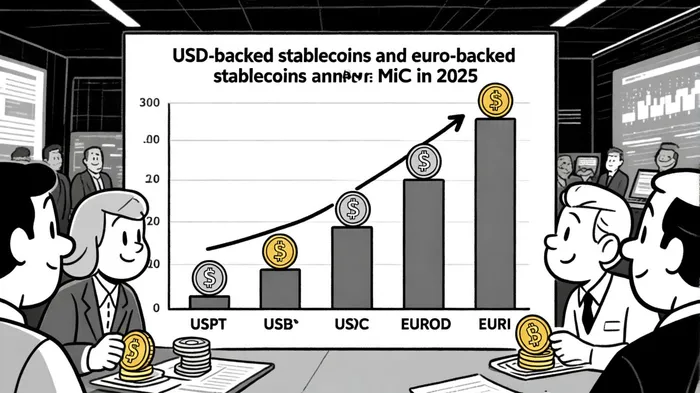
While USD stablecoins (e.g., USDT, USDC) dominate liquidity and trade execution in global markets, their adoption in EU portfolios is increasingly scrutinized for systemic risks and regulatory uncertainty, according to an EY report. In Q3 2025, institutional investors allocated 35% of their stablecoin holdings to USD-based tokens, compared to less than 0.15% in euro-backed alternatives, according to VGLawFirm. However, this gap is narrowing as institutions prioritize diversification and compliance.
EUROD's design-backed by transparent euro reserves held in regulated banks and integrated with Fireblocks' custody infrastructure-addresses key institutional concerns such as reserve transparency and operational security, as noted in the ODDO BHF press release. For example, hedge funds and venture capital firms are beginning to allocate 5–20% of their net asset value (NAV) to stablecoin yield strategies, with EUROD's MiCA compliance making it a viable candidate for such allocations, according to EY. Additionally, its listing on Bit2Me, a platform supported by Telefonica and BBVA, enhances its accessibility for cross-border transactions and B2B settlements, per ODDO BHF's announcement.
Financial Performance and Market Positioning
Despite its early-stage market capitalization (under $500 million as of September 2025), EUROD reflects a broader trend of institutional interest in euro-backed stablecoins. The EU stablecoin market is projected to grow by 37% in 2025, reaching €450 billion, driven by MiCA's single passport model and the ECB's push for a digital euro, CoinLaw projects. This growth is supported by 85% of institutions reporting infrastructure readiness for stablecoin integration, though challenges remain in internal expertise and compliance complexity, CoinLaw also notes.
Comparatively, USD stablecoins face headwinds in the EU due to MiCA's stringent requirements. For instance, Circle's EURC, a MiCA-compliant euro-backed stablecoin, has gained traction as a regulated alternative, but its market share remains modest, according to EY. The ECB's accelerated development of a digital euro (e-euro) further underscores the strategic importance of euro-backed stablecoins in preserving monetary sovereignty, as reported by the European Business Review.
Strategic Implications for Institutional Investors
For institutional investors, the integration of EUROD into portfolios offers three key advantages:
1. Regulatory Resilience: MiCA compliance reduces counterparty risk and aligns with EU financial stability goals.
2. Cross-Border Efficiency: EUROD's design facilitates low-cost, instant settlements for European SMEs and B2B transactions, where legacy systems are costly and slow, as highlighted in ODDO BHF's announcement.
3. Diversification: By reducing exposure to USD-centric stablecoins, institutions can hedge against U.S. regulatory shifts and dollarization risks, the European Business Review suggests.
However, challenges persist. The ECB's digital euro project could cannibalize private euro-backed stablecoins like EUROD if it gains widespread adoption. Additionally, the dominance of USD stablecoins in global markets means that EUROD's utility may be limited to regional use cases unless cross-border adoption accelerates.
Conclusion
ODDO BHF's EUROD stablecoin represents a strategic response to the EU's regulatory and monetary sovereignty imperatives. While USD stablecoins remain dominant, the MiCA framework and ECBXEC-- initiatives are creating fertile ground for euro-backed alternatives. For institutional investors, EUROD's compliance, transparency, and integration with established financial infrastructure position it as a compelling addition to diversified digital asset portfolios. As the EU stablecoin market matures, the balance between regulatory innovation and global liquidity will determine whether EUROD and its peers can challenge the USD hegemony-or coexist as complementary tools in a multi-currency digital ecosystem.





Comentarios
Aún no hay comentarios