
Stablecoin Flow as a Barometer for Blockchain Ecosystem Health
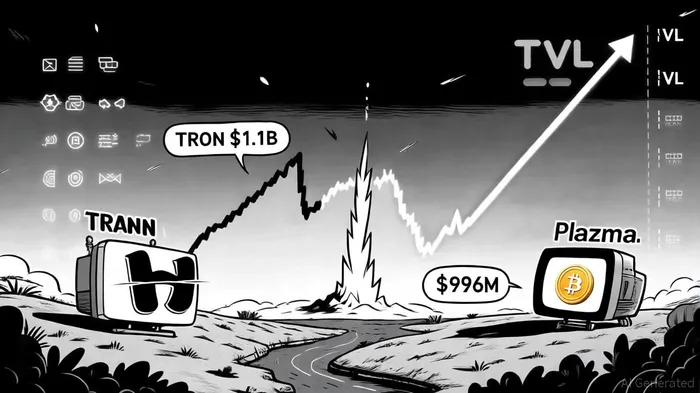
Stablecoin flows have become a critical metric for assessing blockchain ecosystem health. These flows reveal notNOT-- just liquidity dynamics but also user trust, infrastructure efficiency, and competitive positioning. In October 2025, two contrasting narratives emerged: TRON's $1.1 billion stablecoin inflow versus Plasma's $996 million outflow. These figures are more than numbers-they are strategic signals about the future of stablecoin infrastructure.
TRON: The Engine of Stablecoin Dominance
TRON has long been the backbone of the stablecoin ecosystem, particularly for USDTUSDT--. By mid-2025, 51% of the total USDT supply resided on TRON, a figure that grew to 99% of its network's stablecoin supply by Q3, according to a Cointelegraph report. This dominance is underpinned by technical upgrades like the GreatVoyage-v4.8.0 (Kant) update, which enhanced EthereumETH-- compatibility and introduced gas-free USDT transfers, according to Gate's report. These innovations reduced friction for users, enabling 65 million USDT transfers in June 2025 alone, with a total volume exceeding $600 billion, according to CryptoSlate.
TRON's DeFi ecosystem further solidifies its position. Protocols like SunSwap and JustLend have driven substantial trading and lending volumes in USDT and USDD, creating a flywheel effect. Coinfomania reported TRON's stablecoin inflows in Q3 2025 reached $1.52 billion, outpacing Ethereum's $1.02 billion outflow. This migration reflects a broader trend: users prioritizing low-cost, high-speed infrastructure over legacy chains burdened by high gas fees.
Plasma: The Disruptor's Dilemma
Plasma, a new Layer 1 blockchain optimized for stablecoin transfers, launched in September 2025 with a bang. Its TVL surged to $5.6 billion in its first week, fueled by a $1 billion deposit campaign and partnerships with protocols like Aave and Trust Wallet, Sentora reported. By October, Plasma's TVL briefly surpassed Tron's, reaching $6.32 billion, as Cryptotimes reported. However, this growth was followed by a $996 million outflow in October 2025, a stark contrast to TRON's inflow, Coinfomania noted.
Plasma's challenges stem from its speculative nature and ecosystem immaturity. While its zero-fee model and Bitcoin-anchored security are compelling, the native token XPLXPL-- dropped 45% in value within five days of launch, raising concerns about volatility, 99Bitcoins reported. Additionally, Plasma's reliance on USDT-a token deeply entrenched in TRON's ecosystem-limits its ability to diversify. As Coinfomania noted, Plasma's outflow highlights the risks of over-reliance on a single stablecoin and the difficulty of competing with TRON's entrenched network effects.
Strategic Implications for Investors
The contrast between TRONTRX-- and PlasmaXPL-- underscores a key investment thesis: established infrastructure with network effects outperforms novel but unproven models in the short term. TRON's inflows reflect its role as a reliable, scalable settlement layer for stablecoins, supported by deep integrations with CEXs like Binance and a mature DeFi ecosystem. Investors betting on TRON are essentially wagering on the status quo-a bet that has paid off as Ethereum's outflows highlight growing dissatisfaction with high fees.
Plasma, meanwhile, represents a long-term play on the future of stablecoin infrastructure. Its focus on zero-fee transactions, BitcoinBTC-- anchoring, and institutional-grade security could disrupt the market if it addresses token volatility and expands its stablecoin offerings beyond USDT. However, the recent outflow signals that early-stage adoption is fragile, and Plasma must prove its ability to retain liquidity amid competition from both TRON and other EVM-compatible chains like ArbitrumARB-- and Base.
Conclusion
Stablecoin flows are a barometer for blockchain health, and October 2025's data tells a clear story: TRON's ecosystem is thriving, while Plasma's growth is still a work in progress. For investors, this means prioritizing chains with proven scalability and user trust-like TRON-while keeping an eye on Plasma's ability to innovate and stabilize. The stablecoin arms race is far from over, but for now, the old guard holds the upper hand.





Comentarios
Aún no hay comentarios