
Stablecoin-Driven Payment Modernization: The RLUSD-XRPL Partnership as a Catalyst for Institutional Adoption
The RLUSD-XRPL Partnership: A Technical Breakthrough
At its core, the partnership aims to settle Mastercard credit card transactions using RLUSD on the XRP Ledger. This is a departure from traditional systems like ACH or Fedwire, which rely on intermediaries and take days to clear. By contrast, the XRP Ledger processes over 1,500 transactions per second at a cost of less than one cent per transaction, according to a Coinotag report. WebBank, a regulated U.S. financial institution, issues RLUSD with full U.S. dollar reserves, ensuring compliance with New York Department of Financial Services regulations, as noted in a Coinspeaker article. This combination of speed, low cost, and regulatory trust creates a compelling value proposition for institutions seeking to optimize their back-end operations.
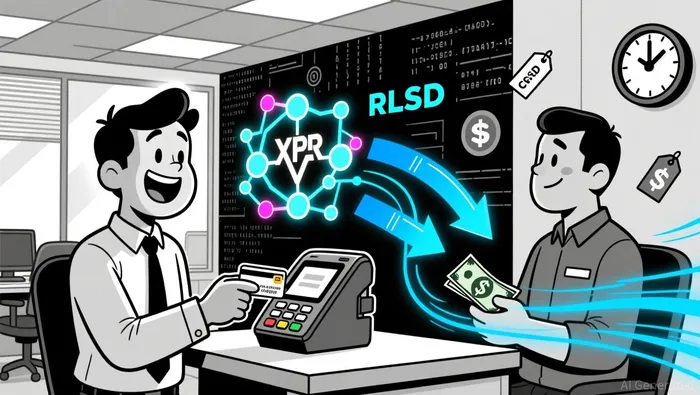
The technical integration is equally noteworthy. RLUSD acts as a bridge asset, enabling near-real-time settlements without exposing users to cryptocurrency volatility. For example, when a consumer swipes a Gemini-issued credit card, the transaction is settled via RLUSD on the XRPL, bypassing traditional banking intermediaries. This reduces counterparty risk and operational complexity while maintaining the familiar user experience of traditional credit cards, according to a CCN analysis.
Strategic Entry Points for Institutional Adoption
The RLUSD-XRPL partnership is notNOT-- just a technical experiment-it's a strategic play to onboard institutions to blockchain-enabled infrastructure. For years, blockchain has struggled to gain traction in institutional finance due to regulatory uncertainty and scalability issues. This initiative addresses both: WebBank's regulatory compliance provides a legal foundation, while the XRP Ledger's throughput and cost efficiency solve scalability concerns.
According to a CryptoTimes report, this pilot could serve as a blueprint for integrating stablecoins into mainstream financial systems. Institutions are particularly attracted to the ability to compress multi-day settlement cycles into seconds, a feature that could reduce liquidity constraints and operational overhead. For example, merchants could access funds instantly, improving cash flow management, while banks could streamline reconciliation processes.
This aligns with broader trends in institutional adoption. HeraclesCapital's investment in MiloGold, a platform for tokenized gold with proof-of-reserve infrastructure, highlights a parallel strategy: using blockchain to enhance transparency and custody clarity for real-world assets, as reported in a GlobeNewswire announcement. Like RLUSD, MiloGold's approach combines regulatory compliance with technological innovation, addressing institutional skepticism through trust mechanisms.
The Ripple Effect: Beyond Credit Cards
Ripple's broader strategy extends beyond this partnership. The company recently secured a $500 million funding round and launched Ripple Prime, a brokerage supporting spot trading for XRP and RLUSD, as noted in a Coinspeaker article. These moves signal confidence in the long-term utility of its ecosystem. Meanwhile, the XRP Ledger's role as a settlement layer for fiat transactions could position it as a critical infrastructure component for global payments.
Critically, this initiative also demonstrates how stablecoins can coexist with traditional finance. Unlike speculative cryptocurrencies, RLUSD's stability and regulatory compliance make it an attractive tool for institutions. As stated by a CCN analysis, stablecoins like RLUSD are "bridging the gap between legacy systems and blockchain innovation" by offering the benefits of digital assets without their volatility.
Conclusion: A New Era of Financial Infrastructure
The RLUSD-XRPL partnership is a microcosm of blockchain's next phase: not replacing legacy systems, but enhancing them. By focusing on regulated stablecoins and institutional-grade infrastructure, Ripple and its partners are addressing the pain points that have historically hindered adoption. For investors, this represents a strategic entry point into a sector poised for growth-where blockchain isn't a fringe experiment, but a foundational upgrade to the global financial system.





Comentarios
Aún no hay comentarios