
Stablecoin Dominance and Cross-Chain Expansion: How Circle-Crossmint Could Disrupt USDT's Payments Hegemony
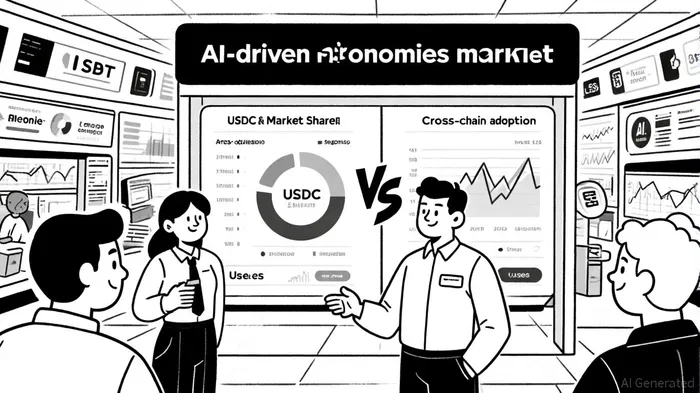
The stablecoin market in 2025 remains a duopoly, with Tether's USDTUSDC-- and Circle's USDCUSDC-- collectively controlling 86% of total market share[1]. USDT, with a 64% dominance and a $140+ billion market cap, continues to outpace USDC's 24.5% share ($56–61.5 billion), particularly in retail payments and cross-chain transactions[1]. However, USDC's rapid institutional adoption, regulatory compliance, and strategic partnerships—most notably with Crossmint—position it as a formidable challenger to USDT's stronghold. This analysis explores how Circle's collaboration with Crossmint could accelerate USDC's cross-chain expansion and AI-driven use cases, reshaping the stablecoin landscape.
USDT's Strengths and USDC's Ascent
USDT's dominance stems from its first-mover advantage, liquidity, and broad blockchain support (13 networks, including TronTRX-- and Solana). It dominates decentralized exchanges (DEXs) in Asia and Web3 gaming, with daily trading volumes exceeding $150 billion compared to USDC's $10–12 billion[5]. Meanwhile, USDC's growth is fueled by its transparency—monthly reserve audits—and compliance with U.S. regulations, making it the preferred stablecoin for institutional investors and DeFi protocols. By Q2 2025, USDC accounted for 18.6% of DeFi lending platforms, 17.5% of derivatives, and 15.9% of real-world asset (RWA) usage[1]. Its integration into EthereumETH-- Layer 2s like ArbitrumARB-- and Base has further expanded its utility, powering $3.2 billion in TVL[1].
The Circle-Crossmint Partnership: A Strategic Counter to USDT
Circle Ventures' partnership with Crossmint represents a pivotal move to scale USDC's adoption across human and AI-driven economies. By funding Crossmint's wallets, APIs, and payment orchestration tools, CircleCRCL-- aims to create a “low-cost, near-instant” stablecoin infrastructure for global transactions[2]. This collaboration targets two key areas:
- Cross-Chain Expansion: USDC now operates on 11 blockchains, including Ethereum, zkSyncZK--, and Scroll, while Crossmint's integration with Tempo—a payments-focused blockchain incubated by Stripe and Paradigm—further diversifies its reach[1]. In Q2 2025, USDC's cross-chain bridged volume hit $5.1 billion, a 22% quarter-over-quarter increase[1].
- AI-Driven Commerce: Crossmint's acquisition of AI user-research startup Cycle AI underscores its focus on autonomous agents[3]. The firm plans to enable AI agents to perform tasks like paying for self-driving taxis or managing digital content, leveraging USDC as a settlement layer[4]. With $23.6 million in recent funding, Crossmint aims to build infrastructure for AI agent-driven e-commerce, where machines could soon account for a significant share of onchain transactions[2].
Real-World Applications and Regulatory Tailwinds
The partnership's practical impact is already evident. MoneyGram's crypto app in Colombia, built on Crossmint's infrastructure, allows users to store USDC as an alternative to the volatile peso[1]. Similarly, in Argentina, crypto “caves” (informal exchange hubs) increasingly use USDC to bypass currency restrictions[1]. These use cases highlight USDC's role in high-inflation economies, where its regulatory compliance offers a trust advantage over USDT.
Regulatory tailwinds further bolster USDC's position. As the EU's MiCA and the U.S. GENIUS Act impose stricter reserve and compliance requirements, USDC's transparent framework gives it an edge over USDT, which has faced scrutiny for its opaque reserves[3]. Circle's recent application for a U.S. National Trust Charter also signals its commitment to aligning with federal standards[6].
Challenges and the Path Forward
Despite these strides, USDT's dominance in volume ($100 billion daily vs. USDC's $10.3 billion) and market cap ($173 billion vs. $74.1 billion) remains a hurdle[1]. USDT's entrenched position on Tron, where it holds $80 billion in supply, and its broader blockchain support (13 vs. USDC's 11) also pose challenges[5]. However, USDC's focus on regulated markets, DeFi, and AI-driven economies could close this gap over time.
If current trends persist, USDC's institutional adoption and cross-chain expansion could enable it to surpass USDT by 2030[5]. The key will be maintaining momentum in AI integration, regulatory alignment, and partnerships like the one with Crossmint. For investors, this dynamic presents a compelling case: USDC's growth trajectory, while currently trailing USDT, is underpinned by innovation and compliance—factors that may prove decisive in the long-term stablecoin race.





Comentarios
Aún no hay comentarios