
Stablecoin Depegging and Its Implications for DeFi Resilience
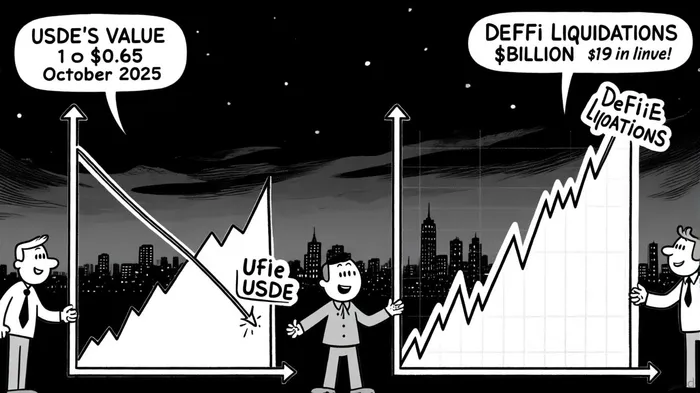
The depegging of USDeUSDe-- in October 2025-plummeting to $0.65 from its $1 peg amid a liquidity shortfall of nearly 89%-has exposed profound vulnerabilities in synthetic stablecoins and the broader DeFi ecosystem. This event, which triggered $19.35 billion in liquidations within a volatile 24-hour period, underscores the systemic risks inherent in crypto markets and the urgent need for regulatory preparedness, according to the Hodder mid-year report. As DeFi protocols face cascading failures during extreme market stress, the interconnectivity of these systems amplifies the consequences of individual depegging events, as detailed in a Markets article.
Systemic Risks in DeFi: A Fragile Ecosystem
Synthetic stablecoins like USDe, which rely on on-chain collateral and delta-neutral hedging strategies, are uniquely susceptible to liquidity crises. Unlike fiat-backed stablecoins, synthetic variants depend on volatile crypto assets and centralized exchange infrastructure, creating circular dependencies that collapse under pressure, as noted in a Paul Hastings guide. The USDe depegging revealed how concentrated collateral pools and insufficient insurance mechanisms can lead to rapid devaluation, with slippage and redemption spirals exacerbating losses, according to a CryptoRobotics analysis.
The October 2025 crisis also highlighted the fragility of DeFi's "black swan" resilience. During the event, leveraged positions across platforms like dYdXDYDX-- and AaveAAVE-- faced mass liquidations exceeding $1.7 billion in a single day, demonstrating how instability in one asset class can propagate through the entire DeFi stack, as reported in the Markets piece. This cascading effect is compounded by the lack of transparency in collateral management and the absence of circuit breakers to mitigate panic-driven selling, a concern raised in the CryptoRobotics analysis.
Regulatory Preparedness: A Mixed Landscape
In response to these risks, U.S. regulators have accelerated legislative efforts to stabilize the stablecoin sector. The GENIUS Act, enacted in July 2025, mandates 1:1 reserve backing for payment stablecoins, annual audits, and enhanced AML/KYC compliance, aiming to prevent future depegging by aligning stablecoin issuance with traditional financial safeguards, per the Paul Hastings guide. Complementing this, the CLARITY Act seeks to clarify the classification of digital assets, distinguishing between securities and commodities to reduce regulatory ambiguity, as outlined by the Hodder report.
However, gaps remain. While the GENIUS Act targets fiat-backed stablecoins, synthetic variants like USDe fall into a gray area, as their collateral models are not explicitly addressed by current frameworks, according to an Analytics Insight overview. Global regulators are also grappling with cross-border challenges: the EU's MiCA regulation (effective late 2024) and the UK's FCA reforms emphasize licensing and transparency but lack mechanisms to address DeFi-specific risks. Meanwhile, the OECD's Crypto-Asset Reporting Framework (CARF) aims to combat tax evasion but does little to stabilize volatile markets.
The Path Forward: Innovation vs. Stability
The USDe crisis has catalyzed innovation in risk mitigation tools, including early warning models that integrate on-chain price data, trading volume, and sentiment analysis to predict depegging events, as shown in a ScienceDirect study. These models, while promising, remain experimental and require broader adoption to prevent future crises. Additionally, the integration of CBDCs as hybrid solutions-combining the stability of central bank systems with blockchain efficiency-is gaining traction, though political resistance (e.g., the U.S. Anti-CBDC Surveillance State Act) complicates progress, as discussed in the Paul Hastings guide.
For investors, the lesson is clear: DeFi's resilience hinges on balancing innovation with robust risk management. While synthetic stablecoins offer composability and yield opportunities, their systemic risks demand cautious allocation. Institutional participation will likely remain limited until regulatory frameworks explicitly address DeFi's unique vulnerabilities, a concern emphasized in the CryptoRobotics analysis.
Conclusion
The October 2025 USDe depegging serves as a wake-up call for the crypto industry. While regulatory progress-such as the GENIUS Act and global compliance initiatives-provides a foundation for stability, DeFi's systemic risks remain under-addressed. Investors must weigh the potential of decentralized finance against its fragility, while policymakers must close gaps in oversight to prevent future crises. As the line between traditional finance and DeFi blurs, preparedness-not just innovation-will define the next era of crypto markets.






Comentarios
Aún no hay comentarios