
Stablecoin Adoption by Major Corporations: A New Era of Institutional Validation and Investment Potential
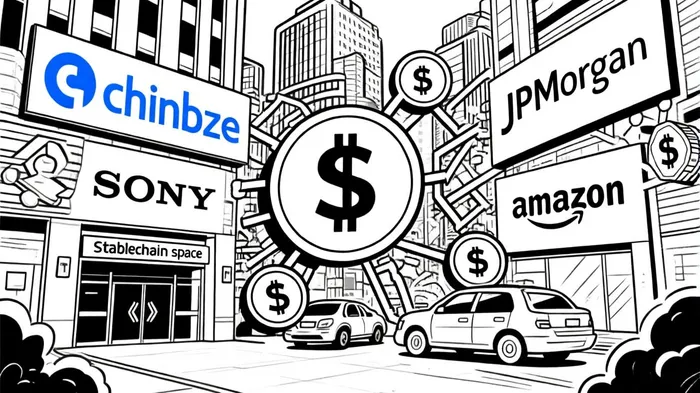
The stablecoin market is undergoing a seismic shift as major corporations and financial institutions increasingly adopt these digital assets. What was once a niche corner of the crypto ecosystem is now a focal point for institutional validation, driven by strategic investments, regulatory clarity, and the pursuit of financial efficiency. This transformation is not merely speculative—it is being actively shaped by industry leaders like CoinbaseCOIN--, SonySONY--, and a growing coalition of banks, tech firms, and fintechs. For investors, this represents a compelling long-term opportunity rooted in structural momentum.
Institutional Validation Through Strategic Partnerships
Coinbase and Sony's recent investment in Bastion, a regulated stablecoin infrastructure provider, underscores the growing institutional confidence in this asset class. In September 2025, Coinbase Ventures led a $14.6 million funding round for Bastion, with Sony Innovation Fund and other major players participating [1]. This brings Bastion's total funding to over $40 million, enabling it to scale its "Stablecoin-as-a-Service" platform. Bastion's offering—comprising issuance tools, reserve management, custodial wallets, and fiat on/off-ramps—addresses a critical gap in the market: the need for compliant, scalable infrastructure for corporate stablecoin adoption [2].
This move is emblematic of a broader trend. As noted by a report from CoinCentral, the stablecoin market expanded from $205 billion to over $290 billion by September 2025, with projections suggesting it could surpass $2 trillion by 2028 [3]. Such growth is not organic alone; it is catalyzed by institutional players building the rails for mass adoption.
Regulatory Tailwinds: The GENIUS Act and Global Frameworks
The U.S. GENIUS Act, passed in July 2025, has been a game-changer. By establishing a federal regulatory framework for stablecoins, it has provided clarity that was previously absent. The act mandates that stablecoin issuers maintain full reserves and operate under regulated entities, such as bank subsidiaries or newly chartered non-bank institutions [4]. This has spurred innovation, as companies can now launch branded stablecoins with legal certainty.
Globally, the EU's MiCA (Markets in Crypto-Assets) framework has similarly bolstered confidence. As highlighted by KPMG, these regulations have reduced compliance risks, enabling institutions like Société Générale and ING to launch euro-denominated stablecoins [5]. The result is a competitive, yet compliant, landscape where traditional financial players and tech giants can coexist.
Diversification of Adopters: From Banks to Big Tech
Stablecoin adoption is no longer confined to crypto-native firms. Traditional banks, tech companies, and even retail giants are entering the fray:
- JPMorgan and Société Générale have launched dollar- and euro-pegged stablecoins (JPM Coin, USD CoinVertible) to streamline cross-border payments [6].
- PayPal and Visa have integrated USDCUSDC-- into their payment networks, leveraging stablecoins for faster, cheaper transactions [7].
- Amazon and Walmart are reportedly exploring their own stablecoins to reduce interchange fees and enhance customer loyalty [8].
- Revolut and Fiserv are building USD-pegged stablecoins to serve their massive user bases, targeting peer-to-peer transfers and remittances [9].
This diversification signals a shift from speculative interest to practical utility. As noted by a Reuters report, a consortium of nine European banks—including ING and UniCredit—has formed a new entity to launch a euro stablecoin, directly challenging U.S. dominance in the space [10].
The Competitive Landscape: Innovation and Infrastructure
While CircleCRCL-- and TetherUSDT-- remain dominant, the entry of infrastructure providers like Bastion is reshaping the market. Bastion's platform eliminates the need for corporations to build complex systems from scratch, offering a turnkey solution for compliance and scalability [11]. This is particularly valuable for non-banking institutions, such as Apple and Airbnb, which are exploring stablecoins to reduce fees and improve transaction efficiency [12].
Moreover, startups like Kura are leveraging stablecoins to disrupt traditional payment systems. By using USDC for cross-border transactions, Kura reduces costs by up to 70% compared to legacy systems [13]. Such innovations highlight the broader ecosystem's potential to redefine global finance.
Long-Term Investment Potential
For investors, the convergence of institutional validation, regulatory clarity, and technological innovation presents a unique opportunity. The stablecoin market's projected growth to $2 trillion by 2028 implies a compounding annual growth rate (CAGR) of over 30% [14]. This trajectory is supported by:
1. Network Effects: As more corporations adopt stablecoins, the infrastructure becomes more robust, attracting further investment.
2. Regulatory Momentum: The GENIUS Act and MiCA create a stable environment for long-term planning, reducing the risk of abrupt policy shifts.
3. Use Case Expansion: From cross-border payments to supply chain finance, stablecoins are proving their versatility in real-world applications.
Conclusion
The stablecoin revolution is no longer speculative—it is institutional. From Coinbase and Sony's strategic bets to the regulatory frameworks enabling compliance, the stage is set for sustained growth. For investors, this means backing not just a technology, but a structural shift in how value is transferred globally. As the market matures, early adopters and infrastructure providers will reap the rewards of a financial ecosystem that is faster, cheaper, and more transparent.







Comentarios
Aún no hay comentarios