
SQQQ as a Strategic Tool in a Volatile Nasdaq Environment
In an era marked by heightened market volatility and rapid shifts in investor sentiment, tactical positioning has become a critical component of portfolio resilience. The Nasdaq-100, a bellwether for technology-driven growth, has experienced pronounced corrections since 2023, creating both risks and opportunities for investors. Amid this backdrop, the ProShares UltraPro Short QQQ (SQQQ) ETF-designed to deliver -3x the daily inverse performance of the Nasdaq-100-has emerged as a tool for short-term hedging and tactical gains. However, its effectiveness hinges on disciplined execution, a nuanced understanding of its mechanics, and alignment with broader market dynamics.
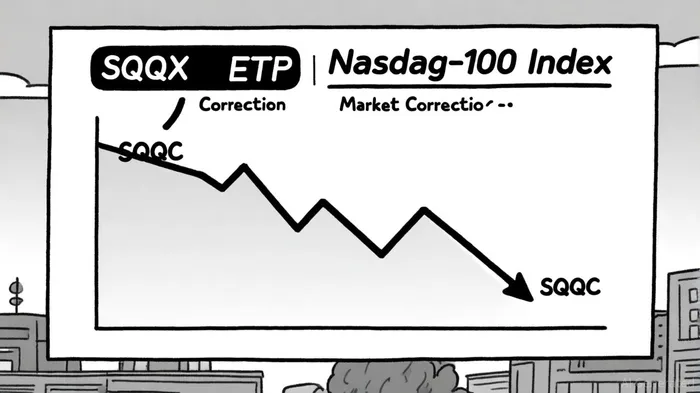
The Mechanics and Risks of SQQQ
SQQQ's triple-leveraged inverse structure amplifies both gains and losses in direct response to daily movements in the Nasdaq-100. For instance, during the 2023 market correction, SQQQSQQQ-- surged as the index plummeted, delivering a -73.61% total return for the year-a reflection of its inverse exposure, per FinanceCharts. Yet, this leverage comes at a cost. Compounding effects over extended periods erode value, as evidenced by its 5-year total return of -96.97% amid the Nasdaq-100's prolonged bull market, according to FinanceCharts. This underscores a critical caveat: SQQQ is not a long-term holding but a precision instrument for short-term tactical use.
Tactical Strategies in Volatile Environments
The key to leveraging SQQQ lies in aligning its deployment with cyclical market signals. Cycle-based trading strategies, such as those employing moving average crossovers (e.g., 2/3 or 3/5-day) and momentum indicators, allow traders to enter positions during rising bearish momentum and exit before reversals, as highlighted in a StockInvest analysis. For example, during the April 2025 market turmoil triggered by trade tensions, SQQQ surged over 30% in a single week, illustrating its potential to capitalize on sharp declines, as StockInvest noted.
Options strategies further enhance SQQQ's utility. Straddles and strangles-combining long calls and puts-can profit from high volatility while mitigating directional risk, a pattern observed in FinanceCharts' performance data. Similarly, dynamic hedging frameworks activated by objective signals (e.g., volatility spikes or earnings cycles) enable investors to protect long portfolios without sacrificing upside potential, according to an AlphaAI analysis. These approaches require active monitoring, as SQQQ's volatility decay and sensitivity to compounding losses demand frequent rebalancing, a point emphasized by StockInvest.
Comparative Effectiveness and Risk Management
While SQQQ offers distinct advantages, its risks must be contextualized. Compared to alternatives like UVIX (a 2x leveraged VIX futures ETF), SQQQ's lower expense ratio (0.95% vs. 2.78%) and tighter correlation to a liquid index (Nasdaq-100 vs. VIX futures) make it more accessible for tactical use, as shown in a PortfolioLab comparison. However, PortfolioLab also highlights UVIX's higher volatility (26.42% annualized vs. SQQQ's 10.53%) and negative Sharpe Ratio (-0.53 vs. SQQQ's -0.87), underscoring the trade-offs between instruments. Diversifying hedging tools-pairing SQQQ with UVIX or cash-secured puts-can mitigate single-instrument risks while preserving flexibility, as PortfolioLab suggests.
The Path Forward: Discipline and Adaptability
The current environment, characterized by mixed technical signals (e.g., SQQQ's recent 10.55% gain on October 10, 2025, juxtaposed with bearish moving average trends), demands a measured approach. Traders must balance short-term opportunities with long-term portfolio goals, recognizing that SQQQ's efficacy is contingent on precise timing. For instance, a "hold" recommendation from analysts reflects the tension between near-term bullish volume patterns and long-term bearish momentum, a nuance covered in the StockInvest analysis.
In conclusion, SQQQ remains a potent tool for navigating Nasdaq-100 volatility, but its strategic value is realized only through disciplined execution. Investors must prioritize risk management frameworks, leverage technical and cycle-based signals, and remain cognizant of compounding decay. As markets continue to oscillate between growth optimism and correctionary pressures, tactical positioning with instruments like SQQQ will be essential for preserving capital and capturing asymmetric returns.





Comentarios
Aún no hay comentarios