
Sprouts Farmers Market (SFM): Assessing Long-Term Growth Amid a Shifting Grocery Landscape
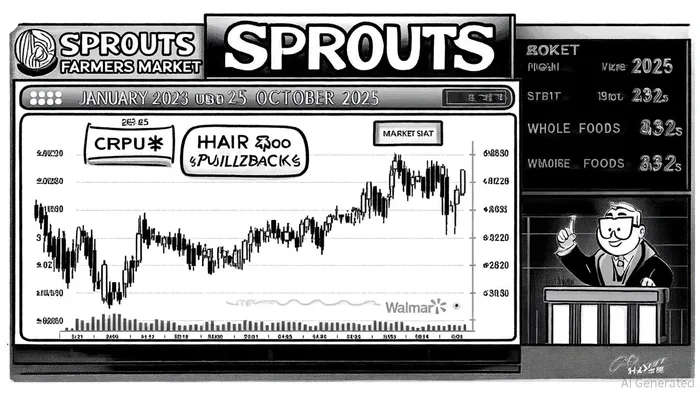
The recent volatility in Sprouts Farmers MarketSFM-- (SFM) shares has sparked debate among investors. After a 25.9% decline in the last 30 days as of October 2025, the stock trades at a stark discount to its intrinsic value, according to a discounted cash flow (DCF) analysis estimating $231.11 per share-a 55.5% gap from its current price of $103.00, based on a Simply Wall St analysis. This disconnect between valuation and fundamentals raises critical questions: Is the market overcorrecting to near-term challenges, or does it reflect legitimate concerns about sustainability? To evaluate SFM's long-term potential, we must dissect its strategic positioning in a rapidly evolving grocery sector, operational resilience, and alignment with enduring consumer trends.
Valuation: A Discounted Opportunity or Overly Optimistic Projections?
SFM's current valuation appears anchored to its fundamentals. Its price-to-earnings (PE) ratio of 21.0x matches industry and peer averages, while a DCF model suggests the stock is undervalued by over 55%, according to Simply Wall St. Analysts back this optimism, with a median price target of $177.21 (72% upside) and a 12-month range of $146–$200, as noted in the Simply Wall St analysis. This optimism is underpinned by projected free cash flow growth, which the Simply Wall St analysis expects to surge to $922 million by 2029. However, the recent 3.7% post-earnings dip, despite beating EPS estimates, signals lingering skepticism about margin pressures from rising supply chain costs and competition, according to a Grocery Doppio report. Historical data on SFM's earnings-beat events from 2022 to 2025 reveals mixed signals: while the average same-day reaction was modest (+0.32%), and no statistically significant outperformance emerged over 30 days, the best relative performance occurred 16 trading days post-event (+4.39%), as observed in the Grocery Doppio analysis. These findings suggest that while earnings surprises may offer short-term optimism, they lack consistency as a standalone investment strategy.
Consumer Trends: Health and Wellness as a Strategic Moat
The grocery sector's pivot toward health-conscious consumption has been a tailwind for Sprouts. In Q2 2025, the company reported a 17% year-over-year sales increase, driven by its focus on high-protein products, no-seed-oil alternatives, and private-label innovation, according to a FoodNavigator-USA article. These offerings cater to a demographic willing to pay premiums for wellness-focused items, with 11.9% higher foot traffic in Q1 2025 compared to traditional supermarkets, as detailed by FoodNavigator-USA. Sprouts' private-label portfolio now accounts for 24% of Q1 sales, leveraging its agility to respond to trends like clean labeling and organic sourcing, per FoodNavigator-USA's coverage.
This strategy differentiates Sprouts from rivals like Walmart, which dominates with low prices but lacks a niche in health-centric products. While Walmart's 31.86% market share dwarfs Sprouts' 2.28%, the latter's 20% pricing advantage over Whole Foods and its focus on underserved regions (e.g., Midwest, Northeast) position it to capture growth in affluent, health-conscious markets, according to a GuruFocus report.
Operational Execution: Scaling E-Commerce and Supply Chain Efficiency
Sprouts' operational strengths are a cornerstone of its growth narrative. Digital commerce now contributes 15% of total sales, up 28% year-over-year, with plans to expand further through a loyalty program launching in late 2025, as reported by Grocery Doppio. The company's self-distribution of fresh meat and seafood-a $73 million capital investment-enhances inventory control and product quality, with full benefits expected by 2026, the Grocery Doppio coverage notes.
Store expansion underscores its ambition: 35 new locations in 2025, bringing the total to 455, and a development pipeline of 120 approved stores, per Grocery Doppio. This physical footprint, combined with a 10.2% comparable store sales growth in Q2 2025, demonstrates its ability to scale without sacrificing operational efficiency, as highlighted by GuruFocus.
Financial Resilience: Free Cash Flow and Prudent Debt Management
SFM's financials reinforce its long-term viability. Free cash flow for the trailing twelve months (TTM) reached $502.5 million, a 104.6% increase from 2024, according to FinanceCharts data. The company ended Q2 2025 with $261 million in cash and no debt on its $700 million revolving credit facility, while recent revisions to its credit terms (expiring in 2030) provide flexibility, as reported by GuruFocus. This liquidity supports its $1 billion share repurchase program, signaling confidence in its undervalued stock, according to the StockAnalysis history.
Net income of $133.7 million in Q2 2025-a 40% year-over-year jump-highlights its profitability, bolstered by a 38.8% gross margin expansion, per GuruFocus. However, challenges persist: e-commerce sales still lag at 2% of total revenue, and its loyalty program remains untested, as noted by GuruFocus.
Risks and Competitive Pressures
Despite its strengths, Sprouts faces headwinds. Walmart's scale and Amazon's 365 brand are intensifying price competition, while discounters like Aldi are gaining traction with value-conscious shoppers, a dynamic outlined by GuruFocus. Additionally, rising input costs and supply chain bottlenecks could erode margins if not offset by pricing power. Analysts like Michael Morris (Evercore ISI) and Thomas Palmer (JP Morgan) have lowered price targets, reflecting caution about macroeconomic uncertainties, according to FoodNavigator-USA.
Investment Outlook: A Case for Strategic Buy-In
Sprouts' alignment with health and wellness trends, operational discipline, and robust free cash flow position it as a compelling long-term play. While short-term volatility is inevitable, the company's expansion plans, digital transformation, and private-label innovation address key growth vectors. At current levels, the stock offers a margin of safety for investors willing to bet on its ability to navigate competitive pressures and capitalize on its niche.





Comentarios
Aún no hay comentarios