
Spot Bitcoin ETFs and the Institutional Inflow Trend: Assessing Market Readiness and Strategic Entry Points for Institutional Capital
Market Readiness: From Niche to Niche to Mainstream
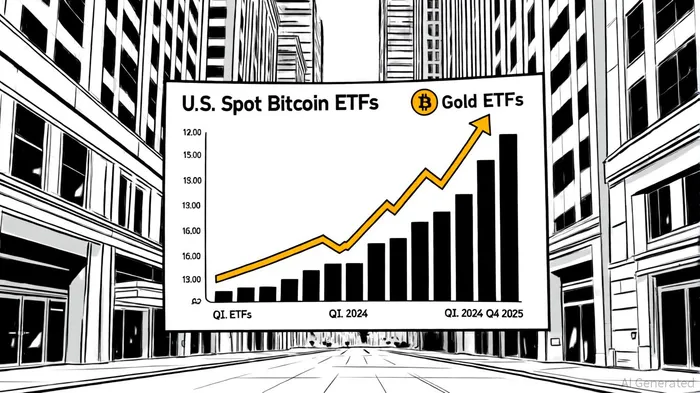
Bitcoin ETFs have evolved from regulatory gray zones to mainstream portfolio tools. The U.S. market alone has seen $25.9 billion in inflows for 2025, with BlackRock's iShares Bitcoin Trust (IBIT) leading the charge, amassing $100 billion in AUM and becoming the fastest-growing ETF in history, according to a TradingNews projection. This growth is underpinned by institutional demand for regulated, custodial solutions that eliminate the complexities of direct Bitcoin ownership. As Fidelity Digital Assets notes, 62% of institutional investors previously hesitated due to regulatory uncertainty, but the SEC's approval of spot ETFs has transformed Bitcoin from a speculative asset into a strategic allocation, according to Kenson Investments analysis.
The Australian market further validates this trend. Monochrome's IBTC ETF, holding 1,101 BTC worth AU$183 million as of October 22, 2025, demonstrates global institutional appetite for regulated crypto exposure, according to a Coinotag report. These funds are not just attracting capital-they are reshaping how institutions perceive Bitcoin's role in hedging against fiat devaluation and inflation, according to a Bitbo prediction.
Strategic Entry Points: Allocation Frameworks and Rebalancing Triggers
Institutions are adopting nuanced strategies to integrate Bitcoin ETFs. Portfolio managers often allocate 1–3% of balanced strategies to these funds, treating them as "hedge" or "alternative" sleeves alongside commodities and real estate, according to Kenson Investments. Larger endowments have even implemented rebalancing triggers: selling Bitcoin ETFs when prices surge and reinvesting during dips to maintain exposure while managing volatility, as noted by Kenson Investments.
The shift from direct Bitcoin treasuries to ETFs underscores this strategic evolution. While corporate Bitcoin holdings plummeted from $2.57 billion in August 2025 to $33.74 million weekly averages by October, ETFs absorbed much of this capital due to their tax efficiency and regulatory clarity, according to an FXStreet analysis. This trend signals a maturing market where institutions prioritize compliance and liquidity over speculative bets.
Regulatory Tailwinds and Future Frontiers
Q4 2025 has been a watershed for regulatory momentum. Bitbo predicts U.S. spot Bitcoin ETF inflows could surpass the $36 billion record set in 2024, driven by firms like Morgan Stanley and UBS now offering client access to these funds, according to Bitbo. The "debasement trade"-a hedge against the U.S. money supply expanding 44% since 2020-has further cemented Bitcoin's appeal, with both gold and Bitcoin outperforming traditional assets this year, Bitbo notes.
Looking ahead, EthereumETH-- ETFs under SEC review and tokenized real estate/credit funds could expand institutional opportunities. Consulting firms are already advising clients on diversified digital sleeves that include Bitcoin, Ethereum, and altcoins once regulatory frameworks expand, according to Kenson Investments.
Conclusion: A Paradigm Shift in Institutional Capital Allocation
Bitcoin ETFs are no longer a niche experiment-they are a cornerstone of modern portfolio theory. With $151.58 billion in AUM and growing, these funds have proven their value in simplifying custody, enhancing liquidity, and aligning with macroeconomic hedges, as reported by TradingNews. For institutions, the strategic entry point lies in balancing exposure through rebalancing triggers, leveraging regulatory clarity, and preparing for the next wave of tokenized assets. The future of institutional capital is digital, and the window to secure a stake is now.





Comentarios
Aún no hay comentarios