
The Splinternet and Its Impact on the Global AI Chip Supply Chain: Identifying Undervalued Semiconductor Firms
The semiconductor industry in 2025 is undergoing a seismic shift driven by the Splinternet-a fragmentation of global technology ecosystems into regional blocs shaped by geopolitical tensions and supply chain decoupling. As nations prioritize self-sufficiency in critical technologies like AI chips, the industry is witnessing a reconfiguration of manufacturing, R&D, and investment strategies. This transformation creates both challenges and opportunities, particularly for undervalued semiconductor firms positioned to capitalize on regionalization and decoupling trends.
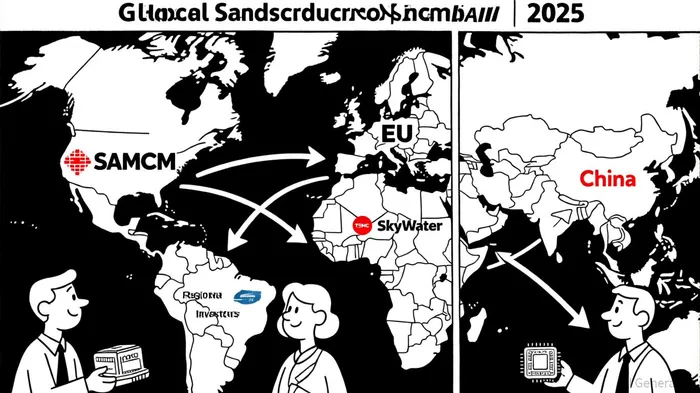
Market Dynamics: Splinternet and Regionalization
The Splinternet has accelerated the bifurcation of the global AI chip supply chain into U.S.-led and China-led blocs, with Europe and Southeast Asia emerging as hybrid hubs. Deloitte's semiconductor outlook projects global semiconductor sales will reach $697 billion in 2025, with AI accelerators driving 23.9% growth in the Logic segment alone. Geopolitical pressures, such as U.S. export controls on advanced chips and China's push for self-reliance, have forced companies to diversify production. For example, the U.S. CHIPS Act and EU Chips Act are allocating $52.7 billion and €43 billion, respectively, to bolster domestic manufacturing, as noted in an Omdia analysis. Meanwhile, firms like TSMCTSM-- and Samsung are expanding in the U.S. and Southeast Asia to access subsidies and mitigate risks, per a Financial Content analysis.
However, regionalization comes with trade-offs. The cost of manufacturing in the U.S. and Europe is 30–50% higher than in Asia, and supply chain delays are common due to extended project timelines (often exceeding 50 months in North America vs. 32 months in East Asia), according to a McKinsey analysis. Despite these hurdles, companies leveraging regional incentives and advanced packaging technologies are gaining traction.
Undervalued Semiconductor Firms: Strategic Positioning and Financial Metrics
1. MACOM Technology Solutions (MTSI)
MACOM is a prime example of a firm capitalizing on regionalization. Specializing in RF and analog chips for 5G and data centers, MACOM has seen its valuation gap widen to 73.1% (intrinsic value: $125/share vs. market price: $72/share), per a Valuesense list. Its strategic acquisitions, such as the 2024 purchase of Analog Devices' RF business, have strengthened its position in edge AI and cloud infrastructure. With the U.S. government prioritizing domestic 5G infrastructure, MACOM's revenue is projected to grow 18% in 2025, according to Analyzestocks.
2. SkyWater Technology (SKYT)
As a U.S.-based foundry, SkyWater benefits from the CHIPS Act's $3.8 billion in subsidies for domestic semiconductor manufacturing. Embedded's overview of the EU Chips Act provides context on similar European measures. Its P/E ratio of 12.3 is significantly lower than industry peers like TSMC (P/E: 28.5), reflecting its undervalued status, per SQ Magazine data. SkyWater's 2025 report shows capital expenditure of $1.2 billion to expand 300mm wafer capacity, as detailed in SkyWater's 2025 report.
3. Amkor Technology (AMKR)
Amkor, a leader in semiconductor packaging and testing, is poised to benefit from the rise of advanced packaging solutions like chiplets and 3D stacking. Industry projections support a 2025 revenue growth of 22% driven by partnerships with TSMC and IntelINTC-- to develop heterogeneous integration technologies, according to a VSE forecast. With a P/E ratio of 14.1 and a valuation gap of 14.5%, Amkor is undervalued relative to its role in enabling AI chip scalability, per Amkor's 2025 report.
4. Alpha and Omega Semiconductor (AOSL)
AOSL's power semiconductors are critical for electric vehicles and renewable energy systems. Its 2025 revenue growth of 16% is fueled by demand in Southeast Asia and India, where governments are incentivizing electrification; AOSL outlines this direction in AOSL's 2025 strategy. AOSL's P/E ratio of 9.8 and a valuation gap of 21.3% highlight its undervalued status, particularly as it diversifies into AI-driven power management solutions, as noted in a Morningstar list.
Strategic Moves and Regional Investments
Undervalued firms are also leveraging geopolitical dynamics through strategic partnerships and regional investments. For example:
- Tower Semiconductor (TSEM) has expanded its 200mm wafer capacity in Israel and Malaysia to serve automotive and industrial clients, avoiding U.S.-China trade tensions, as described in Tower's expansion plans.
- Infineon Technologies is splitting production between Germany and the U.S. to access EU and CHIPS Act subsidies, reducing its reliance on Asian suppliers, per Infineon strategy.
- Rapidus, a Japan-U.S. joint venture, is advancing 2nm process nodes with Intel's support, aiming to challenge TSMC's dominance in advanced manufacturing, according to the Rapidus collaboration.
Risks and Opportunities
While the Splinternet creates opportunities for undervalued firms, risks persist. Tariffs, such as the U.S. 100% import duty on non-domestic chips, could further fragment supply chains, as covered in a Design News analysis. Additionally, startups face challenges in securing advanced manufacturing equipment due to export controls, a concern highlighted in a Daily Breeze article. However, firms with strong regional ties and diversified supply chains-like those highlighted above-are better positioned to navigate these uncertainties.
Conclusion
The Splinternet is reshaping the AI chip supply chain into a mosaic of regional blocs, with undervalued semiconductor firms emerging as key players. Companies like MACOM, SkyWater, and Amkor are leveraging government subsidies, advanced packaging, and strategic diversification to capitalize on this shift. For investors, these firms represent compelling opportunities in a sector poised for $1 trillion in global sales by 2030, according to a GlobeNewswire report. However, success will depend on navigating geopolitical volatility and maintaining agility in a rapidly evolving landscape.





Comentarios
Aún no hay comentarios