
Spirit Airlines' Looming Liquidity Crisis and Strategic Survival Chances
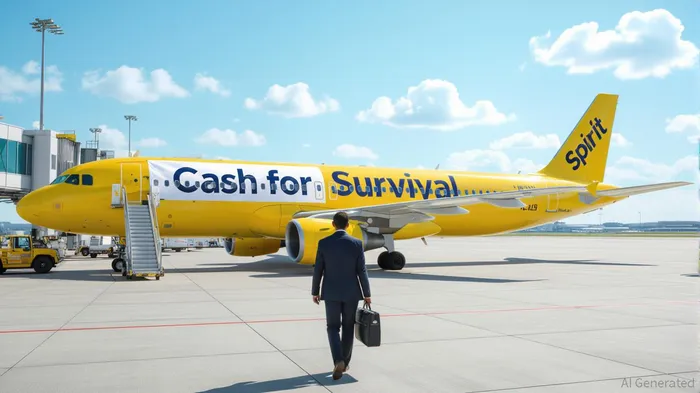
Spirit Airlines, the budget carrier synonymous with yellow planes and bare-bones fares, is teetering on the edge of a liquidity abyss. Just months after emerging from Chapter 11 bankruptcy in March 2025, the airline has issued a stark warning: it may not survive the next 12 months unless it secures a lifeline. The company's Q2 2025 earnings report, released in late July, painted a grim picture of a business struggling to adapt to a post-pandemic world where demand for low-cost leisure travel has faltered. With a net loss of $245.8 million for the quarter—up from $192.9 million in Q2 2024—Spirit's financial health is deteriorating at an alarming rate.
A Debt-Ridden Balance Sheet and Liquidity Constraints
Spirit's debt structure is a labyrinth of secured and unsecured obligations, including $800 million in restructured debt post-bankruptcy, $350 million in new equity, and a $275 million credit line. Yet, these measures have proven insufficient to offset the headwinds. The airline's liquidity is further strained by its reliance on high-interest secured notes, such as the 8.00% Senior Secured Notes due 2025, and a complex web of revolving credit facilities. Its debt agreements now demand rapid liquidity improvements, a challenge compounded by weak revenue from short-haul leisure routes and rising operating costs.
The airline's liquidity crisis is exacerbated by its exposure to Level 3 fair value inputs, which reflect significant uncertainty in valuing its debt instruments. This opacity raises red flags for creditors and investors alike. Spirit's quarterly report explicitly states that it faces “substantial doubt” about its ability to meet minimum liquidity covenants, a warning that could trigger loan defaults and force a return to bankruptcy.
Asset Monetization: A Desperate Gamble
To stave off collapse, Spirit is aggressively pursuing asset sales. The airline has announced plans to monetize non-core assets, including surplus aircraft, airport gates, and real estate. However, the market for these assets is far from favorable. The aviation industry is grappling with oversupply, with BoeingBA-- and Airbus struggling to meet delivery schedules, and airlines operating older, costlier fleets. Selling aircraft at a discount could erode shareholder value, while gate sales might force Spirit to operate from less desirable terminals, further deterring price-sensitive travelers.
The airline's credit card processor has also demanded additional collateral to renew its contract, which expires in late 2025. Spirit's ability to meet this requirement hinges on the success of its asset sales, creating a self-fulfilling risk: if the market for these assets weakens further, the airline's liquidity crisis could spiral out of control.
Operational Restructuring: Cutting Costs, Burning Bridges
Spirit has resorted to drastic cost-cutting measures, including furloughing 270 pilots and demoting 140 others. These actions, while necessary to align expenses with revenue, risk alienating key stakeholders and eroding operational flexibility. The airline's leadership has also shifted, with CEO Dave Davis replacing Ted Christie, who departed with a $4.5 million payout. This instability raises questions about the continuity of Spirit's strategic vision.
The airline's pivot to premium economy class and service upgrades is a double-edged sword. While it aims to attract higher-spending customers, it contradicts Spirit's core identity as a no-frills carrier. Competitors like SouthwestLUV-- and DeltaDAL-- have successfully balanced cost efficiency with service differentiation, but Spirit's thin margins leave little room for error.
Industry Comparisons and Market Realities
The broader U.S. aviation sector offers mixed signals. While international and premium travel segments are rebounding, domestic leisure demand remains weak. Spirit's reliance on the latter makes it particularly vulnerable. Legacy carriers like American and United have cushioned themselves with diversified route networks and premium offerings, but Spirit's narrow focus leaves it exposed to economic shifts.
Ultra-low-cost carriers (ULCCs) such as FrontierULCC-- and Allegiant are also navigating turbulent waters. Frontier's recent 10% capacity reduction and Allegiant's pivot to high-yield routes highlight the sector's fragility. Spirit's attempts to follow suit may not yield the same results, given its weaker balance sheet and brand equity.
Strategic Survival Chances: A Calculated Bet
Spirit's survival hinges on three factors: the success of its asset sales, the effectiveness of its cost-cutting measures, and the trajectory of domestic demand. If the airline can secure $200–300 million from asset monetization and maintain its current cost discipline, it may bridge the liquidity gap until 2026. However, this scenario assumes a stable market environment—a tall order given the looming threat of U.S. tariffs and inflationary pressures.
Investors should also monitor Spirit's ability to renegotiate debt terms. Its post-bankruptcy restructuring eliminated $795 million in obligations, but further concessions from creditors will be critical. A return to Chapter 11 would likely erase shareholder value and deepen operational disruptions.
Investment Implications
For risk-tolerant investors, Spirit's stock offers a high-reward, high-risk proposition. The airline's survival could unlock value in its remaining assets, but the path is fraught with volatility. A more conservative approach would involve shorting the stock or hedging against its downside risk.
In conclusion, Spirit Airlines is a cautionary tale of a business struggling to adapt to a post-pandemic world. Its asset monetization and restructuring efforts are ambitious but precarious. While the airline's survival is possible, it will require a combination of operational discipline, favorable market conditions, and creditor support. For now, the odds remain stacked against it. Investors should proceed with caution, treating Spirit as a speculative bet rather than a core holding.





Comentarios
Aún no hay comentarios