
Spirit Airlines' Financial Turnaround and Strategic Survival: Assessing the Investment Viability of a Distressed Airline in Restructuring
The airline industry has long been a volatile sector, where even well-established players can face existential crises amid shifting market dynamics. Spirit Airlines, the ultra-low-cost carrier that has historically thrived on aggressive cost-cutting and price competition, now finds itself at a critical juncture. As of late 2025, the airline is navigating Chapter 11 bankruptcy proceedings while pursuing a multifaceted restructuring strategy. For investors considering distressed airline investments, Spirit's case offers a compelling case study in the interplay of liquidity management, operational overhauls, and strategic risk.
Financial Fragility and Liquidity Challenges
Spirit's financial struggles have intensified in 2025, with the airline reporting a net loss of $317.5 million for Q3 2025 alone, despite generating $958.5 million in operating revenue. Operating expenses, however, surged to $1.09 billion during the same period, underscoring the widening gap between revenue and costs. The company has repeatedly flagged "substantial doubt" about its ability to continue as a going concern, citing weak leisure demand, domestic capacity imbalances, and persistent losses.
To stave off insolvency, Spirit has accessed $275 million under its revolving credit facility and secured $1.2 billion in debtor-in-possession (DIP) financing, including $475 million in new loans according to reports. A pivotal agreement with aircraft lessor AerCap provided an additional $150 million in liquidity and lease adjustments, reducing operating costs by rejecting leases on 27 aircraft. 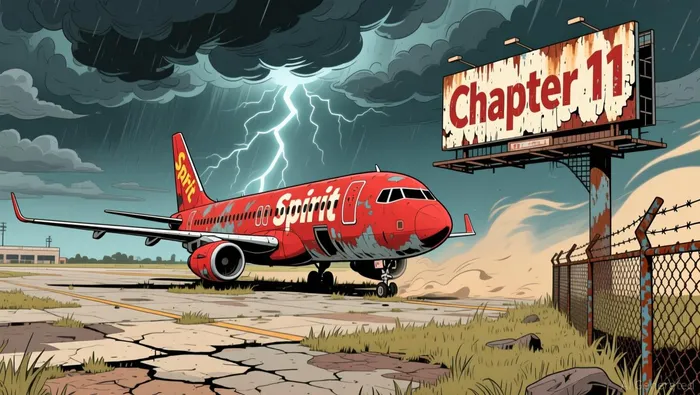 As of September 30, 2025, the airline held $646.6 million in cash and restricted cash but faced $6.7 billion in liabilities under bankruptcy proceedings. These figures highlight a precarious balance sheet, where short-term liquidity is critical to sustaining operations while long-term solvency remains uncertain.
Restructuring Progress: A Mixed Bag of Milestones
Spirit's restructuring efforts have yielded both tangible progress and lingering uncertainties. In December 2025, the airline announced that pilots and flight attendants had ratified new labor agreements, a significant step toward reducing labor costs and stabilizing workforce relations. Earlier in the year, the company secured a $475 million DIP facility, with $120 million immediately accessible, and later added a $100 million financing package, half of which is contingent on further restructuring progress or a strategic transaction.
Cost-cutting measures have included furloughing over 500 pilots and 1,800 flight attendants, selling gates, and trimming routes according to the airline's latest announcement. These actions align with the airline's broader strategy to realign its network and cost structure with current market realities. However, the conditional nature of $50 million in recent financing-tied to the success of a standalone reorganization plan or a potential sale-underscores the fragility of its path forward as reported by industry analysts.
Strategic Uncertainties and Investment Risks
For investors, the key question is whether Spirit's restructuring can generate a viable, sustainable business model. Historical precedents suggest that airline turnarounds often require not only financial discipline but also strategic reinvention. Spirit's reliance on short-term financing and its admission of "substantial doubt" about its survival signal high risk. The airline's focus on ultra-low-cost operations, while historically profitable, may struggle to adapt in a post-pandemic market where consumer preferences and fuel prices remain volatile.
Moreover, the conditional nature of recent funding raises concerns about the airline's ability to meet performance benchmarks. If Spirit fails to finalize a reorganization plan or secure a strategic partner, its liquidity could evaporate, triggering a deeper crisis. The airline's negotiations with creditors and stakeholders will be critical in determining whether it can emerge from bankruptcy with a leaner, more resilient structure.
A Cautious Case for Investment
Despite these risks, Spirit's restructuring efforts present a potential opportunity for investors with a high-risk, high-reward appetite. The airline's aggressive cost-cutting, labor agreements, and DIP financing have created a foundation for operational efficiency. If successful, these measures could position Spirit to regain market share in the ultra-low-cost segment, particularly if broader economic conditions stabilize.
However, the investment case hinges on several key factors: the airline's ability to execute its reorganization plan, the outcome of ongoing negotiations with creditors, and its capacity to adapt to shifting demand patterns. Investors must also weigh the likelihood of a strategic transaction, such as a sale or partnership, which could either catalyze recovery or signal a lack of confidence in the airline's standalone viability according to recent financial disclosures.
Conclusion
Spirit Airlines' journey through bankruptcy and restructuring exemplifies the challenges and opportunities inherent in investing in distressed airlines. While the airline has made measurable progress in securing liquidity and reducing costs, its path to long-term survival remains fraught with uncertainty. For investors, the case underscores the importance of rigorous due diligence, a clear understanding of operational risks, and a willingness to monitor evolving conditions closely. In the end, Spirit's fate may serve as a litmus test for the broader viability of airline restructuring in an increasingly unpredictable industry.







Comentarios
Aún no hay comentarios