
The Spillover Risk of First Brands Bankruptcy on Global Investment Firms
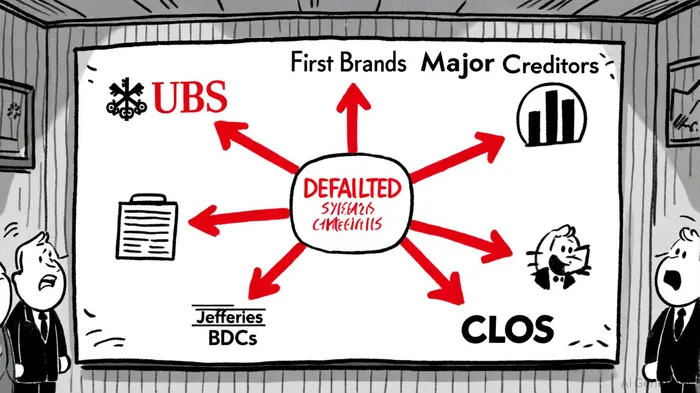
The September 2025 bankruptcy of First Brands Group-a major automotive parts supplier-has exposed critical vulnerabilities in the global financial system, particularly within the private credit and Business Development Company (BDC) sectors. With liabilities estimated between $10 billion and $50 billion against assets valued between $1 billion and $10 billion, the collapse has triggered a cascade of losses for institutional investors, shadow banks, and collateralized loan obligation (CLO) managers. This analysis examines the systemic risks and balance sheet vulnerabilities arising from First Brands' insolvency, drawing on data from Bloomberg, Reuters, and industry reports.
A Perfect Storm of Debt and Opacity
First Brands' financial distress was foreshadowed by a Fitch Ratings downgrade in March 2024, which highlighted unsustainable leverage and a debt-to-EBITDA ratio exceeding 10x, according to a Reuters commentary. The company's aggressive acquisition strategy, funded by opaque financing structures-including off-balance-sheet vehicles, invoice factoring, and inventory-backed facilities-masked its true debt burden until its collapse, as described in a FinancialContent report. By 2025, over $4 billion in shadow debt had been funneled into CLOs, structured products that bundle corporate loans into risk-tranches. This opacity left lenders, including UBSUBS-- and JefferiesJEF--, with incomplete visibility into First Brands' solvency, amplifying the shock of its Chapter 11 filing.
Direct Exposure and Balance Sheet Vulnerabilities
The bankruptcy has hit several global investment firms hard. UBS Group AGUBS--, for instance, faces over $500 million in exposure, with one of its funds emerging as the largest unsecured creditor, according to a Bloomberg Law report. Jefferies Financial GroupJEF-- disclosed a direct hit of $161 million through its Leucadia Asset Management division and Apex Credit Partners LLC. Notably, Jefferies' Point Bonita Capital fund held $715 million in accounts receivables from First Brands, which were abruptly cut off on September 15, 2025 (as reported in the FinancialContent report). Meanwhile, 14 BDCs-including Prospect Capital (PSEC) and Great Elm (GECC)-collectively face $224 million in losses, with individual investments at risk of total write-offs, according to a BDC Reporter article.
Systemic Risks in the Private Credit Market
The fallout from First Brands underscores the fragility of the private credit ecosystem. Over 500 CLOs and shadow banks are indirectly exposed to its debt, which was bundled into tranches with varying risk profiles (as noted in the FinancialContent report). The lack of transparency in these structures means that defaults can propagate rapidly, as seen in the Carnaby Capital Holdings bankruptcy-a First Brands-affiliated financing vehicle that filed for insolvency on September 25, 2025 (also covered by FinancialContent). This event tested the resilience of CLO managers, who now face potential downgrades and liquidity constraints as they reassess the quality of their collateral.
Contagion and the Road Ahead
While First Brands' U.S. operations have secured $500 million in debtor-in-possession (DIP) financing to maintain operations, the broader implications for the financial sector remain dire. The interconnectedness of creditors-from BDCs to global banks-raises concerns about a domino effect, particularly if recovery rates fall below expectations. For instance, BDCs with 75%-100% exposure to First Brands' debt may face margin calls or forced liquidations, further destabilizing the market, as reported by BDC Reporter.
Investors must also consider the regulatory response. The collapse has reignited debates about the oversight of opaque financing structures and the role of non-bank lenders in systemic risk. As noted by a U.S. News article, First Brands' bankruptcy is a "stress test for shadow banks," revealing how diversification can mask concentrated vulnerabilities.
Conclusion
The First Brands bankruptcy is a cautionary tale for the financial sector. It highlights the dangers of excessive leverage, opaque financing, and interconnected credit exposures. For global investment firms, the incident underscores the need for rigorous due diligence and stress-testing of balance sheets. As the restructuring unfolds, market participants must brace for prolonged uncertainty, with ripple effects likely to linger in the private credit and BDC markets for years to come.





Comentarios
Aún no hay comentarios