
Spanning the Impossible: Afcons Infrastructure and the Chenab Bridge's Blueprint for India's Infrastructure Future
The Chenab Railway Bridge, inaugurated by India's Prime Minister Narendra Modi on its completion date of June 6, 2025, is not merely a feat of engineering—it is a declaration of intent. Standing 359 meters above the Chenab River, this steel-and-concrete colossus is now the world's tallest rail bridge, surpassing the Eiffel Tower in height and setting new standards for infrastructure resilience. For Afcons Infrastructure, the project's primary contractor, the bridge is proof of its ascent as a top-tier EPCEPC-- (Engineering, Procurement, and Construction) player capable of delivering projects that defy both geography and geopolitical odds. Here's why this milestone positions Afcons—and India's EPC sector—as pivotal to the nation's developmental ambitions.
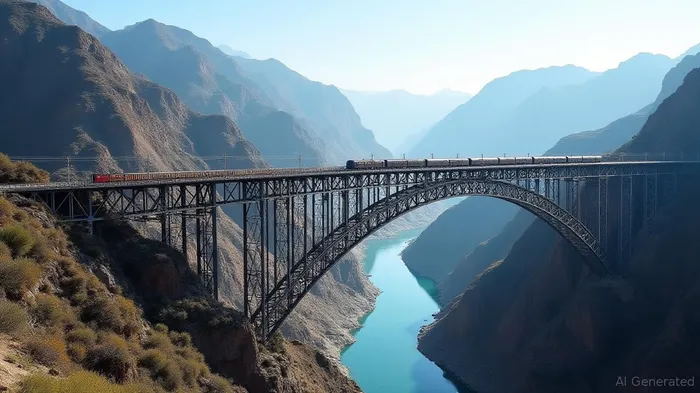
The Engineering Marvel: Resilience Built into Every Bolt
The Chenab Bridge was designed to endure the harshest conditions. Its seismic resistance, engineered for India's Zone-V earthquake zone (capable of withstanding magnitude 8 tremors), and its blast-proof structure (designed to withstand 40 tonnes of TNT equivalent) reflect a deliberate strategy to fortify critical infrastructure in a region prone to both natural disasters and security threats. The bridge's redundant design—ensuring it can operate at 30 km/h even if a pier fails—highlights a forward-thinking approach to risk mitigation.
Technologically, the project pushed boundaries:
- Wind Resistance: Engineered to survive 266 km/h gales using advanced aerodynamic modeling.
- Precision Construction: The first incremental launching of a rail deck on curved spans in India, a globally rare achievement.
- Quality Control: On-site NABL-accredited labs and phased array ultrasonic testing (PAUT) ensured weld integrity, a hallmark of modern industrial rigor.
These innovations are not just technical triumphs—they are proof of Afcons' ability to execute projects that demand exceptional precision, resources, and collaboration. The bridge's 120-year design life underscores its role as a generational asset for India.
Afcons' Strategic Play: From Contractor to EPC Leader
Afcons' success on the Chenab project hinges on its dual strengths: execution in complex environments and strategic alignment with India's priorities. The company, part of the Shapoorji Pallonji Group, leveraged its experience in high-risk, high-stakes projects to navigate the Himalayas' logistical nightmare—remote terrain, energy shortages, and material scarcity. By establishing on-site workshops and deploying the world's largest crossbar cable cranes, Afcons transformed logistical challenges into showcases of adaptive management.
This capability positions Afcons as a go-to partner for India's National Infrastructure Pipeline (NIP), a ₹111 trillion ($1.3 trillion) plan to modernize the country's roads, railways, and energy systems. The Chenab Bridge's inauguration under Modi's watch signals the government's confidence in Afcons' ability to deliver such projects, which are critical to India's economic growth and geopolitical stability.
Afcons' stock has outperformed the broader market since 2022, reflecting investor confidence in its EPC capabilities and project wins like the Chenab Bridge.
The Broader Implications: Why This Matters for Investors
The Chenab Bridge is more than a single project—it is a template for India's infrastructure future. The government's focus on “Make in India” and self-reliance (Atmanirbhar Bharat) aligns with Afcons' strategy of leveraging local resources and partnerships. For investors, the company's expertise in megaprojects with strategic value—whether rail links in conflict zones or renewable energy grids—creates a moat against competitors.
Key catalysts for Afcons' growth:
1. Pipeline of EPC Contracts: With a ₹14.86 billion (US$180 million) success under its belt, Afcons is well-positioned to secure future contracts under the USBRL project and other NIP initiatives.
2. Global Technology Partnerships: Collaborations with firms like WSP and the Indian Institute of Science (IISc) enhance its credibility in cutting-edge projects, from smart cities to defense infrastructure.
3. Resilience as a Competitive Edge: In an era of climate volatility and geopolitical tension, projects like Chenab demonstrate that Afcons can deliver infrastructure that endures both natural and man-made shocks.
Risks and Considerations
No investment is without risk. Challenges such as delays in government approvals, funding gaps for the NIP, and cost overruns on large projects remain concerns. However, Afcons' track record on Chenab—which was completed on time after starting in 2017—suggests it can mitigate these risks through meticulous planning and execution.
The Investment Thesis: A Bridge to Long-Term Growth
Afcons' role in the Chenab Railway Bridge cements its reputation as an EPC leader capable of tackling India's most ambitious projects. For investors seeking exposure to India's infrastructure boom, the company offers a compelling blend of execution excellence and strategic alignment with national priorities.
Recommendation:
- Buy: For investors with a 3–5 year horizon, Afcons presents a strong growth story, especially if the NIP accelerates.
- Hold: For short-term investors, given the cyclical nature of infrastructure projects.
The Chenab Bridge is not just a span over a river—it is a bridge to India's future. Afcons, as its architect, has proven it can engineer that future.
This analysis underscores that in an era of infrastructure nationalism, companies like Afcons are not just building bridges but shaping economies. The Chenab project is a testament to what Indian engineering can achieve—and a sign of what's to come.







Comentarios
Aún no hay comentarios