
Spanish Equities Gain Momentum: Assessing Macroeconomic Catalysts Ahead of October 13 Developments
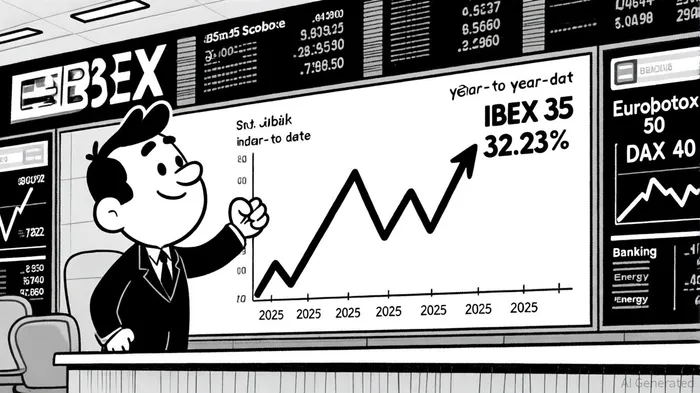
The IBEX 35, Spain's benchmark equity index, has emerged as a standout performer in 2025, surging 32.23% year-to-date and outpacing major European peers like the Eurostoxx 50 and DAX 40. As of October 13, 2025, the index traded at 15,482 points, reflecting a 32.10% gain over the past 12 months despite a minor 0.69% intraday decline from its September 30 peak, according to Trading Economics data. This resilience underscores a confluence of robust domestic fundamentals and strategic sectoral dynamics, even as global macroeconomic uncertainties loom.
Sectoral Drivers: Banking and Energy Fuel the Rally
The IBEX 35's outperformance is anchored by its banking and energy sectors. Financials such as Banco SantanderSAN-- and BBVA have returned billions to shareholders through dividends and buybacks, capitalizing on a low-interest-rate environment and improved credit metrics, according to an XTB note. Meanwhile, Repsol, Spain's energy giant, has benefited from volatile oil prices and a strategic pivot toward renewable energy, contributing significantly to the index's gains, as noted by The Financial Analyst. Energy utilities like Iberdrola and Naturgy have also seen strong demand, driven by Spain's green transition initiatives and EU funding allocations, as reported by Growth Shuttle.
Macroeconomic Fundamentals: A Resilient Domestic Economy
Spain's macroeconomic backdrop remains a critical tailwind. Real GDP growth is projected at 2.6% for 2025, driven by robust domestic consumption and a labor market with unemployment near 9.5%-a decade-low, according to the European Commission forecast. The European Commission attributes this strength to immigration-driven labor force expansion and the phased implementation of the Recovery, Transformation, and Resilience Plan (RTRP), which has unlocked €120 billion in EU funding for green and digital projects, according to an OECD report.
Inflation, which averaged 3.8% in mid-2025, is expected to ease to 1.9% by 2026, supported by falling energy prices and moderated services inflation, according to Caixabank Research. This trajectory has allowed the Banco de España to maintain accommodative monetary policy, with the European Central Bank signaling no rate hikes for the remainder of 2025 in an ECB release.
External Risks: Trade Tensions and Fiscal Constraints
Despite these positives, external risks persist. The U.S. imposition of a 10% tariff on EU goods in April 2025 has introduced uncertainty, though Spain's direct exposure remains limited-exports to the U.S. account for just 1% of GDP, according to a FRBSF analysis. Analysts at Caixabank Research note that while trade fragmentation could dampen investor sentiment, Spain's services-dominated economy offers insulation from export shocks.
Fiscal consolidation is another area of focus. The general government deficit is projected to narrow to 2.8% of GDP in 2025, aided by the phase-out of energy subsidies and higher tax revenues, per the European Commission's forecast. However, public debt remains elevated at 100.9% of GDP, necessitating careful fiscal management to avoid rating agency downgrades, the OECD report warns.
Market Outlook: Balancing Optimism and Caution
Analysts remain cautiously optimistic. UBS's R.E.V.S. ranking highlights Spanish equities as a top European pick, citing undervaluation (a trailing P/E of 12.8 versus the European average of 17.8) and structural growth drivers, according to UBS's R.E.V.S. ranking. However, global macroeconomic models suggest a potential pullback, with the IBEX 35 projected to trade at 15,095 points by year-end and 13,848 in 12 months, according to a Trading Economics projection, reflecting concerns over U.S. monetary policy and trade tensions.
Conclusion: A Strategic Case for Spanish Equities
Spanish equities present a compelling case for investors seeking growth in a risk-on environment. The IBEX 35's outperformance is underpinned by resilient domestic demand, sectoral strength, and favorable monetary conditions. While external risks such as trade tensions and fiscal constraints warrant caution, Spain's structural advantages-including a low valuation multiple and EU funding tailwinds-position it to outperform in the near term. As October 13, 2025, approaches, market participants should monitor ECB policy signals and trade developments for potential catalysts, but the broader narrative of Spain's economic revival remains intact.







Comentarios
Aún no hay comentarios