
Spain's Rising Credit Profile and Its Implications for Equity and Debt Markets
Spain's recent triple credit rating upgrade—from “Baa1” to “A3” by Moody's, and to “A” by Fitch and S&P—marks a pivotal moment in its economic trajectory. These upgrades, driven by robust GDP growth, a resilient labor market, and structural reforms, signal a shift in investor sentiment toward the country. As of September 2025, Spain's economy is projected to expand by 2.6% in 2025, outpacing the eurozone average, while public debt stabilizes at 102% of GDP amid fiscal consolidation efforts [1]. This improved credit profile is not merely a reflection of short-term momentum but a validation of Spain's long-term structural strengths, particularly in sectors poised for transformative growth.
The Economic Underpinnings of the Rating Upgrades
The upgrades hinge on Spain's ability to balance macroeconomic stability with innovation-driven growth. According to a report by Bloomberg, the country's “economic performance has exceeded expectations,” with productivity gains and moderate wage growth offsetting global headwinds like U.S. trade policy shifts [2]. The OECD's Economic Outlook for 2025 underscores this, projecting real GDP growth of 2.4% in 2025 and 1.9% in 2026, fueled by domestic demand and the disbursement of EU Recovery and Resilience Funds [3]. Meanwhile, Spain's unemployment rate has fallen to multi-decade lows, and its tourism sector—resilient despite geopolitical tensions—has rebounded to pre-pandemic levels.
However, the upgrades also reflect a recalibration of risk. Spain's limited exposure to U.S. tariffs and its strategic pivot to green energy and digital infrastructure have insulated it from external shocks. As Fitch noted, the country's “improved external competitiveness” and “robust banking sector” have bolstered confidence, even as political instability persists [1].
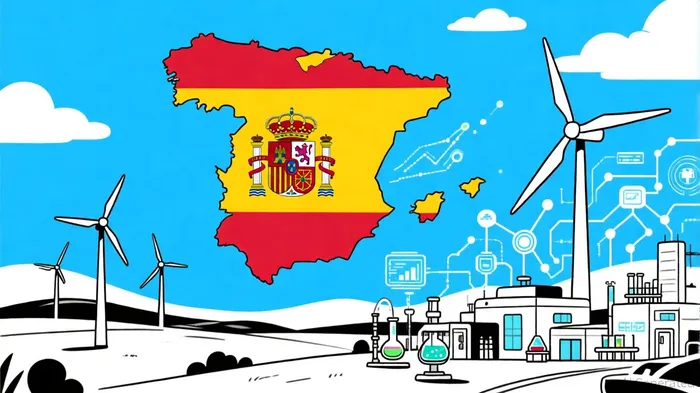
Undervalued Sectors: Renewable Energy, Digital Transformation, and Biotechnology
The credit upgrades are likely to catalyze capital inflows into Spain's equity and debt markets, particularly in sectors that combine structural growth with undervaluation. Three areas stand out:
1. Renewable Energy: A Sector at a P/E Discount
Spain's renewable energy sector, a cornerstone of its decarbonization strategy, is currently trading at a P/E ratio of 12.2x as of September 2025, significantly below its 3-year average of 19.0x [4]. This discount reflects investor skepticism about near-term earnings, despite the sector's long-term potential. The market cap of the renewable energy industry has fluctuated in 2025 but is projected to grow at a compound annual growth rate (CAGR) of 16.25% from 2023 to 2033, driven by solar and wind expansion, green hydrogen production, and energy storage innovations [5].
Government support is critical. Spain's National Integrated Energy and Climate Plan (PNIEC) aims for 74% renewable energy in electricity generation by 2030, with EUR 10 billion allocated to hydrogen projects. For investors, the sector's undervaluation—coupled with policy tailwinds—presents a compelling opportunity.
2. Digital Transformation: A High-Growth, Low-Population Bottleneck
Spain's digital transformation sector is another standout, with market size estimates ranging from €35.29 million to USD 41.62 billion in 2025, growing at a CAGR of 17.95% through 2033 [6]. The sector is being propelled by Extended Reality (XR), IoT, and industrial robotics, as well as government initiatives like the Digital Spain 2026 agenda, which targets 100% digitization of public services.
Despite challenges such as a shortage of digital skills and cybersecurity risks, the sector's growth is underpinned by strong public-private partnerships. For instance, Madrid's investment in 5G infrastructure and AI research hubs has positioned the country as a European leader in digital innovation.
3. Biotechnology: A Quiet Powerhouse with Global Ambitions
Spain's biotechnology sector, though less discussed, is quietly gaining traction. The market size was valued at USD 30.69 billion in 2023 and is projected to reach USD 110.13 billion by 2033, growing at a CAGR of 13.63% [7]. While specific P/E ratios for Spanish biotech firms are scarce, the global biotech industry's P/E ratio of 19.45 as of September 2025 [8] suggests that Spain's sector is undervalued relative to its peers.
The sector's strength lies in R&D investment—Spain's biotech industry spent €1.282 billion on R&D in 2023, with 68% from private sources—and its focus on personalized medicine and biosimilars. Catalonia and Madrid, which account for nearly 48% of the sector's turnover, are emerging as innovation hubs.
Risks and the Road Ahead
While the outlook is positive, risks remain. Spain's public debt, though declining, still sits at 102.3% of GDP, and political fragmentation could delay critical reforms. Additionally, global trade tensions and energy price volatility could disrupt growth. However, the recent credit upgrades and the resilience of Spain's growth model suggest that these risks are manageable.
For investors, the key is to focus on sectors where structural growth and undervaluation align. Renewable energy, digital transformation, and biotechnology offer not only exposure to Spain's economic rebound but also alignment with global megatrends—decarbonization, digitalization, and healthcare innovation. As the OECD notes, Spain's “ability to outperform its European peers” is a testament to its adaptability, and the current market environment offers a rare window to capitalize on its potential [3].







Comentarios
Aún no hay comentarios