
SpaceX's Strategic Land Expansion in Texas and Its Implications for Long-Term Growth: Balancing Aerospace Ambitions with Environmental and Regulatory Challenges
The Trump administration's proposed land exchange with SpaceX in South Texas represents a pivotal moment for the aerospace giant's operational ambitions and the broader U.S. space industry. By acquiring 775 acres of the Lower Rio Grande Valley National Wildlife Refuge in Cameron County, SpaceX aims to expand its rocket launch and production infrastructure, a move that could significantly enhance its capacity to meet global demand for orbital launches according to reports. However, this expansion comes with mounting environmental, regulatory, and reputational risks that investors must carefully evaluate.
Strategic Gains: Accelerating Launch Capabilities and Operational Scale
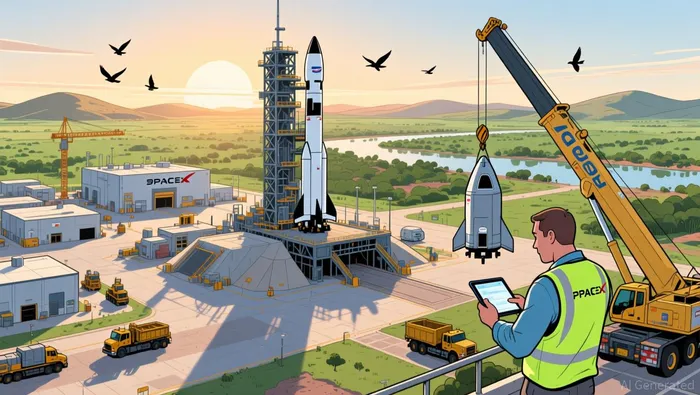
SpaceX's current operations in South Texas, centered at the Boca Chica launch site, have already demonstrated the company's ability to innovate rapidly. The proposed land exchange would grant SpaceX additional land adjacent to its existing facilities, enabling the construction of larger launch pads, expanded manufacturing zones, and improved logistics infrastructure as reported. This expansion aligns with the company's goal of increasing launch frequency-a critical factor in maintaining its 60% share of global orbital launches according to data.
 Government support has been instrumental in SpaceX's growth. The Trump administration's emphasis on "promoting American innovation and economic competitiveness" has facilitated regulatory approvals and legislative wins for the company according to analysis. For instance, recent approvals for increased rocket launches and access to closed beaches underscore the administration's prioritization of SpaceX's operational needs as reported. If finalized, the land exchange would further solidify SpaceX's dominance in the commercial space sector, potentially accelerating its path to profitability and an anticipated initial public offering (IPO) according to market analysis.
Environmental and Regulatory Risks: A Double-Edged Sword
Despite the strategic advantages, the land exchange has sparked significant opposition from environmental groups and conservationists. The Lower Rio Grande Valley National Wildlife Refuge is home to endangered species such as the ocelot and jaguarundi, whose habitats could be disrupted by SpaceX's expanded operations according to reports. Critics also highlight the ecological value of the Palmito Ranch Battlefield, a Civil War-era site at risk of degradation according to analysis.
Regulatory scrutiny remains a key concern. While the Federal Aviation Administration (FAA) issued a in May 2025, environmental advocates argue that the assessment underestimated long-term risks according to reports. A 2024 lawsuit challenging the FAA's environmental review was dismissed, with a federal judge ruling that the agency's decision fell within a "broad zone of reasonableness" according to court records. However, this does not preclude future legal challenges, particularly as SpaceX faces a history of environmental violations. For example, according to monitoring data.
Reputational and Financial Implications for Investors
The reputational risks associated with SpaceX's expansion could have tangible financial consequences. Environmental groups, including the Center for Biological Diversity and the Carrizo/Comecrudo Tribe of Texas, have consistently criticized SpaceX's operations for their impact on coastal ecosystems according to reports. according to ecological studies. Such controversies could erode investor confidence, particularly as (Environmental, Social, and Governance) criteria gain prominence in capital markets.
Moreover, regulatory delays or penalties could disrupt SpaceX's growth trajectory. Rocket launches require meticulous planning, and any operational setbacks-such as those caused by environmental compliance issues-could delay revenue-generating missions. , even minor disruptions could ripple through its financial performance according to financial analysis.
Balancing the Trade-Offs: A Path Forward for Investors
For investors, the key lies in assessing whether SpaceX's strategic gains outweigh its environmental and regulatory risks. The land exchange could unlock significant value by enabling the company to scale its operations and reduce costs through streamlined logistics. However, the long-term sustainability of this growth depends on SpaceX's ability to mitigate ecological harm and maintain regulatory compliance.
The Trump administration's emphasis on "long-term wildlife conservation" suggests a potential compromise, though it remains unclear whether SpaceX will be required to implement specific habitat protection measures according to reports. Investors should monitor developments in this area, including the outcome of pending lawsuits and the FAA's enforcement of environmental safeguards.
In conclusion, SpaceX's Texas land exchange represents a high-stakes gamble. While it positions the company to capitalize on the burgeoning space economy, the associated risks-ecological, regulatory, and reputational-demand rigorous scrutiny. For investors, the challenge will be to balance the promise of aerospace innovation with the realities of environmental stewardship in an increasingly regulated world.







Comentarios
Aún no hay comentarios