
SpaceX's Satellite Supremacy: A Catalyst for the Next Industrial Revolution in Space
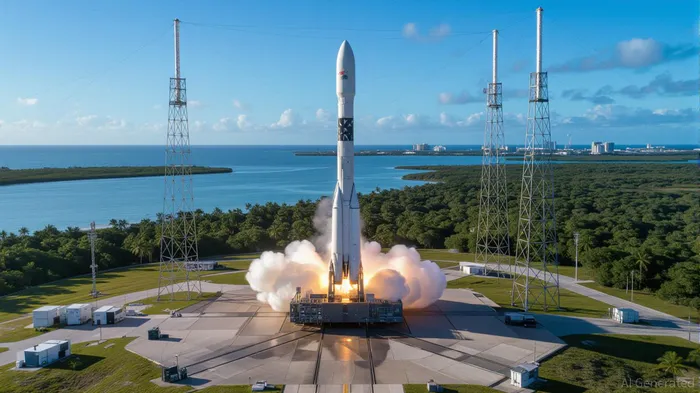
The aerospace industry is undergoing a seismic shift, driven by SpaceX's relentless innovation in satellite deployment. By 2025, the company has cemented its dominance in the global launch market, accounting for 57% of all satellite launches in Q2 2025 and 71% of commercial space revenue. This leadership is not merely a function of scale but a strategic redefinition of infrastructure in the space economy. SpaceX's Falcon 9 rocket, with its 80% cost reduction compared to traditional systems, has democratized access to orbit, enabling a cascade of economic and technological advancements across connectivity, defense, and emerging tech sectors.
The Infrastructure Revolution: Cost, Scale, and Reusability
SpaceX's reusable rocket technology has slashed launch costs from $62 million in 2020 to $12 million in 2025, a metric that underscores its disruptive edge. This efficiency has fueled a 140% increase in launch cadence compared to 2024, with 170 launches projected for 2025. The company's ability to deploy 1,200 satellites annually—far outpacing competitors like Amazon's Project Kuiper and OneWeb—has created a defensible moat in the $1 trillion space economy.
The implications are profound. SpaceX's Starlink V2 Mini satellites, operating at 525–535 km altitude with laser inter-satellite links, now deliver 25ms latency and 95% faster connectivity than traditional systems. This has unlocked a $28 billion market in high-latitude and remote regions, where terrestrial infrastructure is sparse. Investors should note that Starlink's revenue surged to $11.8 billion in 2025, a 53% year-over-year increase, with breakeven EBITDA expected by 2026.
Defense and National Security: A Strategic Partnership Play
SpaceX's expansion into defense is reshaping national security infrastructure. The $3 billion Starshield program, an encrypted variant of Starlink, now supports U.S. military operations in high-latitude and contested environments. By 2025, the U.S. Space Force's MILNET initiative—a hybrid mesh network combining commercial and military satellites—relies on SpaceX's constellation for secure, real-time communication.
The Proliferated Low Earth Orbit (PLEO) Satellite-Based Services program, a $13 billion IDIQ contract, further solidifies SpaceX's role in battlefield support. These contracts, coupled with the deployment of 480+ Starshield satellites, highlight the company's transition from a commercial player to a critical infrastructure provider for global defense. For investors, this diversification into defense contracts offers a buffer against market volatility and underscores long-term revenue stability.
Cascading Effects on Emerging Tech and Telecom
The ripple effects of SpaceX's infrastructure investments are reshaping industries. In telecom, partnerships like T-Mobile's Direct-to-Cell (DTC) service—which allows smartphones to connect directly to Starlink satellites—threaten to disrupt the $1.2 trillion global telecom sector. With 1.8 million testers already enrolled, DTC could redefine connectivity in rural and disaster-stricken areas.
Moreover, SpaceX's laser-linked satellites and quantum inertial navigation systems (tested via the X-37B OTV-8 mission) are pushing the boundaries of 5G convergence and autonomous systems. These advancements position SpaceX as a key enabler for industries ranging from autonomous vehicles to AI-driven logistics.
Investment Implications: A Long-Term Play on Space Infrastructure
For investors, SpaceX's dominance in satellite deployment signals a shift from speculative bets to infrastructure-driven growth. The global space infrastructure market, valued at $148.8 billion in 2024, is projected to reach $307.41 billion by 2032 at a 9.68% CAGR. Key sectors to watch include:
- Aerospace manufacturing: Companies supplying components for reusable rockets and satellites.
- Orbital logistics: Firms enabling satellite maintenance and in-space refueling.
- Defense tech: Providers of secure communication systems and quantum navigation.
However, risks remain. Regulatory challenges, competition from emerging players like Rocket LabRKLB-- and Blue Origin, and the environmental impact of space debris could temper growth. Yet, SpaceX's first-mover advantage, technical superiority, and strategic partnerships with governments and tech giants create a compelling case for long-term investment.
Conclusion: A New Era of Space-Driven Capitalism
SpaceX's infrastructure investments are not just about launching satellites—they are about building the backbone of a new economy. By reducing costs, expanding connectivity, and securing defense contracts, the company is accelerating the commercialization of space. For investors, this represents a rare opportunity to capitalize on a sector poised for exponential growth. As the space economy nears $1 trillion by 2030, those who align with SpaceX's vision of a connected, resilient, and technologically advanced future will find themselves at the forefront of the next industrial revolution.





Comentarios
Aún no hay comentarios