
SpaceX's Rapid Launch Cadence and Its Implications for the Commercial Space Economy
Operational Efficiency: The Falcon 9 Revolution
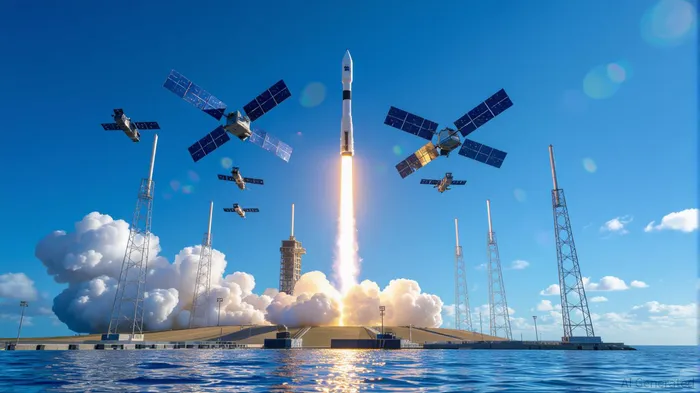
SpaceX's ability to maintain a rapid launch cadence hinges on its mastery of reusability and streamlined production. The Falcon 9's partially reusable design has per Starlink launch, . This efficiency is amplified by SpaceX's Redmond satellite factory, which employs mass production techniques to churn out Starlink V3 satellites at unprecedented rates. By October 2025, , a feat enabled by rapid booster refurbishment and optimized scheduling.
The implications for the broader industry are profound. Traditional satellite operators, constrained by high launch costs and long lead times, now face a paradigm shift. SpaceX's model-where economies of scale and reusability drive down costs-sets a new benchmark, forcing competitors to innovate or risk obsolescence.
Cost Trends and Regulatory Tailwinds
Cost efficiency is not the only driver of SpaceX's success. The company's commitment to orbital sustainability has addressed a critical regulatory hurdle. Starlink V3 satellites are equipped with propulsion systems for autonomous deorbiting, minimizing long-lived debris. This proactive approach aligns with global efforts to manage the growing density of satellites in low Earth orbit (LEO) and has positioned SpaceX as a leader in responsible space operations.
Regulatory bodies, including the (FCC) and international space agencies, are increasingly prioritizing debris mitigation. SpaceX's collaboration with these entities to refine guidelines ensures that its aggressive deployment plans remain compliant, reducing the risk of regulatory pushback. For investors, this means a lower barrier to entry for space infrastructure projects that prioritize sustainability.
Market Growth and Investor Opportunities
The commercial space economy is projected to grow exponentially, , according to market analysis. This growth is fueled by demand for miniaturized, radiation-hardened components critical to LEO constellations and deep-space missions. Key players like Honeywell, Teledyne, and Moog are already capitalizing on this trend, supplying precision motion control systems for satellites and spacecraft.
Investor inflows into the sector reflect this optimism. MDA Space, for instance, , driven by its TelesatTSAT-- Lightspeed and GlobalstarGSAT-- programs according to Q3 2025 results. The company's acquisition of SatixFy Communications and its development of digital beamforming technology highlight the sector's focus on next-gen satellite broadband. Similarly, Leidos' involvement in the Starlab commercial space station.
Strategic Entry Points for Investors
The confluence of technological innovation, cost efficiency, and regulatory alignment makes the current moment a strategic inflection point for space infrastructure investments. Exposure can be gained through:
1. Space Logistics Providers: Companies like Moog and Safran, which supply critical components for satellite and rocket systems.
2. Satellite Broadband Pioneers: Firms such as MDA Space and , advancing AI-driven data availability and LEO connectivity.
3. Next-Gen Aerospace Tech: Startups and established players developing reusable launch systems, orbital servicing, and in-space manufacturing.
However, risks remain. The abrdn Global Infrastructure Fund's underperformance in Q3 2025, partly due to concerns over SpaceX's cellular spectrum acquisition, highlights the sector's volatility. Investors must balance long-term growth potential with short-term headwinds, favoring companies with diversified revenue streams and strong regulatory partnerships.
Conclusion
SpaceX's rapid launch cadence is more than a technical achievement-it is a catalyst for the commercial space economy's next phase. By lowering costs, accelerating deployment, and addressing regulatory challenges, the company has created a foundation for sustained growth in satellite broadband and space logistics. For investors, the message is clear: now is the time to position for a future where space infrastructure is as integral to global connectivity as terrestrial networks.







Comentarios
Aún no hay comentarios