
SpaceX's IPO Potential and Strategic Valuation: A Catalyst for the New Space Economy
The commercial space industry is on the cusp of a transformative era, and SpaceX's anticipated 2026 initial public offering (IPO) looms as a defining event. With a projected valuation of $1.5 trillion-nearly double its $800 billion secondary offering valuation in 2025-the aerospace giant is positioning itself not just as a disruptor but as the architect of a new economic paradigm in space according to reports. This valuation, if realized, would dwarf even the most ambitious public market debuts in history, reflecting a blend of technological ambition, financial engineering, and strategic foresight.
Valuation and IPO: A High-Stakes Bet on the Future
SpaceX's IPO plans, confirmed by Elon Musk himself, are more than a fundraising exercise; they represent a vote of confidence in the company's ability to monetize its vision of interplanetary travel and space-based infrastructure as Musk stated. The $1.5 trillion valuation is predicated on several factors: a projected revenue surge from $15 billion in 2025 to $22–24 billion in 2026, driven primarily by Starlink's expansion, and the potential to unlock value from nascent ventures like space-based data centers and lunar infrastructure according to Bloomberg.
The path to this valuation has already seen significant milestones. In 2025, SpaceX completed a secondary offering at $800 billion, nearly double its earlier valuation, and initiated an insider share sale to prepare for public market scrutiny according to reports. These moves underscore the company's readiness to transition from private capital to a broader investor base, a critical step for scaling its most ambitious projects, including the Starship rocket and Mars colonization efforts.
Growth Catalysts: Starlink, Starship, and the Space Economy
SpaceX's long-term growth hinges on three pillars: Starlink, Starship, and the broader commercialization of space.
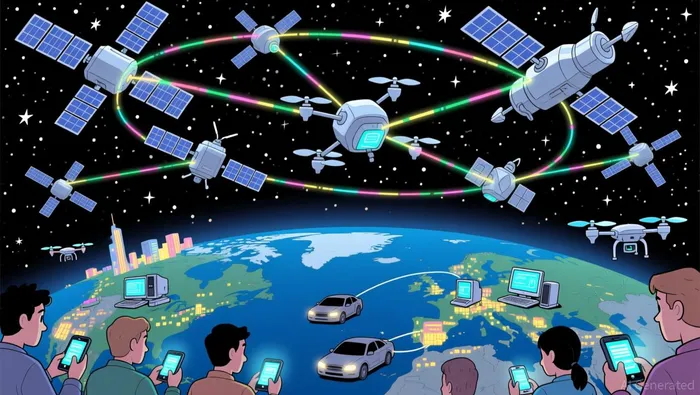
- Starlink as a Cash Engine: The satellite broadband service has already become a financial linchpin. Generating $7.7 billion in 2024 and projected to reach $11.8–12.3 billion in 2025, Starlink's low-latency, high-speed connectivity is expanding into maritime, aviation, and government markets according to SpaceNews. With over 50,000 satellites planned for deployment, the service could eventually generate tens of billions annually, providing a stable revenue stream to fund riskier ventures like Starship.
Starship: The Game Changer: The fully reusable Starship system, currently in development, promises to reduce the cost of space travel by orders of magnitude. By enabling interplanetary missions and large-scale cargo transport, Starship could open new revenue streams in cargo logistics, scientific research, and even space tourism according to SpaceX stock analysis. Its potential to serve as a platform for space-based manufacturing and data centers further amplifies its strategic value.
The Expanding Space Economy: The global space launch services market, valued at $15.2 billion in 2024, is projected to grow at a 14% compound annual rate to $35 billion by 2030. SpaceX's dominance in this sector-accounting for 82% of U.S. commercial launches in 2025-positions it to capture a disproportionate share of this growth. Government contracts, satellite constellations, and lunar exploration initiatives are additional tailwinds.
Competitive Advantages: Why SpaceX Stands Apart
SpaceX's market leadership is underpinned by a combination of technological superiority, operational efficiency, and a vertically integrated business model. Its reusable Falcon 9 rockets have slashed launch costs by 90% compared to traditional systems, enabling high-frequency launches and undercutting competitors like Blue Origin and Rocket Lab according to research. Meanwhile, its culture of rapid iteration and cost-cutting-exemplified by in-house production of critical components-creates a moat difficult for rivals to replicate.
The company's strategic diversification into adjacent markets, such as direct-to-device satellite communication and interplanetary logistics, further cements its dominance. While competitors like Amazon's Project Kuiper and OneWeb focus narrowly on satellite internet, SpaceX is building an ecosystem that spans launch services, broadband, and deep-space infrastructure according to market analysis.
Market Positioning and Industry Implications
SpaceX's IPO could have ripple effects far beyond its own valuation. As noted by Bloomberg, the event may attract institutional investors to the space sector, accelerating innovation and investment in emerging ventures according to Bloomberg. The proposed $30+ billion fundraising, whether through a traditional IPO or Bill Ackman's unconventional merger with Pershing Square SPARC Holdings, would provide SpaceX with capital to scale its operations while offering Tesla shareholders a stake in the aerospace giant-a move Musk has endorsed according to financial reports.
However, the $1.5 trillion valuation is not without risks. The commercial space industry remains unproven at scale, and regulatory hurdles, technical delays, or market saturation could temper expectations. Yet, given SpaceX's track record of defying skeptics-from reusable rockets to Mars ambitions-the company's IPO appears less like a gamble and more like an inevitability.
Conclusion: A New Frontier for Capital and Innovation
SpaceX's IPO is not merely a financial milestone but a harbinger of the space economy's maturation. By leveraging its technological edge, strategic diversification, and the explosive growth of the commercial space sector, the company is poised to redefine what is possible-and profitable-in orbit and beyond. For investors, the question is no longer if SpaceX will go public, but how its valuation will reshape the landscape of global capital markets.







Comentarios
Aún no hay comentarios