
SpaceX's 2026 IPO: A Game-Changer for the Space Economy and AI-Driven Growth
The anticipated 2026 initial public offering (IPO) of SpaceX, Elon Musk's aerospace and satellite company, has ignited significant speculation about its potential to redefine the space economy and catalyze AI-driven technological innovation. With a projected valuation of $1.5 trillion-nearly double that of Apple at its peak-and a fundraising target of $30 billion, the offering could become the largest in history. For long-term investors, the IPO represents not just a bet on a single company but a strategic play on the convergence of space infrastructure, artificial intelligence (AI), and the next frontier of global data processing.
Strategic Implications: From Rocket Science to Orbital Infrastructure
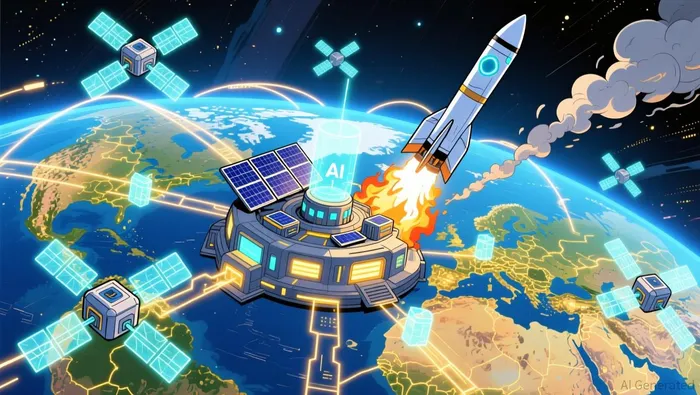
SpaceX's IPO is poised to cement its role as a cornerstone of the emerging space economy. Traditionally viewed as a rocket manufacturer, the company is now positioning itself as a provider of orbital infrastructure, akin to cloud computing giants like Amazon Web Services or Microsoft Azure. This shift is driven by its Starlink satellite-internet service, which generated $15 billion in revenue in 2025 and is projected to reach $22–$24 billion in 2026. Beyond connectivity, SpaceX aims to leverage its satellite network for space-based data centers, a concept Musk has described as "the next logical step in computing infrastructure".
 The strategic rationale for the IPO extends beyond financial goals. By going public, SpaceX seeks to accelerate its dominance in space exploration, including lunar operations and Mars colonization efforts, which analysts argue could unlock trillions in value over decades. The company's ability to reduce launch costs-Musk projects $10–$20 per kilogram-further strengthens its competitive edge, enabling scalable deployment of satellites and orbital assets.
Financial Projections: A High-Stakes Bet on Growth
The IPO's valuation hinges on SpaceX's ability to deliver outsized revenue growth. Starlink remains the primary driver, with its global internet service expanding into rural and underserved markets. However, the company's long-term financial health will depend on its success in monetizing AI and space-based data centers. According to a report by , SpaceX plans to allocate a significant portion of its IPO proceeds to developing orbital computing infrastructure, which Musk envisions as a $100-gigawatt-per-year AI power source.
Critics question whether such a valuation is justified, given the technical and regulatory hurdles of space-based data centers. Yet, proponents argue that SpaceX's track record of innovation-such as reusable rockets and rapid satellite deployment-positions it to overcome these challenges. The IPO's success will also depend on macroeconomic factors, including interest rates and investor appetite for high-growth tech stocks, which have fluctuated in recent years.
Technological Innovations: AI in Orbit and Solar-Powered Computing
SpaceX's technological ambitions are as audacious as its financial targets. The company's Starlink V3 satellites, set for deployment in 2026, will feature terabit-class data processing capabilities and high-speed laser links, enabling real-time orbital computing. These satellites could form the backbone of space-based data centers, which Musk claims will outperform terrestrial facilities by leveraging 24/7 solar power and avoiding energy and cooling costs.
The integration of AI into this infrastructure is a game-changer. By 2026, SpaceX aims to use its orbital network for AI training and machine learning operations, a move that could reduce latency and enhance data security for clients ranging from governments to enterprises. Competitors like Blue Origin and Google are also exploring space-based AI, but SpaceX's first-mover advantage and cost efficiencies give it a distinct edge.
Risks and Challenges: Technical, Regulatory, and Market
Despite its bold vision, SpaceX's IPO faces significant risks. Technically, deploying and maintaining data centers in the harsh environment of space remains unproven at scale. Skeptics highlight the high costs of satellite manufacturing, launch logistics, and radiation shielding as potential roadblocks. Regulatory challenges, including spectrum allocation and international space law, could also delay timelines.
From a market perspective, the $1.5 trillion valuation assumes sustained demand for Starlink and space-based AI services, which may not materialize as quickly as projected. Additionally, the IPO's timing-amid a broader economic slowdown-could impact investor confidence.
Conclusion: A Pivotal Moment for Investors
SpaceX's 2026 IPO is more than a financial event; it is a signal of the space economy's maturation and the growing intersection of AI and orbital infrastructure. For long-term investors, the offering presents an opportunity to participate in a company that is redefining the boundaries of technology and commerce. However, the risks are substantial, and success will depend on SpaceX's ability to execute its ambitious plans while navigating technical, regulatory, and market uncertainties.
As Musk himself has stated, "The future belongs to those who can build it." For SpaceX, the IPO is a step toward building a future where space is not just a frontier for exploration but a foundation for global innovation.







Comentarios
Aún no hay comentarios