
SpaceX's $1.5 Trillion Valuation: A New Era in Aerospace Commercialization and Wall Street's Readiness for Space Infrastructure Investing
The aerospace industry is on the cusp of a transformative shift, driven by SpaceX's audacious $1.5 trillion valuation target and a broader maturation of the commercial space economy. As the company prepares for a 2026 IPO, its valuation-nearly double that of Saudi Aramco's historic 2019 offering-reflects not just SpaceX's dominance in orbital infrastructure but also a seismic shift in how Wall Street perceives the economic potential of space. This valuation, if realized, would position SpaceX among the top 10 most valuable companies globally, signaling a paradigm shift in aerospace commercialization and investor sentiment.
SpaceX's Valuation Drivers: Starlink, Starship, and Space-Based Innovation
At the core of SpaceX's valuation is its control of 65% of all satellites in orbit, a testament to the rapid expansion of its Starlink satellite internet network. With over 8 million active subscribers and an annualized revenue run rate of $12–15 billion, Starlink has become a cash-generating engine, extending into aviation, maritime, and government markets. Analysts highlight that Starlink's ability to monetize remote connectivity-once a niche use case-has redefined the economics of satellite infrastructure, creating a scalable business model.
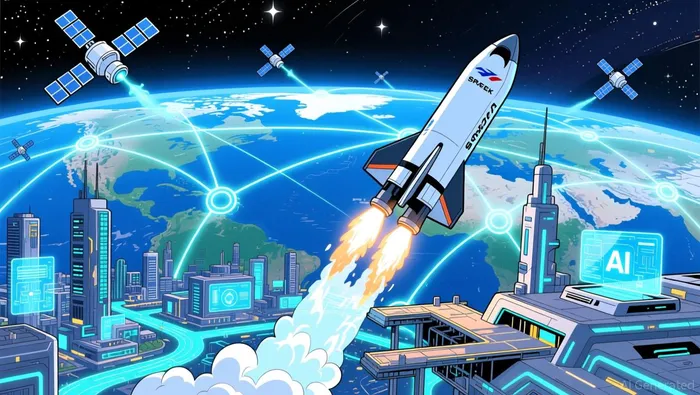
Equally pivotal is SpaceX's development of the Starship rocket system, which promises to reduce the cost of deep-space missions and enable large-scale infrastructure deployment. Coupled with plans for space-based data centers capable of running advanced AI systems, SpaceX is positioning itself as a foundational player in the next phase of global information processing. These innovations align with Morgan Stanley's projection that the global space industry, currently valued at $350 billion, could expand to over $1 trillion by 2040.
Market Trends Fueling Space Infrastructure Investment
The surge in SpaceX's valuation is not an isolated phenomenon but part of a broader trend of capital inflows into space infrastructure. Global investments in core space infrastructure hit a five-quarter high of $4.4 billion in Q3 2025, driven by U.S. satellite manufacturing and Chinese launch industry advancements. Defense contracts, such as the Pentagon's Golden Dome initiative, are further accelerating investment, with companies like Apex securing $200 million to scale satellite production for national security and commercial applications.
The launch sector, historically a capital-intensive segment, has seen costs plummet by 97% since the mid-2000s, making commercial ventures more viable. This cost reduction, combined with SpaceX's reusable rocket technology, has democratized access to orbit, attracting both institutional and private capital. Meanwhile, U.S. late-stage venture capital investments in space-related ventures surged to 41% of all deals in 2025-the highest in a decade-indicating growing confidence in the sector's scalability.
Investor Sentiment: Aerospace and Defense in Sync
Investor appetite for aerospace and defense has strengthened in 2025, fueled by both commercial and geopolitical factors. In the commercial aerospace segment, easing supply chain bottlenecks have enabled OEMs like Airbus and Boeing to increase production rates, while orderbooks remain at record levels. Aerospace and defense company valuations have risen 24% year-to-date, reflecting optimism about long-term demand.
The defense sector, meanwhile, has seen a dramatic shift due to global instability. European defense valuations surged 87% year-to-date, driven by the war in Ukraine and a rearmament cycle. The U.S. defense budget increased by 13.4% in 2025, part of a global trend prioritizing security. Private equity firms are capitalizing on this momentum, with increased M&A activity as they divest assets held during the supply chain crisis and acquire mission-critical technologies.
Wall Street's Readiness for Space Investing
The maturing space economy has made Wall Street more receptive to infrastructure investing. SpaceX's potential $1.5 trillion IPO-aimed at raising $30 billion-would not only break records but also serve as a litmus test for institutional confidence in the sector. The IPO's success could catalyze further investment in space-based services, from satellite manufacturing to in-orbit assembly, as firms seek to replicate SpaceX's disruptive model.
Moreover, the rise of dual-use technologies-systems with both commercial and defense applications-has blurred traditional sector boundaries, attracting cross-industry capital. For instance, space-based data centers could serve both civilian AI workloads and military surveillance needs, creating a hybrid market with broad appeal. This convergence is likely to drive further consolidation and innovation, as companies optimize portfolios to align with evolving security and commercial demands.
Conclusion: A Tipping Point for the Space Economy
SpaceX's $1.5 trillion valuation is not merely a corporate milestone but a harbinger of a new economic era. By leveraging Starlink's revenue potential, Starship's cost efficiencies, and space-based AI infrastructure, SpaceX is redefining the value proposition of space. Meanwhile, Wall Street's growing appetite for space infrastructure-bolstered by falling launch costs, geopolitical imperatives, and technological convergence-suggests that the sector is transitioning from speculative frontier to mainstream asset class.
For investors, the key takeaway is clear: the aerospace commercialization wave is accelerating, and SpaceX's IPO could serve as the catalyst that propels the industry into a new stratosphere.







Comentarios
Aún no hay comentarios