
Soybeans Tumble on Doubts Over US-China Trade Progress
The soybean market is in turmoil as escalating U.S.-China trade tensions cast a long shadow over global agricultural trade. U.S. soybean exports to China, once a cornerstone of American agribusiness, have collapsed to 218 million bushels in the first eight months of 2025-a stark 79% drop from 985 million bushels in 2024, according to a Farm Bureau report. This collapse has been driven by China's retaliatory 34% tariff on U.S. soybeans, as detailed in an S&P Global analysis, which has rendered American exports uncompetitive against Brazil and Argentina. Brazil now dominates 70% of China's soybean imports, while U.S. market share has plummeted to 21%, the Farm Bureau report found. The geopolitical rift has not only destabilized U.S. farmers but also reshaped global supply chains, creating both risks and opportunities for investors.
The U.S. Soybean Crisis: A Geopolitical Casualty
U.S. soybean farmers are facing an existential crisis. From January to August 2025, shipments to China hit zero in June and July-the first time since 2004, the Farm Bureau report notes. This void has been filled by Brazil, which exported a record 2.474 billion bushels to China during the same period, according to the S&P Global analysis. The Trump administration's tariffs, coupled with China's infrastructure investments in Brazil (e.g., ports and railways), have entrenched South American dominance, as examined in an AgriNews piece. U.S. farmers, meanwhile, are increasingly reliant on government aid to stay afloat, with many questioning the long-term viability of their operations, a trend highlighted in a Farm Progress commentary.
The U.S. soybean carryout for 2025-26 is projected to hit 956 million bushels, a 500-million-bushel increase from pre-trade-war levels, the Farm Bureau report projects. This oversupply has depressed prices, exacerbating financial strain. As one farmer put it, "The frustration is overwhelming... we feel betrayed by the trade policies that prioritized politics over our livelihoods," the Farm Bureau report quotes.
South America's Rise: A New Soybean Powerhouse
Brazil and Argentina have emerged as the beneficiaries of this trade war. Brazil's 2024-25 production hit 6.15 billion bushels-a 13% surge-bolstered by favorable weather and a weakened real, according to farmDOC Daily. China's August 2025 soybean imports of 12.28 million metric tons were almost entirely sourced from Brazil, Argentina, and Uruguay, farmDOC Daily reports. Argentina, too, has capitalized on reduced export taxes and a 7-million-ton soybean sale to China in 2025, as noted by Farm Progress.
Investment opportunities abound in South American agribusiness. Brazil's record harvest and infrastructure projects (e.g., the Port of Itaqui expansion) are attracting foreign capital. Argentine soybean producers, despite domestic crushing industry challenges noted by S&P Global, are leveraging lower tariffs to boost exports. Commodity funds focused on South American soybean ETFs or logistics firms like Brazil's Rumo Logística (which operates key rail networks) are also gaining traction, according to a Geopolitical Monitor analysis.
Geopolitical Risks: Beyond the Trade War
While South American producers thrive, investors must navigate significant risks. First, trade policy volatility looms large. The U.S.-China trade waiver expires in November 2025, potentially triggering further tariffs or retaliatory measures, the S&P Global analysis warns. Second, environmental concerns are intensifying. South American soybean expansion has been linked to deforestation in the Amazon and Gran Chaco, raising sustainability red flags, the S&P Global analysis also highlights. Third, political instability in Argentina and Brazil-marked by currency fluctuations and policy shifts-could disrupt supply chains, farmDOC Daily cautions.
China's deepening infrastructure investments in South America, such as the Peruvian Chancay port, were detailed in the Geopolitical Monitor analysis; these projects enhance soybean logistics but risk entrenching China's economic influence in the region, potentially complicating U.S. trade strategies.
Strategic Investment Considerations
For investors, the soybean market presents a paradox: high growth potential amid geopolitical uncertainty. Short-term opportunities lie in South American producers and infrastructure firms, while long-term risks demand diversification. Commodity funds with exposure to Brazil's Cargill or Argentina's Louis Dreyfus Company could offer balanced returns. However, investors should also hedge against price volatility by allocating to agricultural commodities with lower geopolitical exposure, such as corn or wheat.
The U.S. soybean sector, though battered, is not without hope. Diversification into alternative markets (e.g., Mexico, Vietnam) and technological innovation in sustainable farming could mitigate long-term risks, the Geopolitical Monitor analysis suggests. Yet, these efforts require time and policy support-resources that remain uncertain in the current political climate.
Conclusion
The soybean market is a microcosm of the broader U.S.-China trade war's cascading effects. While South American producers have seized the moment, the sector's future hinges on geopolitical stability, environmental stewardship, and policy foresight. For investors, the key lies in balancing the allure of high-growth markets with the sobering realities of a fragmented global trade landscape.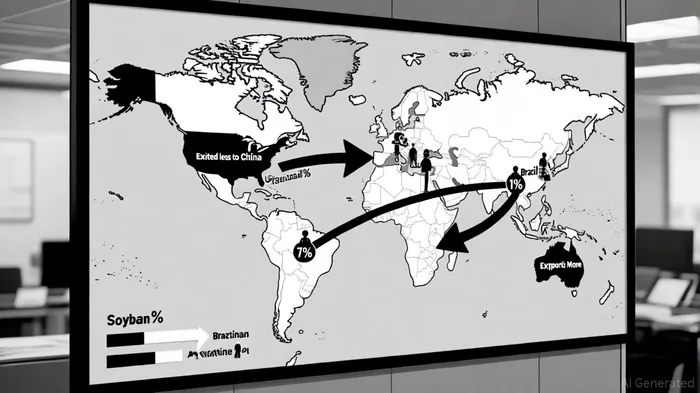







Comentarios
Aún no hay comentarios