
Soybean Market Momentum and Export Demand Drivers in 2026
The global soybean market in 2026 is poised for a period of sustained momentum, driven by a confluence of near-term bullish fundamentals and evolving export demand dynamics. While short-term volatility remains a feature of agricultural markets, the interplay of U.S. export sales trends, China's strategic procurement activity, and projected supply constraints creates a compelling case for continued price strength. This analysis examines these drivers through the lens of USDA data, Chinese import patterns, and production outlooks, offering a roadmap for strategic positioning in soybean futures and related ag commodities.
USDA Export Sales: A Mixed but Resilient Picture
The USDA's weekly export sales report for the 2025/2026 marketing year reveals a nuanced narrative. For the week ending January 1, 2026, net sales totaled 877,900 metric tons, a 26% decline from the prior week and 42% below the four-week average. This dip, however, masks the underlying resilience of demand. China, the largest buyer, accounted for 470,100 MT of sales, underscoring its role as a critical anchor for U.S. soybean exports. Egypt followed with 173,200 MT, reflecting diversification in emerging markets.
Cumulative exports for the 2025/2026 marketing year stand at 1.05 billion bushels, trailing the 1.476 billion bushels recorded at the same point in the prior year. Yet, this gap is narrowing as China's procurement pace accelerates. By January 2026, confirmed U.S. soybean purchases by China had reached 10 million metric tons, aligning with commitments made during the October 2025 trade truce. These purchases, though delayed in shipment, represent forward-looking demand that will materialize in the coming months, providing a tailwind for prices.
China's Strategic Demand: A Structural Shift
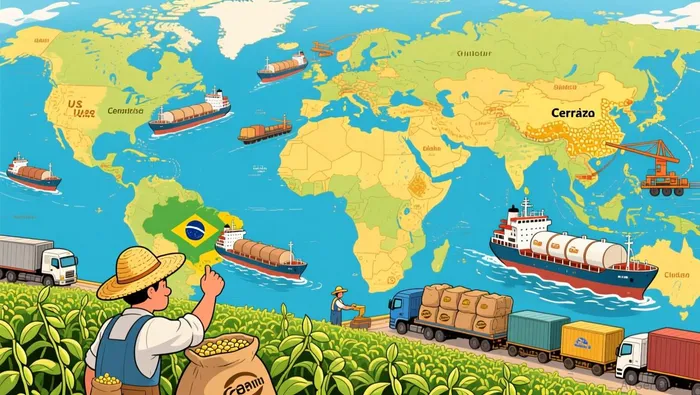 China's soybean import data for 2025 highlights a structural shift in global demand patterns. Total imports for the first 11 months of 2025 surged 6.9% year-on-year to 103.78 MMT, driven by robust purchases from Brazil and the resumption of U.S. soybean imports. November 2025 alone saw a record 8.11 MMT of soybean imports, the highest since 2021, signaling a post-pandemic rebound in processing activity and livestock feed demand.
The U.S. has reemerged as a key supplier, with China's state-owned Sinograin acquiring 8.5–10 MMT of U.S. soybeans since October 2025. While most of these cargoes are yet to arrive, their inclusion in the 2025/2026 marketing year ensures a steady flow of demand into early 2026. This strategic diversification-away from overreliance on Brazil- reflects China's efforts to mitigate trade uncertainties. For U.S. producers, this represents a durable tailwind, as China's procurement commitments are likely to persist beyond 2026.
Production Estimates and Supply Constraints
The USDA's outlook for U.S. soybean production in 2026 introduces a critical supply-side constraint. While specific yield figures remain pending, the agency projects a significant expansion in planted acres, with 85 million acres allocated to soybeans in 2026-a 3.9 million acre increase from 2025. This shift, driven by higher prices and strong export demand, reflects farmers' responsiveness to market signals. However, the conversion of planted acres into actual production hinges on weather conditions and input costs, both of which remain uncertain.
Global supply dynamics further reinforce the bullish case. Brazil, the largest soybean exporter, has already saturated its 2025/2026 export quotas, limiting its ability to offset U.S. supply gaps. Meanwhile, Argentina's production is constrained by policy instability and currency controls. These factors, combined with China's insatiable demand, create a tight global market where U.S. exports are increasingly indispensable.
Strategic Positioning for Investors
For investors, the soybean market in 2026 presents a compelling opportunity. The alignment of strong export demand, constrained global supply, and U.S. production expansion creates a favorable environment for price appreciation. Soybean futures, which have historically reflected these fundamentals, offer a direct play on the sector. Additionally, related ag commodities-such as corn and soybean meal-could benefit from cross-commodity spillovers as demand for livestock feed and biofuels intensifies.
However, risks persist. Weather-related disruptions, geopolitical tensions, and policy shifts could alter the trajectory. Investors should adopt a hedged approach, balancing exposure to soybean futures with diversification into other ag commodities or inflation-protected assets.
Conclusion
The soybean market in 2026 is being shaped by a powerful trifecta: resilient U.S. export sales, China's strategic procurement, and global supply constraints. While short-term fluctuations are inevitable, the near-term fundamentals are firmly bullish. For those attuned to the interplay of these forces, the coming months offer a window of opportunity to capitalize on a market in motion.







Comentarios
Aún no hay comentarios