
Soybean Market Dynamics and Near-Term Price Pressures: Navigating Supply-Demand Imbalances and Trade Policy Shifts
The global soybean market in 2025 is at a crossroads, shaped by record production levels, shifting trade dynamics, and escalating geopolitical tensions. While supply has surged to unprecedented heights, demand growth has lagged, creating a surplus that is pressuring prices. Simultaneously, trade policy shifts—particularly between the U.S. and China—have disrupted long-standing export patterns, further complicating the outlook for farmers, traders, and investors.
Supply-Demand Imbalances: A Surplus-Driven Market
Global soybean production for the 2024/2025 season reached 421 million tons, a 6.6% increase from the previous year, driven by record outputs in Brazil (164 million tons), the U.S. (121 million tons), and Argentina (51.5 million tons) [1]. This surge has outpaced demand, which is projected at 386 million tons for the same period, leaving a surplus that has pushed global soybean stocks to 62 million tons [3]. China, the largest importer, remains a critical player, consuming 128 million tons annually while producing only 20 million tons domestically. However, its reliance on imports has intensified competition among exporters, with Brazil dominating 70% of China's soybean imports [1].
The OECD-FAO Agricultural Outlook forecasts a 1% annual growth in global soybean production over the next decade, underscoring a structural oversupply trend [4]. Meanwhile, the U.S. is shifting acreage from soybeans to corn due to higher profitability, further reducing its competitive edge [1]. Brazil's expansion of planted area by 1.5% to a record high in 2025/26 highlights its growing dominance, while Argentina and Ukraine benefit from favorable weather conditions [4].
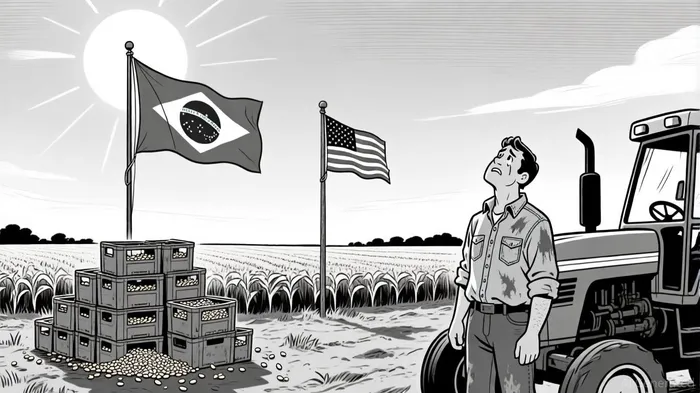
Trade Policy Turbulence: The U.S.-China Trade War's Ripple Effects
The most immediate driver of price volatility in 2025 has been the U.S.-China trade war. China's 34% retaliatory tariffs on U.S. soybeans, imposed in response to American tariffs on Chinese goods, have effectively halted U.S. exports to its largest market [5]. This has redirected Chinese demand to Brazil and Argentina, which have capitalized on lower export taxes and improved logistics. Brazil's September 2025 exports hit 6.75 million metric tons, a 31% increase from the same period in 2024 [1].
The fallout for U.S. farmers has been severe. With prices near $9 per bushel—close to the cost of production—many are operating at a loss. The American Soybean Association has warned of potential billions in losses for the 2025/26 crop year, with key soybean states like Illinois and Iowa facing disproportionate impacts [5]. Meanwhile, China's deepening ties with South American suppliers threaten long-term U.S. market share, which has already fallen from 60% in 2014 to 23% in 2024 [3].
Price Pressures and Market Outlook
Soybean futures have reflected this turbulence, with prices falling to $1,007.34 per bushel on September 10, 2025—a one-and-a-half-week low—despite a 1.57% rise over the past month [1]. Analysts project futures will trade at $1,029.21 per bushel by the end of the quarter, supported by non-Chinese demand and the expectation that China may eventually resume U.S. purchases as Brazilian stocks dwindle [1]. However, near-term pressures persist due to oversupply and trade uncertainty.
Weather risks add another layer of complexity. Drier-than-average conditions in Brazil's southern states and heatwaves in the U.S. Midwest could disrupt yields, while Argentina and Ukraine remain in favorable conditions [4]. Investors must also monitor policy developments, as further tariffs or trade agreements could rapidly shift market sentiment.
Conclusion
The soybean market in 2025 is defined by a fragile balance between oversupply and geopolitical fragility. While Brazil's production boom and logistical advantages have cemented its dominance, U.S. farmers face a precarious outlook amid trade barriers and price compression. For investors, the path forward hinges on two critical factors: the resolution of U.S.-China trade tensions and the ability of producers to adapt to shifting demand patterns. Those who can navigate these dynamics—while hedging against weather and policy risks—may find opportunities in a market poised for transformation.







Comentarios
Aún no hay comentarios