
Soybean Futures Decline Amid Mounting Market Uncertainties: A Strategic Investment Opportunity?
The soybean market has entered a period of heightened volatility, with futures prices hitting their lowest levels since November 2020. A confluence of geopolitical tensions, shifting weather patterns, and evolving trade policies has created a labyrinth of risks and opportunities. While technical indicators hint at potential bullish reversals, fundamental headwinds—such as ample global supply and policy uncertainty—suggest deeper structural challenges. Is this a buying opportunity, or does the decline signal a prolonged downturn? Let's dissect the technical and macroeconomic landscape to find clarity.
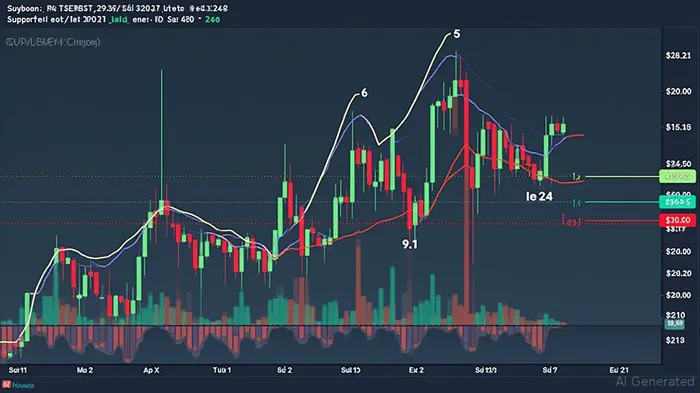
Technical Analysis: Bullish Signals Amid Bearish Momentum
The technical picture for soybean futures (e.g., the June 2025 contract, SN25) is mixed but intriguing. A bullish inverted head & shoulders pattern has formed, suggesting a potential upward breakout if the neckline at $10.80 is cleared. This pattern, however, faces headwinds from a bearish death cross (21-day moving average above the 9-day), which emerged in late May, signaling weakening momentum.
Key Levels to Watch:
- Resistance: $10.80 (April high), $11.00 (psychological threshold). A sustained breakout above $10.80 could ignite a rally toward $11.00.
- Support: $10.20 (critical bearish target), $10.37, and $10.45. A close below $10.20 would confirm bearish dominance.
The MACD and RSI indicators further complicate the picture. While the MACD shows easing bearish momentum, the RSI remains neutral, leaving room for either a rebound or a deeper correction.
Fundamental Drivers: A Delicate Balance of Supply and Demand
The decline in soybean prices is rooted in both structural and cyclical factors:
1. Overwhelming Supply Dynamics
- U.S. Planting Progress: As of June 1, 84% of soybeans were planted, above the five-year average, hinting at a bountiful harvest.
- South American Surpluses: Brazil and Argentina's record-breaking harvests have flooded global markets, with U.S. export share dipping to 26% in 2025/26.
- Global Stocks: The USDA's May WASDE report projects U.S. ending stocks at 295 million bushels—lower than initially feared but still ample to keep prices capped.
2. Trade Tensions and Policy Uncertainty
- U.S.-China Trade: Fluctuating tariffs—ranging from 3% to 125% in 2025—have created a rollercoaster for prices. A recent reduction to 23% in May sparked a temporary rebound, but renewed tariffs could repress prices.
- Biofuel Mandates: EPA's proposed reduction in biomass-based diesel targets threatens soybean oil demand, a key driver of prices.
3. Weather and Geopolitical Risks
- U.S. Weather: Favorable conditions during the critical July–August podPODC-- development period could boost yields, further pressuring prices.
- South America: While current forecasts are benign, any weather disruptions in Brazil or Argentina would tighten supply.
The Crossroads: Opportunity or Structural Weakness?
The question of whether this decline is a buying opportunity hinges on two scenarios:
Scenario 1: Bullish Reversal
- Trigger: A breakout above $10.80 (confirming the inverted head & shoulders) paired with positive news on China tariffs or a stronger biofuel mandate.
- Catalysts: A weaker U.S. dollar, geopolitical instability in oil-producing regions (boosting soybean oil demand), or adverse weather in key production zones.
Scenario 2: Structural Decline
- Trigger: A breakdown below $10.20, signaling capitulation, coupled with continued policy uncertainty and surging global supply.
- Catalysts: Further tariff hikes, EPA's finalized weaker biofuel targets, or a U.S. harvest exceeding expectations.
Tactical Positioning and Risk Management
Traders must navigate these crosscurrents with discipline:
Bullish Play (Long Position):
- Entry: $10.45 (current support), with a stop-loss below $10.20.
- Target: $11.00 (if $10.80 resistance is breached).
- Risk-to-Reward: 1:4 if $10.80 is cleared, but high volatility demands tight stops.
Bearish Play (Short Position):
- Entry: $10.80 (resistance zone), targeting $10.20 or $10.00.
- Stop-Loss: Above $11.00 to account for false breakouts.
- Fundamental Backing: Focused on U.S.-China tariff risks and oversupply dynamics.
Risk Management Tools:
- Micro Futures (MZS): Consider the CME's Micro Soybean Futures (e.g., MZSQ25) for lower capital exposure.
- Options: Sell out-of-the-money puts at $10.00 to capitalize on volatility while limiting downside risk.
Conclusion
Soybean futures sit at a pivotal juncture. While technical patterns suggest a potential rebound, the market remains hostage to macroeconomic and geopolitical tailwinds. For bulls, the $10.80 breakout is a litmus test for sustained optimism. Bears, however, have ample ammunition in oversupply and policy risks.
Investors should treat this as a tactical, not strategic, opportunity. Position sizes must be small, with stops ruthlessly enforced. The soybean market isn't dead—it's merely in hibernation, waiting for a catalyst to awaken it. Monitor the $10.20–$10.80 range closely; it holds the key to this summer's trajectory.
Disclaimer: This analysis is for informational purposes only. Always consult a licensed financial advisor before making investment decisions.







Comentarios
Aún no hay comentarios