
Southwest Airlines' Strategic Shift to Premium Travel: A New Revenue Engine for Investors?
Southwest Airlines (LUV) is undergoing a transformative pivot toward premium travel, betting on airport lounges and co-branded credit card partnerships to unlock new revenue streams and enhance shareholder value. This strategic shift, once unthinkable for the airline synonymous with low-cost, no-frills service, reflects a broader industry trend where premium services and loyalty programs now dominate profitability. But can this pivot deliver sustainable returns for investors, or is SouthwestLUV-- merely playing catch-up to industry leaders like Delta and United?
The Premiumization Playbook
Southwest's foray into premium travel centers on two pillars: airport lounges and credit card partnerships. The airline has secured approval for its first lounge at Honolulu's Daniel K. Inouye International Airport, with a $20 million minimum investment commitment over five years. This lounge, accessible to elite Rapid Rewards members and holders of a new Chase credit card, will offer amenities like dining, showers, and seating-features traditionally reserved for competitors like Delta and United according to lounge expert analysis. CEO Bob Jordan has called lounges a "huge next benefit" for our customers, signaling a departure from Southwest's historical cost-conscious model.
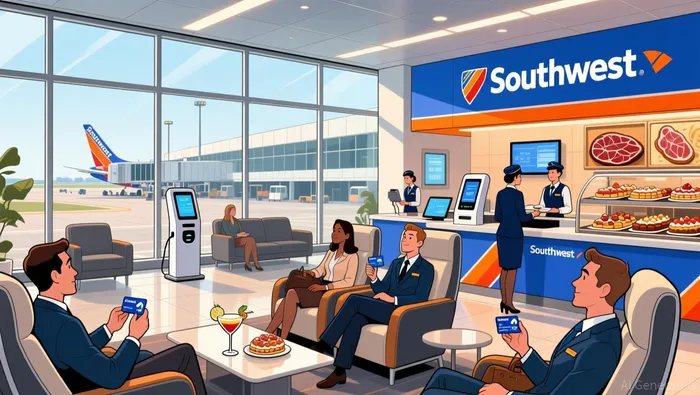 Complementing this is the airline's credit card strategy. By partnering with Chase, Southwest aims to monetize lounge access and loyalty program benefits, mirroring the success of Delta's American Express and United's Chase programs. Early data suggests promise: credit card and loyalty revenue accounted for 21.1% of Southwest's total revenue in 2024, the highest among major U.S. airlines. This is critical for an airline that historically relied on low fares and high volume to generate profits.
Financial Projections and EBIT Impact
Southwest's Q3 2025 results underscored the potential of these initiatives. The airline reported record operating revenue , . However, the company revised its EBIT outlook downward to $500 million in December 2025, citing the U.S. government shutdown and rising fuel costs. Analysts project , driven by assigned seating, extra legroom options, and loyalty program enhancements.
Yet, these projections face headwinds. Delta and United, which have long capitalized on premium cabins and loyalty programs, , respectively. , highlighting the challenges of competing in a market where premium services now account for 43% of Delta's passenger revenue according to industry analysis.
A Tale of Two Models: Southwest vs. Delta/United
The financial disparity between Southwest and its peers underscores the risks of its premiumization strategy. Delta's SkyMiles program generated $7.4 billion in revenue in 2024 (12% of total revenue), . By contrast, Southwest's loyalty program revenue, though robust, lacks the scale of its competitors.
Delta and United have also leveraged premium cabins and international routes to diversify revenue. Delta's premium revenue is projected to exceed main cabin revenue by 2027, while United's premium cabin revenue grew 5.6% year-over-year in Q2 2025 according to earnings data. Southwest, with its single-class seating structure and limited international presence, remains exposed to domestic demand fluctuations.
Risks and Rewards for Investors
The long-term viability of Southwest's strategy hinges on execution. While lounge access and credit card programs could attract high-value travelers, they also risk alienating the budget-conscious customers who have long defined Southwest's brand. As Forbes notes, "Southwest is winning the quarter but losing the brand" by introducing fees for bags and assigned seating. This tension between profitability and brand identity could erode customer loyalty over time.
Moreover, the airline's reliance on credit card revenue introduces volatility. Delta's American Express partnership generated $2 billion in revenue in Q3 2025, but Southwest's Chase program is untested at scale. If the new credit card fails to attract sufficient demand, the $20 million lounge investment could become a drag on margins.
Conclusion: A Calculated Bet
Southwest's premiumization strategy is a calculated bet to capture a share of the high-margin travel market. While the airline's Q3 2025 results and analyst price targets , the path to profitability is fraught with challenges. Delta and United's dominance in premium services and loyalty programs sets a high bar, and Southwest's single-class model may limit its ability to compete on price and service.
For investors, the key question is whether Southwest can execute its transformation without sacrificing its core brand. If successful, the lounge and credit card initiatives could become a new revenue engine, driving EBIT growth and shareholder value. But if the airline falters, it risks becoming a middle-ground player in an industry increasingly defined by premium differentiation.





Comentarios
Aún no hay comentarios