
Southwest Airlines: Strategic Patience and the Path to Value Creation in a Volatile Sector
For investors navigating the volatile airline sector, Southwest AirlinesLUV-- (LUV) presents a compelling case study in balancing strategic patience with disciplined entry points. The company's recent financial performance and transformation initiatives underscore both its resilience and the risks inherent in a demand-sensitive industry.
Valuation Metrics: A Tale of Optimism and Caution
Southwest's market capitalization of $16.985 billion as of October 2025 reflects investor optimism, despite a trailing P/E ratio of 48.49, according to the StockAnalysis financial ratios. This elevated multiple suggests that the market is pricing in significant future earnings growth, a bet that hinges on the success of the airline's transformation initiatives. The forward P/E ratio of 17.69, however, indicates a more tempered view of near-term prospects, aligning with the company's revised EBIT guidance of $600 million to $800 million for 2025, per StockAnalysis.
Debt levels remain a critical factor. With a debt-to-equity ratio of 0.67, Southwest's leverage is moderate compared to peers but still warrants scrutiny, particularly in a high-interest-rate environment, as shown on StockAnalysis. The airline's ability to generate incremental EBIT of $1.8 billion from its 2025 initiatives-such as bag fees and a basic economy product-could alleviate these concerns, provided demand stabilizes, according to Southwest's Q2 press release.
Revenue Trends and Strategic Adjustments
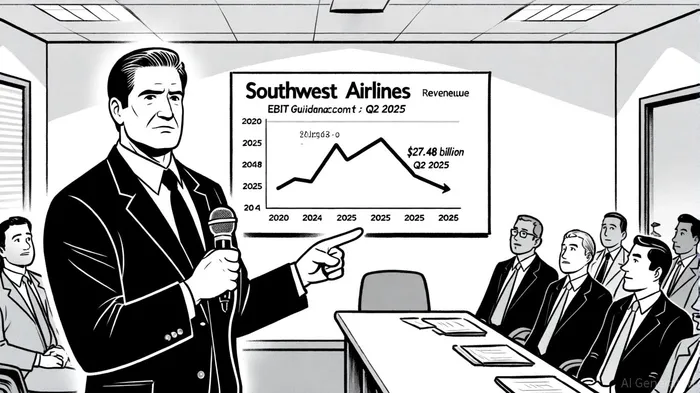
Southwest's revenue growth has been uneven. Full-year 2024 revenue rose 5.34% to $27.48 billion, but Q2 2025 saw a 1.5% year-over-year decline in operating revenues, driven by domestic leisure demand softness and temporary booking challenges post-pricing strategy changes, according to StockAnalysis. The 3.1% drop in revenue per available seat mile (RASM) further highlights operational fragility, as noted in the company's Q2 press release.
Yet the company's strategic pivot to ancillary revenue streams-such as bag fees and tiered pricing-has exceeded expectations, contributing one-third of the targeted $1.8 billion in incremental EBIT by mid-2025, per StockAnalysis. These initiatives, coupled with capacity reductions in the second half of 2025, signal a disciplined approach to aligning supply with demand, according to an AviationSource News article.
Risk-Reward Profile: Navigating Uncertainty
The primary risks for SouthwestLUV-- remain demand volatility and macroeconomic headwinds. Domestic leisure travel, a key revenue driver, has shown signs of stabilization but remains sensitive to broader economic conditions, as the Q2 press release indicates. Operational disruptions from new pricing strategies also pose short-term risks, as evidenced by the Q2 booking challenges.
However, the airline's revised EBIT guidance and confidence in achieving $4.3 billion in incremental EBIT by 2026 suggest a long-term value proposition, based on StockAnalysis data. For patient investors, Southwest's forward P/E ratio of 17.69 offers a margin of safety if the company meets its targets, particularly as the sector recovers from cyclical downturns.
Strategic Entry Points: Timing the Market with Discipline
For investors seeking disciplined entry points, Southwest's Q3 2025 earnings report on October 23-projected at $0.51 EPS and $7.3 billion in revenue-could provide critical insights, according to the MarketBeat earnings page. A miss on these estimates might create a buying opportunity, especially if the market overreacts to short-term challenges. However, historical data from 2022 to 2025 reveals mixed outcomes for LUVLUV-- following earnings misses: five such events yielded an average 1-day return of –0.53% but recovered to +1.46% by day 10, with no statistically significant directional bias over 30 days (Backtest of LUV Earnings Miss Impact, 2022–2025; internal analysis). This suggests that while short-term volatility is possible, the stock's long-term trajectory remains tied to operational execution rather than transient earnings surprises.
Conclusion: A Calculated Bet on Transformation
Southwest Airlines' valuation and risk profile demand a measured approach. While the current P/E ratio reflects optimism, the airline's ability to execute its transformation initiatives and navigate demand fluctuations will determine its long-term success. For investors willing to adopt a patient, data-driven strategy, Southwest's disciplined cost management and revenue diversification efforts could yield substantial rewards-provided they enter at the right inflection point.





Comentarios
Aún no hay comentarios