
Southwest Airlines' Customer Experience Reforms: Balancing Profitability and Brand Loyalty in a Competitive Landscape
Southwest Airlines' recent operational and customer experience reforms have sparked intense debate among investors and industry analysts. As the airline navigates a post-pandemic landscape marked by shifting traveler preferences and rising competition, its strategic pivot toward premiumization and fee-based services raises critical questions about long-term profitability, brand loyalty, and competitive positioning. For investors, the key challenge lies in assessing whether these changes align with Southwest's core identity as a low-cost carrier or risk eroding the trust that has historically defined its success.
Strategic Shifts and Revenue Implications
Southwest's 2023–2025 reforms include the introduction of assigned seating, extra legroom options, and a tiered fare system featuring "Basic" economy tickets and enhanced Business Select offerings according to its customer enhancements page. These moves, coupled with the end of its "Bags Fly Free" policy in May 2025 as reported by investor relations, signal a deliberate shift toward revenue diversification. According to a report by Investing.com, these initiatives could generate incremental annual revenue ranging from $275 million to $1.1 billion. 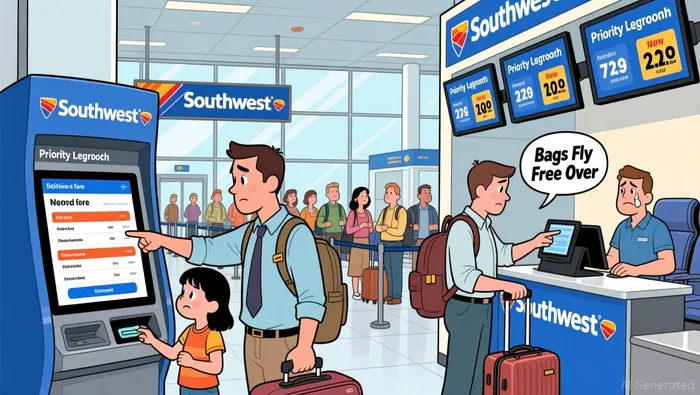 . The airline's third-quarter 2025 results highlighted in investor communications underscored this potential, with record operating revenues of $6.9 billion and reaffirmed EBIT guidance of $600–$800 million for the year.
However, the path to profitability has not been without turbulence. In Q2 2025, passenger revenue dipped by 1.3% year-over-year, and the rollout of basic economy fares temporarily dented bookings. Analysts attribute this to the inherent risk of altering a brand built on simplicity and transparency. As Forbes noted, "Southwest is winning the quarter but losing the brand," highlighting the tension between short-term gains and long-term customer trust.
Brand Loyalty and Customer-Centric Trade-offs
Southwest's historical strength has rested on its customer-friendly policies, including no change fees, open seating, and a no-overbooking approach as documented in industry analysis. The airline's Rapid Rewards program, now offering variable redemption rates and higher points on premium fares, aims to deepen loyalty while capturing value from frequent flyers as outlined in its customer enhancement plan. Yet, the introduction of fees for amenities once considered free-such as checked baggage and seat selection-has drawn criticism. A 2025 industry analysis by Renascence.io emphasized that Southwest's transparent pricing model was a cornerstone of its brand loyalty as highlighted in their customer experience journal, suggesting that recent changes risk alienating price-sensitive travelers.
The airline's response has been to balance these shifts with customer-centric innovations. For instance, Getaways by Southwest™ and enhanced digital tools for baggage tracking and seat selection aim to retain the "Southwest experience" while adapting to market demands as described in its customer enhancements. Additionally, the airline's 98.3% on-time performance rate in 2025 and investments in winter operations underscore its commitment to reliability-a critical factor in maintaining customer trust during transitions.
Competitive Positioning in the Low-Cost Sector
Southwest's reforms reflect a broader industry trend toward premiumization, as competitors like Delta and United introduce similar fee-based models. However, the airline's cost leadership strategy-rooted in fleet standardization and point-to-point routing-remains a differentiator as analyzed by business model experts. Analysts at MatrixBCG argue that Southwest's operational efficiency and customer-centric ethos still position it to outperform rivals in the low-cost segment according to their competitive positioning report. That said, the airline faces dual pressures: competing with ultra-low-cost carriers (ULCCs) like Spirit and Frontier while appealing to premium travelers through new seating and loyalty incentives as noted in a market analysis.
The introduction of assigned seating and premium legroom options, set for January 2026 as announced on its customer enhancements page, aligns SouthwestLUV-- with industry norms but risks diluting its unique value proposition. As Aviation A2Z noted, "Southwest is changing faster than ever," a pace that could either solidify its relevance or fracture its brand identity.
Investor Considerations: Weighing Risks and Rewards
For investors, the critical question is whether Southwest's reforms will sustainably boost margins without sacrificing its customer-centric DNA. The airline's third-quarter 2025 performance-marked by strong revenue execution and reaffirmed EBIT guidance as reported in investor communications-suggests confidence in its transformational strategy. . However, mixed signals persist: while load factors and revenue per available seat mile (RASM) dipped in 2025 according to market analysis, the airline's focus on cost management and strategic partnerships (e.g., with Icelandair and China Airlines as detailed in its customer enhancements) offers long-term upside.
The key risk lies in brand erosion. As Forbes cautions, altering core promises-such as the "Bags Fly Free" policy-could alienate loyal customers and erode the trust that fueled Southwest's rise. Conversely, successful execution of premiumization and loyalty program enhancements could unlock new revenue streams, particularly as leisure travel dominates the post-pandemic recovery as noted in market research.
Conclusion
Southwest Airlines' customer experience reforms represent a calculated gamble to balance profitability and brand loyalty in an evolving industry. While the airline's operational efficiency and strategic investments position it to capitalize on premiumization trends, the long-term success of these changes hinges on maintaining the simplicity and transparency that defined its legacy. For investors, the path forward will require close monitoring of customer sentiment, load factors, and the airline's ability to execute its transformation without compromising its core identity.







Comentarios
Aún no hay comentarios