
South32 Limited's Climate Change Action Plan: Strategic ESG Alignment and Shareholder Value Creation
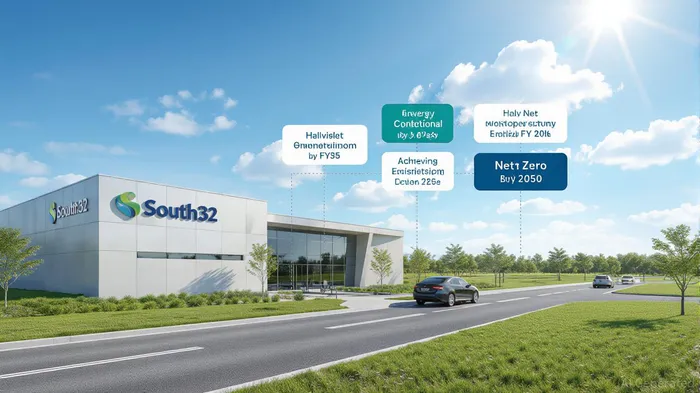
In an era where ESG (Environmental, Social, and Governance) criteria increasingly dictate investment success, South32 Limited's Climate Change Action Plan 2025 emerges as a pivotal strategy to align with global sustainability trends while safeguarding long-term shareholder value. The mining giant's roadmap, which includes ambitious emissions reduction targets and a pivot toward energy transition metals, reflects a calculated response to both regulatory pressures and market demands for decarbonization.
Strategic Alignment with ESG Frameworks
South32's Climate Change Action Plan is explicitly structured to align with international ESG frameworks. The company has committed to achieving net-zero greenhouse gas (GHG) emissions across all scopes (1, 2, and 3) by 2050, with an intermediate target to halve net operational emissions by FY35 from FY21 levels [1]. These goals are evaluated as partially aligned with the 1.5°C trajectory by the Transition Pathway Initiative, though medium-term targets exclude Scope 3 emissions, a limitation noted by stakeholders [4].
The plan's alignment with the Global Reporting Initiative (GRI) Standards is evident in South32's sustainability reporting, which integrates climate-related disclosures with broader ESG metrics [1]. Additionally, the company's participation in Climate Action 100+ underscores its commitment to collaborative climate action, a key criterion for ESG-conscious investors [1]. However, direct alignment with the Paris Agreement remains ambiguously stated in public materials, despite the company's stated ambition to support global decarbonization [2].
Financial Performance and Risk Mitigation
South32's FY25 financial results highlight the interplay between ESG strategy and profitability. Despite an 8% year-over-year revenue decline to US$7.61 billion—primarily due to the divestment of its metallurgical coal business—the company achieved a 7% increase in underlying EBITDA to US$1.93 billion and a 3.5 percentage point margin expansion to 26.3% [2]. This resilience is attributed to cost reductions (down 9.6% to US$5.44 billion) and strategic shifts toward metals critical to the energy transition, such as copper and aluminum, which saw production growth of 20% and 6%, respectively [2].
The company's focus on low-carbon portfolio optimization—divesting high-emission assets and investing in renewable technologies—has also bolstered free cash flow, which turned positive at US$272 million in FY25 [2]. Shareholder returns, including a US$350 million payout in FY25, further demonstrate how ESG-driven operational efficiency can translate into tangible financial benefits [2].
Challenges and Third-Party Perspectives
While South32's Climate Change Action Plan garners praise for its scope and ambition, third-party analyses reveal areas for improvement. The Australian Climate Change Research Centre (ACCR) has criticized the company for delayed prioritization of decarbonization and insufficient quantification of abatement targets at major polluting assets [4]. Additionally, the absence of detailed Scope 3 emissions reduction plans by 2035 raises concerns about the plan's comprehensiveness [4].
Nevertheless, South32's strategic pivot from fossil fuels to energy transition metals has earned support from stakeholders like ACCR, contrasting with peers such as BHPBHP--, which has faced scrutiny for continued fossil fuel expansion [4]. The company's 2025 Annual Report also integrates climate risk disclosures into financial statements, signaling improved transparency and alignment with ESG governance standards [2].
Long-Term Value Creation and Investment Implications
South32's Climate Change Action Plan is not merely a compliance exercise but a strategic lever for long-term value creation. By positioning itself as a supplier of critical minerals for renewable technologies, the company taps into a market expected to grow exponentially as global energy systems decarbonize. This forward-looking approach mitigates exposure to carbon-intensive regulations and capitalizes on demand for sustainable commodities.
For investors, the alignment of South32's ESG strategy with its financial outcomes suggests a robust risk-mitigation framework. However, the company must address gaps in Scope 3 emissions planning and provide more granular data on decarbonization timelines to fully satisfy ESG benchmarks.
Conclusion
South32 Limited's Climate Change Action Plan 2025 represents a strategic and financially prudent response to the dual imperatives of climate action and shareholder value. While challenges remain in achieving full alignment with global ESG frameworks, the company's operational improvements, portfolio transformation, and stakeholder engagement position it as a compelling case study in the mining sector's transition to sustainability. For investors, the key takeaway is clear: ESG integration is not just a regulatory checkbox but a catalyst for enduring profitability in an evolving market.





Comentarios
Aún no hay comentarios