
South Korean Automakers' Strategic Positioning in the US-Japan Trade Deal
The U.S.-Japan trade deal of July 2025, which reduced tariffs on Japanese automotive exports to 15% from a threatened 25%, has reshaped global supply chains and competitive dynamics in the EV and automotive sectors. While Japanese automakers like ToyotaTM-- and HondaHMC-- are leveraging localized production and hybrid technology to mitigate tariff impacts, South Korean automakers—Hyundai and Kia—are charting a distinct path. Their strategies, driven by geopolitical tailwinds and supply chain realignment, position them as formidable contenders in a fragmented global market.
Geopolitical Tailwinds and Strategic Resilience
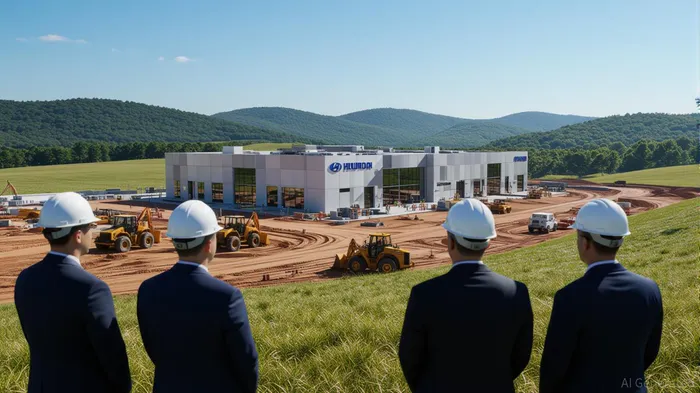
South Korean automakers are navigating a complex geopolitical landscape marked by U.S. protectionism and shifting alliances. The Trump administration's 25% tariffs on South Korean automotive exports, effective August 1, 2025, have forced companies to prioritize U.S. production and diversify supply chains. Hyundai's $21 billion U.S. investment plan, including a $7.6 billion EV plant in Georgia, exemplifies this pivot. By localizing production, Hyundai aims to bypass tariffs and align with the Inflation Reduction Act (IRA), which incentivizes domestic EV manufacturing.
South Korea's government has also played a critical role, offering a 15 trillion won support package to cushion the blow of tariffs. This includes tax cuts, EV subsidies, and liquidity injections, enabling automakers to maintain cost competitiveness. Meanwhile, South Korea's "multi-alignment" foreign policy—balancing U.S. security ties with economic engagement in China and Southeast Asia—has created a buffer against U.S. trade pressures. This geopolitical agility allows South Korean firms to hedge against risks while expanding into high-growth markets.
Supply Chain Realignment and Diversification
The U.S. tariffs have accelerated South Korean automakers' efforts to diversify sourcing and production. Hyundai and Kia are shifting part of their supply chains to Southeast Asia and the Global South, where labor and material costs are lower. For instance, Kia has increased U.S. parts sourcing to 20% of its total, while Hyundai sources 12% locally. This shift not only reduces exposure to tariffs but also strengthens supply chain resilience against geopolitical shocks.
Partnerships with U.S. suppliers are another key strategy. Hyundai's collaboration with LG Energy Solution for battery technology and Kia's integration of local logistics networks highlight their commitment to U.S. market integration. These moves mirror Japanese automakers' strategies but leverage South Korea's strengths in EV innovation and cost efficiency.
The EV Opportunity and Long-Term Positioning
While Japanese automakers focus on hybrid and hydrogen technologies, South Korean companies are capitalizing on the U.S. EV boom. Hyundai's Ioniq series and Kia's EV6 GT have gained traction in the U.S. market, supported by IRA tax credits for domestic production. By 2027, Hyundai aims to produce 1.2 million EVs annually, with 80% sourced from North America. This aligns with global decarbonization trends and positions the company to outperform as EV adoption accelerates.
Moreover, South Korean automakers are expanding into emerging markets. Hyundai's ventures in India and Southeast Asia, where EV demand is surging, offer a counterbalance to U.S. trade uncertainties. This diversification strategy not only reduces reliance on a single market but also taps into growth opportunities in regions with less developed EV infrastructure.
Investment Implications and Risk Mitigation
For investors, South Korean automakers present a compelling case. Their strong balance sheets, localized production, and strategic partnerships mitigate exposure to trade wars. Hyundai's debt-to-equity ratio of 0.3x and Kia's undervalued P/B ratio (1.1x) underscore financial prudence, enabling aggressive R&D and acquisitions.
However, risks persist. Nissan's struggles with EV margins and U.S. tariff litigation outcomes could ripple across the sector. Investors should monitor South Korea's July 31 court ruling on U.S. tariffs and the progress of EV partnerships with Chinese firms.
Conclusion: A Resilient Sector with Long-Term Potential
South Korean automakers are strategically positioned to thrive in a post-U.S.-Japan trade deal era. By leveraging geopolitical flexibility, supply chain diversification, and EV innovation, they are not only surviving tariffs but redefining competitive advantages. For investors, this represents a unique opportunity to capitalize on a sector poised for growth amid global economic and environmental transitions.
The key takeaway is clear: South Korean automakers are not just adapting to the new trade reality—they are leading the charge in reshaping it.





Comentarios
Aún no hay comentarios