
South Korea's Won Stabilization: Implications for FX and Emerging Market Investments
Strategic Interventions and Domestic Priorities
The BOK has held its benchmark interest rate at 2.5% since late 2024, prioritizing household debt management and housing market cooling over aggressive rate hikes to prop up the won. This policy stance underscores a recognition that over-tightening could exacerbate domestic financial fragility. Instead, the government has turned to indirect tools, including collaboration with the state-owned National Pension Service (NPS). Recent reports indicate that the NPS has engaged in foreign exchange operations-selling U.S. dollars and buying won-to counter capital outflows. These measures, while less transparent than direct central bank interventions, aim to stabilize the currency without triggering broader market distortions.

Regional Ripple Effects: Capital Flows and Exchange Rate Dynamics
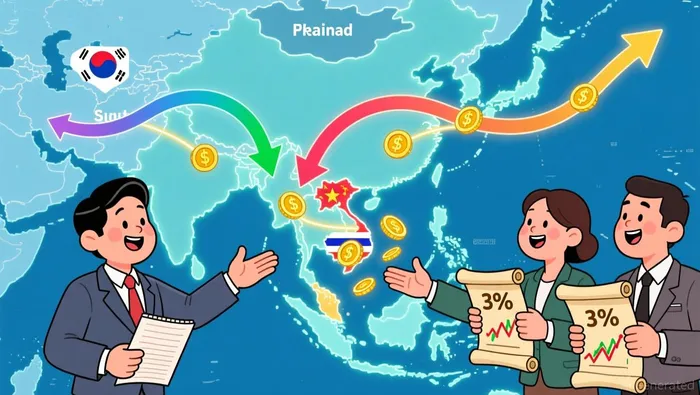
South Korea's interventions are not confined to domestic markets. A 2025 study published in Emerging Markets Review reveals that foreign equity inflows into South Korea can drive a 2.2% rise in the Korean benchmark stock index and a 1.0% appreciation of the won against the dollar. These effects, rooted in the Inelastic Market Hypothesis, suggest that South Korea's currency moves can influence regional capital flows, particularly in larger, more liquid stocks with high foreign ownership. For neighboring emerging markets like Vietnam and Southeast Asian economies, this creates a dual challenge: competing for foreign capital while managing exchange rate volatility triggered by South Korea's stabilization efforts.
The study further notes that South Korean interventions ease domestic short-term treasury rates and improve dollar funding conditions, indirectly affecting covered interest parity deviations in regional markets. For instance, as the won stabilizes, capital may reallocate to other emerging markets perceived as safer or more undervalued, amplifying cross-border flow volatility. Investors in China or Indonesia, where foreign inflows are critical for growth, must now factor in South Korea's role as both a capital source and a potential competitor for global liquidity.
Strategic Considerations for Investors
For FX traders, the won's trajectory hinges on the interplay between the BOK's policy restraint and the NPS's market operations. A key risk lies in the asymmetry of information: while the government has hinted at intervention readiness, the lack of transparency around tools like FX swaps or sterilized interventions complicates predictive modeling. Meanwhile, emerging market investors should monitor how South Korea's actions influence regional capital allocation. The $4.6 billion in equity outflows from Korea this quarter-a portion of which may redirect to Southeast Asia-could temporarily buoy markets in Thailand or Malaysia but also heighten susceptibility to sudden reversals.
Conclusion
South Korea's won stabilization strategy exemplifies the complexities of managing currency pressures in an interconnected global economy. While the BOK's cautious approach prioritizes domestic stability, its interventions-direct and indirect-carry significant spillovers for regional emerging markets. Investors must navigate these dynamics by closely tracking both policy signals and real-time capital flow shifts. As the line between domestic and regional monetary policy blurs, strategic positioning in FX and emerging market equities will require a nuanced understanding of South Korea's evolving role as a stabilizer-and a catalyst.







Comentarios
Aún no hay comentarios