
South Korea's Trade Policy Shifts Amid Leadership Transition: Geopolitical and Economic Implications for Tech and Export-Driven Sectors
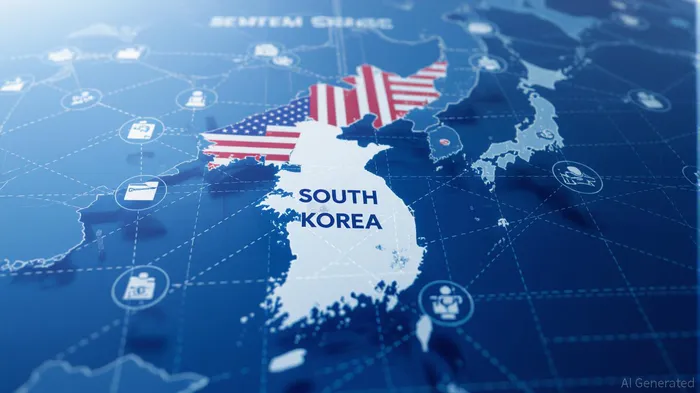
South Korea's political turmoil under President Yoon Suk-yeol has sent ripples through its trade policy landscape, creating uncertainty for tech and export-driven sectors. The abrupt impeachment and arrest of Yoon following his controversial martial law declaration in December 2024 have not only destabilized domestic governance but also disrupted the country's strategic economic and geopolitical positioning. For investors, the fallout underscores the fragility of policy continuity in a nation whose economy relies heavily on global trade and technological innovation.
Political Instability and Trade Policy Uncertainty
Yoon's impeachment marked a turning point in South Korea's trade trajectory. His failed attempt to impose martial law—a move justified as a response to “anti-state” opposition—triggered a constitutional crisis and eroded trust in his administration's ability to manage international relations[1]. This instability coincided with a critical juncture for South Korea's export sectors, particularly semiconductors, automotive, and green technology. The political vacuum created by Yoon's removal has left acting President Han Duck-soo scrambling to address immediate economic risks, including retaliatory U.S. tariffs on South Korean steel and automotive exports[1].
According to a report by The New York Times, Yoon's impeachment has exacerbated concerns about South Korea's capacity to uphold its trade agreements and maintain strategic alliances, particularly with the U.S. and Japan[2]. The U.S. imposed 25% tariffs on South Korean exports in early 2025, citing “unfair trade practices” and security risks linked to Yoon's erratic governance[1]. These tariffs threaten to erode profit margins for tech giants like Samsung and Hyundai, which together account for over 20% of South Korea's total exports[2].
Geopolitical Realignments and Economic Responses
The political chaos has also complicated South Korea's geopolitical balancing act. Yoon's confrontational rhetoric toward the opposition and his ambiguous stance on U.S.-China relations left allies and partners wary. Acting President Han has since pledged to prioritize “stabilizing trade relations” and “rebuilding trust” with key partners[1]. However, the lack of a coherent long-term strategy under interim leadership raises questions about South Korea's ability to navigate shifting global dynamics.
A Carnegie Endowment analysis notes that South Korea's tech sector, already vulnerable to U.S. export controls on advanced semiconductors and AI chips, now faces additional headwinds from political instability[2]. The U.S. has leveraged its economic influence to pressure Seoul into aligning more closely with its “de-risking” agenda, which includes restricting technology transfers to China. Yet, without a stable leadership, South Korea risks falling behind in critical innovation races, particularly in EVs and next-generation batteries, where competition with China and the U.S. is intensifying[2].
Investment Implications for Tech and Export Sectors
For investors, the immediate risks are twofold: regulatory uncertainty and geopolitical volatility. The snap election scheduled for June 2025 will determine whether South Korea adopts a more conciliatory trade policy or doubles down on Yoon's nationalist approach. A pro-business administration could mitigate some of the damage caused by U.S. tariffs, but the current climate suggests prolonged instability.
Data from the Stimson Center highlights that South Korea's export-driven sectors are particularly exposed to policy shifts[2]. For instance, the semiconductor industry, which contributes 15% of South Korea's GDP, faces dual pressures from U.S. tariffs and China's growing self-sufficiency in chip manufacturing. Similarly, the automotive sector, reliant on U.S. and European markets, could see demand erosion if trade tensions escalate further[1].
Conclusion: Navigating a Fragile Transition
South Korea's trade policy is now in a state of flux, shaped more by political chaos than strategic vision. While acting President Han has vowed to address trade tensions, the absence of a clear roadmap leaves investors in limbo. The coming months will test the resilience of South Korea's tech and export sectors, with outcomes hinging on the June election and the new administration's ability to restore international confidence. For now, the message is clear: in a world where geopolitics and economics are inextricably linked, stability is the most valuable currency.







Comentarios
Aún no hay comentarios