
South Korea's Trade Deadline: A Pivot Point for Undervalued Sectors
The July 9 deadline for the U.S.-South Korea trade negotiations has become a make-or-break moment for investors in Asia's fourth-largest economy. With U.S. tariffs threatening to disrupt $100 billion in annual trade, sectors like automotive, steel, and tech face existential risks—or outsized rewards—if a resolution is reached. Here's why the clock is ticking for undervalued stocks and how investors can position for a potential rebound.
Automotive: Hyundai's Pivot to U.S. Manufacturing
The automotive sector is ground zero for the trade clash. Hyundai Motor (005380.KS), South Korea's largest automaker, faces a 25% U.S. tariff threat on its cars and trucks—a move that could slash profits by billions. Yet Hyundai's aggressive localization strategy offers a lifeline.
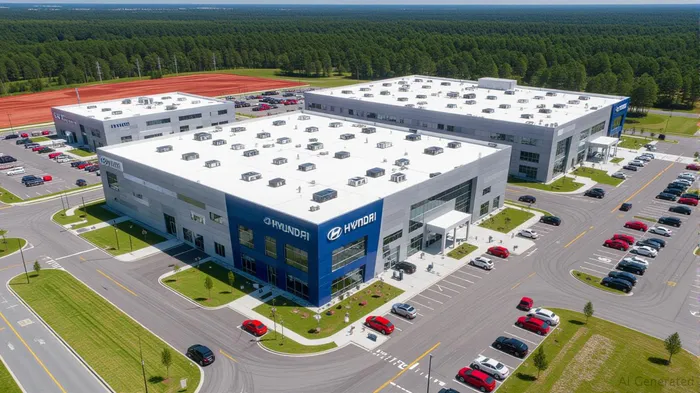
Hyundai has poured $21 billion into U.S. facilities, including an electric vehicle (EV) plant in Georgia and a steel mill to supply its assembly lines. This localization not only aims to dodge tariffs but also aligns with U.S. climate goals. Analysts at KB Securities estimate Hyundai's shares could rise 15–20% if the tariff freeze is extended, with a $80 price target (vs. $68 today).
Kia Motors (000270.KS), while similarly exposed, trades at a smaller market cap and higher risk. Its underperformance reflects investor skepticism about its ability to replicate Hyundai's scale in U.S. manufacturing.
Steel: A $10B Revenue Crossroads
The steel sector is collateral damage in the trade war. A 25% U.S. tariff on steel and 50% on automotive steel could erase $10 billion in annual revenue for Hyundai and Kia. South Korea's $15 billion stimulus package for EVs and auto parts—targeting battery tech and lightweight materials—is a critical lifeline.
The government's push to retool steel production for EVs (e.g., high-strength alloys) could offset demand losses. However, lingering threats from U.S. anti-dumping measures and weak Chinese demand keep pressure on margins.
Tech: Semiconductors as the Diplomatic Bellwether
South Korea's tech giants—Samsung Electronics (005930.KS) and SK Hynix (000660.KS)—are pivotal to resolving the broader trade impasse. U.S. demands for data localization and intellectual property (IP) guarantees remain contentious, but a compromise is emerging.
Samsung's $23 billion U.S. chip plant in Texas and SK Hynix's advanced memory chips (critical for AI and high-performance computing) are key bargaining chips. A 25% tariff on semiconductors would destabilize global supply chains, making a freeze likely.
Analysts see a 20–25% upside for SK Hynix if tariffs are deferred, with its shares trading at a 30% discount to U.S. peers. Samsung's semiconductor division, which accounts for 40% of its profits, could see margin improvements if trade tensions ease.
Diplomacy and Defense: The Wild Cards
While sector-specific strategies matter, geopolitical risks loom. A Trump presidential win in November could reignite tariff threats, while North Korea's nuclear tests add volatility.
The U.S. is also pushing South Korea to raise defense spending to 5% of GDP (from 2.3%), which could strain budgets if agreed. Investors should monitor these talks but prioritize the July 9 deadline—the immediate catalyst.
Investment Strategy: Buy the Dip Before July 9
The calculus is clear: a 90-day tariff freeze extension or partial deal would remove a $100 billion overhang, unlocking undervalued stocks. The KOSPI index lags emerging markets by 8%, offering asymmetric upside.
Top Picks:
1. Hyundai Motor (005380.KS): Buy at $68, target $80. Its U.S. investments and EV shift justify a rebound.
2. Samsung Electronics (005930.KS): Accumulate for EV/EBITDA expansion to 6x, driven by chip demand.
3. SK Hynix (000660.KS): Consider call options targeting $70, hedged by AI-driven memory chip demand.
4. Energy Plays: Hyundai Heavy Industries and Doosan Heavy (down 18% YTD) offer exposure to LNG and SMR projects.
Hedge: Use USD-denominated bonds (e.g., KB Financial Group's 2030 bonds) to offset currency risk if defense talks sour.
Final Take: A Deal Is More Likely Than a Rupture
Despite risks, South Korea's pragmatic diplomacy—such as piloting data localization agreements—suggests a resolution is probable. The July 9 deadline is a binary event: a freeze extension could trigger a 10–15% market rally, while failure risks a synchronized selloff.
Investors should act now: the clock is ticking, and the best opportunities lie in sectors that are already pricing in disaster. The automotive and tech sectors are the clearest beneficiaries of a deal—and the stakes couldn't be higher.







Comentarios
Aún no hay comentarios