
South Korea's Tech Sector Soars on Labor Market Resilience: A Contrarian Play in Semiconductors and AI
South Korea’s unemployment rate dipped to 2.7% in April 2025, marking a five-month low and underscoring the nation’s labor market resilience. This robustness, paired with a 2.7% year-on-year surge in temporary workers to 4.80 million in March, signals a workforce primed to fuel growth in its tech-driven economy. For investors, this dynamic bodes well for semiconductors and AI-driven equities—sectors where South Korea’s tech giants like Samsung (005930.KS) and SK Hynix (000660.KS) are leveraging labor flexibility and global AI demand to outpace rivals.
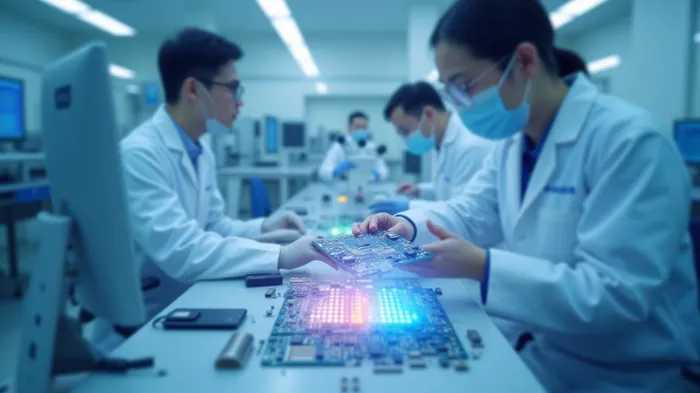
Labor Market Strength: The Unsung Catalyst
South Korea’s temporary workforce expansion isn’t merely a numbers game—it’s a strategic advantage. The 2.7% YoY rise in March 2025 reflects a labor market that’s agile enough to meet surging demand in AI, 5G, and advanced manufacturing. While industries like construction and manufacturing face contraction, the service sector—bolstered by government job-creation programs—added 567,000 jobs year-on-year. This flexibility ensures tech firms can scale without long-term labor commitments, critical as they navigate global AI chip shortages.
Meanwhile, the labor force participation rate hit 64.6% in March, a record high, indicating sustained workforce engagement. A stable and growing labor pool directly supports Samsung’s $17 billion AI chip investment plans and SK Hynix’s push to dominate next-gen memory chips. With unemployment near decade lows, domestic demand remains robust, underpinning corporate revenues and R&D spending.
Semiconductors: The Heart of AI’s Global Hunger
The AI revolution is a semiconductor arms race, and South Korea is winning. The country’s $180 billion semiconductor industry accounts for 19% of global chip production, with Samsung and SK Hynix controlling 80% of the DRAM market. As AI training demands exponential computing power, advanced logic and memory chips—where South Korea excels—are in critical shortage.
Samsung’s 5nm AI chip and SK Hynix’s HBM3E high-bandwidth memory are cornerstones of this shift. Even amid U.S.-China trade tensions, South Korean firms are diversifying supply chains and investing in AI-specific fabrication facilities. The government’s 10-trillion won supplementary budget further targets semiconductor R&D, ensuring South Korea stays ahead of rivals in Taiwan and the U.S.
AI Adoption: A Domestic Growth Engine
Beyond chips, South Korea’s tech ecosystem is AI-ready. The All-Care Platform for Youth Employment, part of the government’s 2025 Livelihoods Plan, is upskilling workers for AI-driven roles. Meanwhile, KT Corporation (030200.KS) and LG Uplus are rolling out AI-powered telecom services, while Naver’s Clova AI platform fuels enterprise adoption.
This domestic AI boom isn’t just tech-centric—it’s consumer-facing. From autonomous vehicles to smart cities, AI integration is boosting productivity and creating new revenue streams. With a labor force already adapting to tech shifts, South Korea’s equity markets are pricing in this transition. The Kospi Semiconductor Index (KSQ1005) has outperformed global benchmarks by 15% YTD, signaling investor confidence.
Why This is a Contrarian Play
Bearish sentiment lingers over global trade wars and South Korea’s reliance on exports. Yet, three factors make this a contrarian opportunity:
1. Labor-Driven Stability: A 2.7% unemployment rate and 4.8 million temporary workers provide a buffer against economic shocks.
2. AI Chip Supremacy: South Korea’s dominance in memory and logic chips positions it as the unsung hero of the AI age.
3. Underappreciated Valuations: Kospi tech stocks trade at 12x forward P/E, a discount to U.S. peers at 20x, despite stronger growth trajectories.
Actionable Investment Thesis
- Overweight Kospi-listed semiconductors: Samsung (005930.KS), SK Hynix (000660.KS), and ChipMOS Technology (3035.TWO) for their AI chip exposure.
- Add telecom/tech enablers: KT (030200.KS) and LG Innotek (011170.KS) for 5G and AI infrastructure plays.
- Monitor the won: A strengthening currency (KRW/USD near 1,200) could amplify returns for dollar-based investors.
Final Call
South Korea’s tech sector isn’t just surviving—it’s thriving. With a labor market that’s both stable and flexible, and a semiconductor-AI moat that’s widening, now is the time to overweight Kospi tech stocks. The data is clear: this is a contrarian bet with asymmetric upside as AI reshapes the global economy. Don’t miss the chip in the next tech revolution.







Comentarios
Aún no hay comentarios