
South Korea's Stablecoin Regulatory Deadline and Market Implications
The Regulatory Stalemate: Banks vs. Fintech
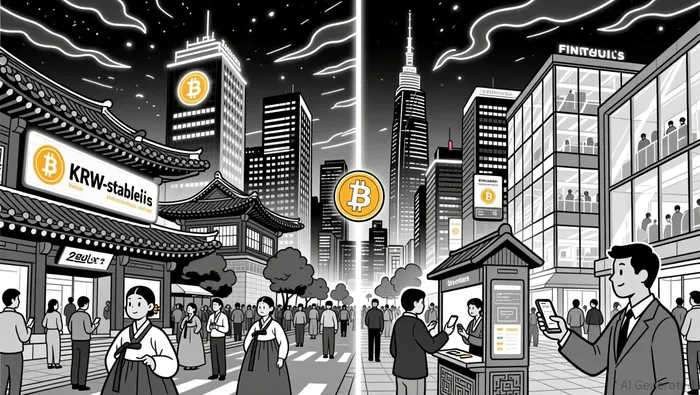
The core debate centers on whether stablecoin issuance should be dominated by banks or opened to fintech and tech firms. The BankBANK-- of Korea (BOK) has long advocated for a bank-led model, arguing that banks' existing regulatory oversight and infrastructure make them ideal stewards of stablecoin reserves and anti-money laundering (AML) protocols. This stance aligns with Japan's approach, where banks similarly dominate stablecoin initiatives according to market analysis. Conversely, the FSC and parts of the ruling party favor a more inclusive ecosystem, allowing tech firms like Naver and Kakao to leverage their user bases and technological agility to drive adoption according to regulatory filings.
This divide has stalled negotiations, particularly over the proposed 51% ownership threshold for banks in any stablecoin consortium according to market reports. While major banks such as KB Kookmin Bank, Shinhan Financial GroupSHG--, and Hana Bank have established stablecoin task forces and applied for trademarks according to legal filings, tech giants are not waiting for regulatory clarity. Naver, for instance, plans to integrate its KRW-pegged stablecoin into e-commerce and webtoon platforms via its Upbit exchange according to industry reports, while KakaoPay explores K-pop fan-based use cases and foreign currency conversion partnerships according to market analysis.
Market Implications: A Dual-Track Opportunity
The regulatory outcome will shape divergent investment opportunities. A bank-led model could strengthen traditional financial institutions' dominance in cross-border payments, custody, and blockchain-powered financing. For example, KB Kookmin Bank and Shinhan Financial Group are already collaborating with tech firms to integrate stablecoins into their platforms according to fintech reports, positioning them to capture institutional and enterprise use cases. Conversely, a fintech-led framework would likely accelerate innovation in consumer-facing applications, such as Web3 gaming, e-commerce, and decentralized finance (DeFi). Startups and Web3-native companies are already preparing to fill niche markets, particularly in offline payments and decentralized identity solutions according to industry analysis.
The regulatory bill under development also mandates 100% cash or government bond reserves for stablecoins, along with regular audits and public disclosures according to policy reports. These measures aim to mitigate systemic risks but could raise operational costs for smaller players, potentially consolidating market share among larger entities with robust compliance infrastructure.
Key Investment Targets
- Tech Giants and Fintech Platforms:
- Naver and KakaoPay are leading the integration of stablecoins into their ecosystems. Naver's merger with Dunamu, which owns Upbit, positions it as a key player in regulated stablecoin issuance according to company filings. Kakao's focus on K-pop fan engagement and international partnerships could unlock cross-border revenue streams according to regulatory analysis.
Samsung and Kakao Bank are developing blockchain infrastructure, with Kakao Bank's "Kakao Coin" project signaling long-term ambitions in digital finance according to market reports.
Banks and Financial Institutions:
KB Kookmin Bank, Shinhan Financial Group, and Hana Bank are well-positioned to benefit from a bank-led model, leveraging their regulatory expertise and existing customer bases. Their collaborations with tech firms (e.g., Naver, Kakao) suggest a hybrid approach that could dominate institutional use cases according to legal filings.
Regulatory Arbitrage Opportunities:
- Companies like Dunamu (operator of Upbit) and Kakao Bank are uniquely positioned to bridge the gap between traditional finance and fintech, offering compliance solutions and blockchain infrastructure according to industry analysis.
The Path Forward: Near-Term Catalysts
The December 10 deadline is a critical inflection point. If the government meets it, the bill is expected to be reviewed in an extraordinary National Assembly session in January 2026 according to reports. A delayed or fragmented regulatory framework, however, could spur independent legislative action, potentially favoring fintech interests. Investors should monitor the following:
- Legislative Developments: The outcome of the December 10 deadline and subsequent negotiations over bank ownership thresholds.
- Corporate Partnerships: Collaborations between banks and tech firms, such as KB Kookmin Bank's alliances with Naver and Kakao according to industry reports.
- Global Precedents: South Korea's regulatory approach will likely be influenced by U.S. (GENIUS Act) and EU (MiCA) frameworks, which could shape cross-border stablecoin adoption according to policy analysis.
Conclusion
South Korea's stablecoin market is poised for rapid growth, driven by a regulatory framework that could either consolidate power in traditional banks or democratize innovation through fintech and tech giants. For investors, the near-term resolution of the December 10 deadline offers a strategic opportunity to align with the winning paradigm. Whether through institutional banking partnerships or consumer-driven fintech platforms, the country's digital finance ecosystem is set to redefine global stablecoin dynamics in 2026 and beyond.





Comentarios
Aún no hay comentarios