
South Korea Resumes Binance's Gopax Acquisition Review: Implications for Crypto Market Integration and Investor Confidence
South Korea's resumption of its review of Binance's acquisition of Gopax marks a pivotal moment in the country's cryptocurrency regulatory landscape. After a two-year pause driven by anti-money laundering (AML) concerns and Binance's U.S. legal challenges, the Financial Intelligence Unit (FIU) is now assessing Gopax's executive changes-a critical step toward validating Binance's suitability as a controlling shareholder, as reported by The Block. This development, coupled with South Korea's broader regulatory reforms, signals a maturing market poised to attract institutional investment.
Regulatory Hurdles and Strategic Resumption
The initial delay in the Gopax acquisition review stemmed from Binance's $4.3 billion U.S. settlement and its ongoing legal battles with the SEC and DOJ, The Korea Times reported (The Korea Times). These issues raised red flags for South Korean regulators, who prioritized AML compliance under the 2025 Virtual Asset User Protection Act (VAUPA). However, the resolution of U.S. litigation-including the dismissal of the SEC's case against Binance-has alleviated some concerns, enabling the FIU to reopen the review, Panewslab reported (Panewslab). Binance's CEO, Richard Teng, has emphasized the exchange's compliance credentials, including a 23% workforce dedicated to regulatory affairs and 1,400 compliance personnel globally, CoinEdition reported (CoinEdition). This strategic alignment with South Korea's stricter AML/KYC requirements is likely to address lingering regulatory skepticism.
Market Integration and Institutional Appetite
South Korea's regulatory framework is evolving to bridge the gap between crypto and traditional finance. The VAUPA's phased implementation, including stablecoin oversight and tokenized securities legislation, creates a dual regulatory structure: securities-based tokens fall under the Capital Markets Act, while other virtual assets are governed by VAUPA, BeinCrypto explains (BeinCrypto). This clarity is critical for institutional investors, who require legal certainty to allocate capital. For instance, the National Assembly's review of tokenized securities legislation could unlock blockchain-based asset classes for pension funds and asset managers, a market segment that has been sidelined since 2018, BeinCrypto noted.
Meanwhile, the Korea Financial Intelligence Unit (KoFIU) reported a 22% surge in daily crypto trading volumes in Q3 2024, alongside a 25% rise in user engagement-metrics highlighted by BeinCrypto. These metrics underscore growing retail and institutional interest, particularly as South Korea explores crypto spot ETFs and security token offerings (STOs). The government's political consensus-both the Democratic Party of Korea and People Power Party support crypto growth-further reinforces market stability, a point BeinCrypto also emphasizes.
Investor Confidence and Risk Mitigation
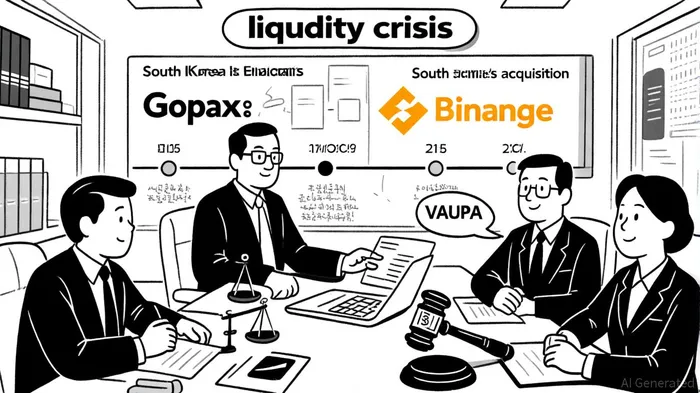
Binance's acquisition of Gopax was initially framed as a rescue mission after the exchange's 2023 liquidity crisis, which froze $47 million in customer funds due to Genesis Global Capital's collapse, The Block reported. By injecting capital and restructuring Gopax's executive team, Binance aims to restore trust in the platform. Teng's recent high-level meetings with South Korean lawmakers, including discussions on repaying GoFi staking service investors, highlight the exchange's focus on resolving legacy issues, CryptoNews reported (CryptoNews). Such efforts are essential for rebuilding confidence, particularly among retail investors who suffered losses during the crisis.
For institutional investors, the Gopax-Binance deal represents a test case for regulatory cooperation. If approved, it would demonstrate South Korea's ability to balance innovation with risk management-a key consideration for global asset managers evaluating emerging markets. The FIU's favorable inclination toward the acquisition, coupled with Binance's compliance-driven governance model, suggests a path toward regulatory alignment, Panewslab reported.
Conclusion: A Catalyst for Institutional Adoption
South Korea's regulatory developments-ranging from VAUPA to tokenized securities legislation-are creating a fertile ground for institutional investment in digital assets. The resumption of the Gopax acquisition review, supported by Binance's compliance overhauls and South Korea's legal reforms, underscores a broader trend: regulators are no longer merely policing crypto but actively integrating it into traditional finance. As the FIU's decision looms in late 2025, the market will watch closely to see whether this alignment translates into a new era of institutional participation, liquidity, and investor confidence.







Comentarios
Aún no hay comentarios