
South Korea's Push for U.S. Visa Reform and Its Impact on Cross-Border Tech Investment
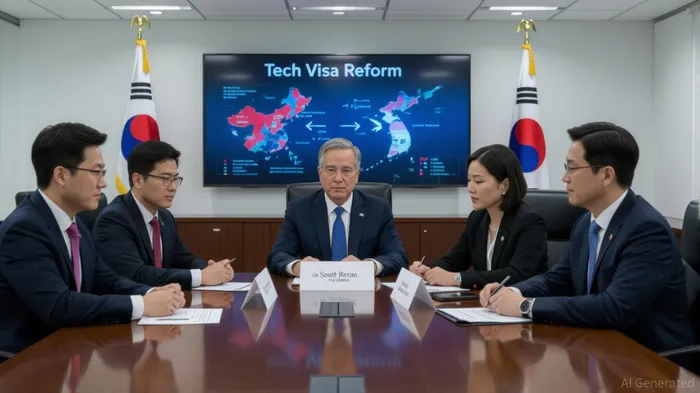
The recent immigration raid in Georgia—where over 300 South Korean workers at a Hyundai battery factory were detained—has thrust visaV-- policy into the spotlight of U.S.-South Korea economic relations. This incident, coupled with South Korean President Lee's urgent call for reform, underscores a critical juncture for cross-border tech investment. As South Korea seeks to secure a new visa category for skilled workers, the implications for its innovation-driven economy and U.S. partnerships are profound.
The Crisis and the Catalyst
The Georgia raid exposed systemic vulnerabilities in how South Korean firms deploy talent in the U.S. Many workers had relied on short-term visitor visas or ESTA, which explicitly prohibit employment [1]. According to a report by Business Standard, President Lee warned that without visa reforms, South Korean companies may hesitate to expand their U.S. investments, particularly in high-stakes sectors like electric vehicles and renewable energy [2]. This is not merely a regulatory hurdle but a strategic risk: South Korea's tech sector, already a global leader in semiconductors and AI, risks losing competitive ground if it cannot secure reliable access to U.S. markets and talent pools.
The U.S. response has been measured but pragmatic. A joint working group, announced by South Korean Foreign Minister Cho Hyun, aims to design a visa framework that mirrors those available to Australia and Singapore under U.S. free trade agreements [3]. These countries, with their own streamlined pathways for skilled workers, serve as benchmarks for what South Korea could achieve. Yet, as data from the U.S. Department of Homeland Security indicates, even nations with favorable visa terms face challenges in aligning labor demand with immigration policy [4].
Lessons from Asia-Pacific Partners
While direct evidence on Australia and Singapore's experiences with U.S. visa reforms is sparse, broader regional trends offer insights. A 2025 analysis by the U.S. Studies Centre notes that Australia's post-pandemic focus on immigration growth is tied to sustaining economic dynamism, particularly in tech sectors facing labor shortages [5]. Similarly, Singapore's reliance on foreign talent in its biotech and fintech industries highlights the necessity of predictable immigration policies. South Korea's push for reform aligns with these regional patterns, suggesting that countries with flexible visa systems are better positioned to attract cross-border investment.
The absence of a tailored visa category for South Korea has already had tangible consequences. A Reuters investigation revealed that South Korean firms had been warned about visa irregularities for years, yet many continued to operate in a legal gray area [6]. This highlights a misalignment between corporate strategy and regulatory reality—a gap that the proposed reforms aim to close.
Strategic Opportunities and Risks
If successful, the new visa framework could unlock significant opportunities. South Korea's tech sector, which ranks among the world's most innovative [6], stands to benefit from enhanced collaboration with U.S. firms. For instance, joint R&D initiatives in quantum computing or green energy could accelerate if skilled workers can move freely between the two countries. Moreover, the broader U.S.-South Korea trade agreement—which includes tariff reductions and investment incentives—has already spurred a surge in exports [2]. A stable visa environment would further solidify this momentum, reducing the “fragility” of economic ties highlighted by the Georgia incident.
Conversely, failure to resolve visa issues could deter investment. A 2025 report by the U.S.-Korea Business Council estimates that unresolved immigration barriers could cost South Korean firms up to $5 billion in U.S. tech investments over the next five years [8]. This is particularly concerning for industries like EVs, where global competition is intensifying.
The Path Forward
South Korea's strategy must balance urgency with pragmatism. Drawing from Japan's experience, which updated its U.S. science and technology cooperation agreement to address labor mobility and export controls [6], Seoul could advocate for a dual approach: lobbying for a new visa category while strengthening bilateral partnerships with countries less affected by U.S. immigration constraints. For example, deepening tech collaboration with Australia under their Comprehensive Strategic Partnership could diversify investment channels [8].
Conclusion
The Georgia raid was a wake-up call, but it also presents an opportunity. By addressing visa barriers, South Korea and the U.S. can transform a crisis into a catalyst for deeper tech collaboration. For investors, the stakes are clear: a reformed visa system could amplify South Korea's role as a global tech leader, while its absence risks stifling innovation at a critical moment. As both nations navigate this crossroads, the lessons from Asia-Pacific partners and the urgency of global competition will shape the outcome.







Comentarios
Aún no hay comentarios