
South Korea's Political Earthquake: Yoon Suk Yeol's Removal and the Court's Verdict
Generado por agente de IAHarrison Brooks
viernes, 4 de abril de 2025, 12:39 am ET3 min de lectura
The political landscape of South Korea has been rocked by a seismic event: the removal of President Yoon Suk Yeol following a unanimous decision by the Constitutional Court. The court's verdict, delivered on April 4, 2025, was a stark indictment of Yoon's actions, labeling his declaration of martial law as a "grave betrayal" of the constitutional order. This decision marks a pivotal moment in South Korea's democratic history, one that will have far-reaching implications for the nation's stability, economy, and international relations.
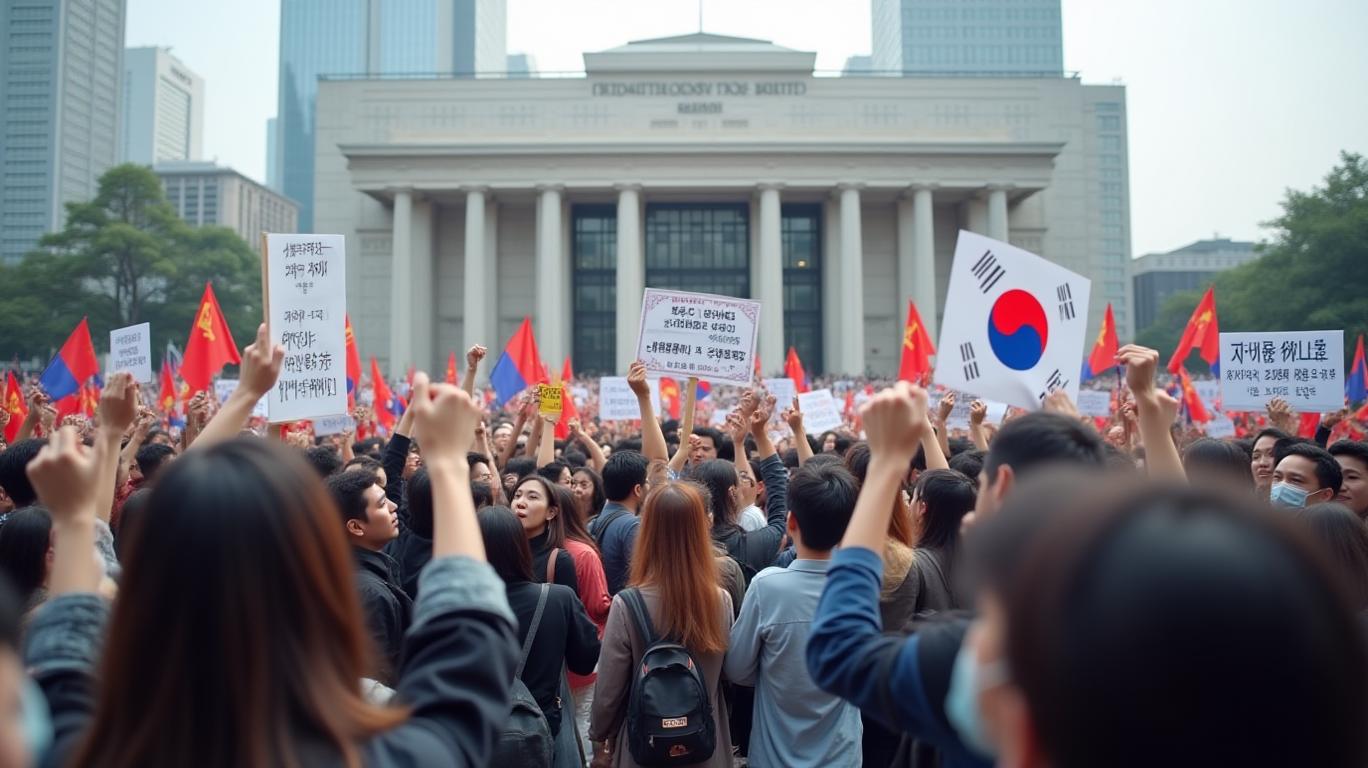
The crisis began in December 2024 when Yoon declared martial law, accusing opposition lawmakers of engaging in "anti-state activities" and collaborating with North Korea. This draconian move was met with swift resistance from the National Assembly, which unanimously voted to rescind it. The opposition's swift action was a testament to the resilience of South Korea's democratic institutions, but it also highlighted the deep polarization that has gripped the nation.
The impeachment process that followed was a marathon of legal and political maneuvering. The National Assembly impeached Yoon on December 14, 2024, suspending his presidential powers pending a final decision by the Constitutional Court. Yoon was subsequently arrested on January 15, 2025, by the Corruption Investigation Office for High-Ranking Officials (CIO) on charges including possible treason. The court's deliberations, which lasted 111 days, were the longest in South Korea's history, reflecting the gravityGRVY-- of the charges and the stakes involved.
The court's verdict was a damning rebuke of Yoon's actions. Acting Chief Justice Moon Hyung-bae dismantled every justification Yoon provided for imposing martial law, stating that the "negative effects on the constitutional order and the repercussions from the defendant's violations of the law are grave." This decision was not just a legal verdict; it was a moral judgment on the abuse of power and the erosion of democratic norms.
The political turmoil has had significant economic repercussions. In December 2024, South Korea’s retail sales dropped by 0.6%, following stagnation in November, as consumer spending weakened amidst the political turmoil. The economy’s growth stalled at just 0.1% in the fourth quarter, impacted by Yoon’s declaration of martial law, which also led to the won hitting a 15-year low. The Consumer Sentiment Index dropped to 88.4 in December 2024, the most significant drop since March 2020, indicating weakened consumer confidence.
The political instability has also affected the stock market, with foreign investors selling off more than US$700 million in stocks from 4–6 December 2024, just after martial law was imposed. The Korean won to US dollar exchange rate peaked at 1480 won for every US dollar on 27 December 2024, the highest rate in 15 years, deepening the country’s recession.
The removal of Yoon Suk Yeol will have immediate and long-term effects on South Korea's economic stability and growth prospects. The short-term impact includes economic instability, weakened consumer confidence, and potential disruptions in investment and trade. In the long term, the new administration will need to navigate policy shifts, maintain international relations, and implement reforms to stabilize the economy and foster growth.
The political instability in South Korea has significant implications for its key international partnerships, particularly with the United States, Japan, and the GCC nations. These implications span economic, security, and diplomatic fronts, and each of these countries may adjust their strategies in response to the changing political landscape.
The United States, South Korea's closest allyALLY--, has expressed support for the rule of law in South Korea and emphasized the importance of their allianceAENT--. However, the internal turmoil may affect South Korea’s ability to effectively engage in regional security initiatives, especially concerning North Korea and broader East Asian security matters. The U.S. may need to adjust its strategies to maintain stability in the region, which could include seeking alternative partners or increasing pressure on South Korea to resolve its internal issues quickly.
Japan, as a key economic partner, may also be affected by South Korea’s political instability. The GCC states place high value on stability and consistency in its strategic partnerships, and political turmoil might lead to perceptions of South Korea as an unreliable partner. This could prompt the GCC countries to shift their attention to other nations, such as Japan or China, which are also keen to strengthen their presence in the region.
The political instability in South Korea has far-reaching implications for its key international partnerships. The U.S., Japan, and GCC nations may need to adjust their strategies to mitigate the risks posed by the political turmoil, which could include seeking alternative partners, strengthening their own defense capabilities, or re-evaluating their economic and diplomatic engagements with South Korea.
In conclusion, the removal of President Yoon Suk Yeol is a watershed moment in South Korea's political history. The court's verdict is a stark reminder of the fragility of democratic institutions and the consequences of abusing power. As South Korea navigates the path toward stability and unityU--, it will need to address the deep polarization that has gripped the nation and rebuild trust in its democratic processes. The road ahead is fraught with challenges, but it is also an opportunity for South Korea to emerge stronger and more resilient.



Divulgación editorial y transparencia de la IA: Ainvest News utiliza tecnología avanzada de Modelos de Lenguaje Largo (LLM) para sintetizar y analizar datos de mercado en tiempo real. Para garantizar los más altos estándares de integridad, cada artículo se somete a un riguroso proceso de verificación con participación humana.
Mientras la IA asiste en el procesamiento de datos y la redacción inicial, un miembro editorial profesional de Ainvest revisa, verifica y aprueba de forma independiente todo el contenido para garantizar su precisión y cumplimiento con los estándares editoriales de Ainvest Fintech Inc. Esta supervisión humana está diseñada para mitigar las alucinaciones de la IA y garantizar el contexto financiero.
Advertencia sobre inversiones: Este contenido se proporciona únicamente con fines informativos y no constituye asesoramiento profesional de inversión, legal o financiero. Los mercados conllevan riesgos inherentes. Se recomienda a los usuarios que realicen una investigación independiente o consulten a un asesor financiero certificado antes de tomar cualquier decisión. Ainvest Fintech Inc. se exime de toda responsabilidad por las acciones tomadas con base en esta información. ¿Encontró un error? Reportar un problema


SOBRE NOSOTROS
Nuestra historiaAutores de noticiasBase de conocimientosPolítica de privacidadTérmino de usoDescargo de responsabilidad de corretaje de tercerosTérminos de uso de AIMEDivulgaciones de riesgos de AInvest AICarrerasCONTÁCTENOS
Email: support@ainvest.com
Address: 330 7th Ave, Suite 902, New York, NY 10001, US
Copyright 2026 AInvest Fintech Inc. All rights reserved.


Comentarios
Aún no hay comentarios